
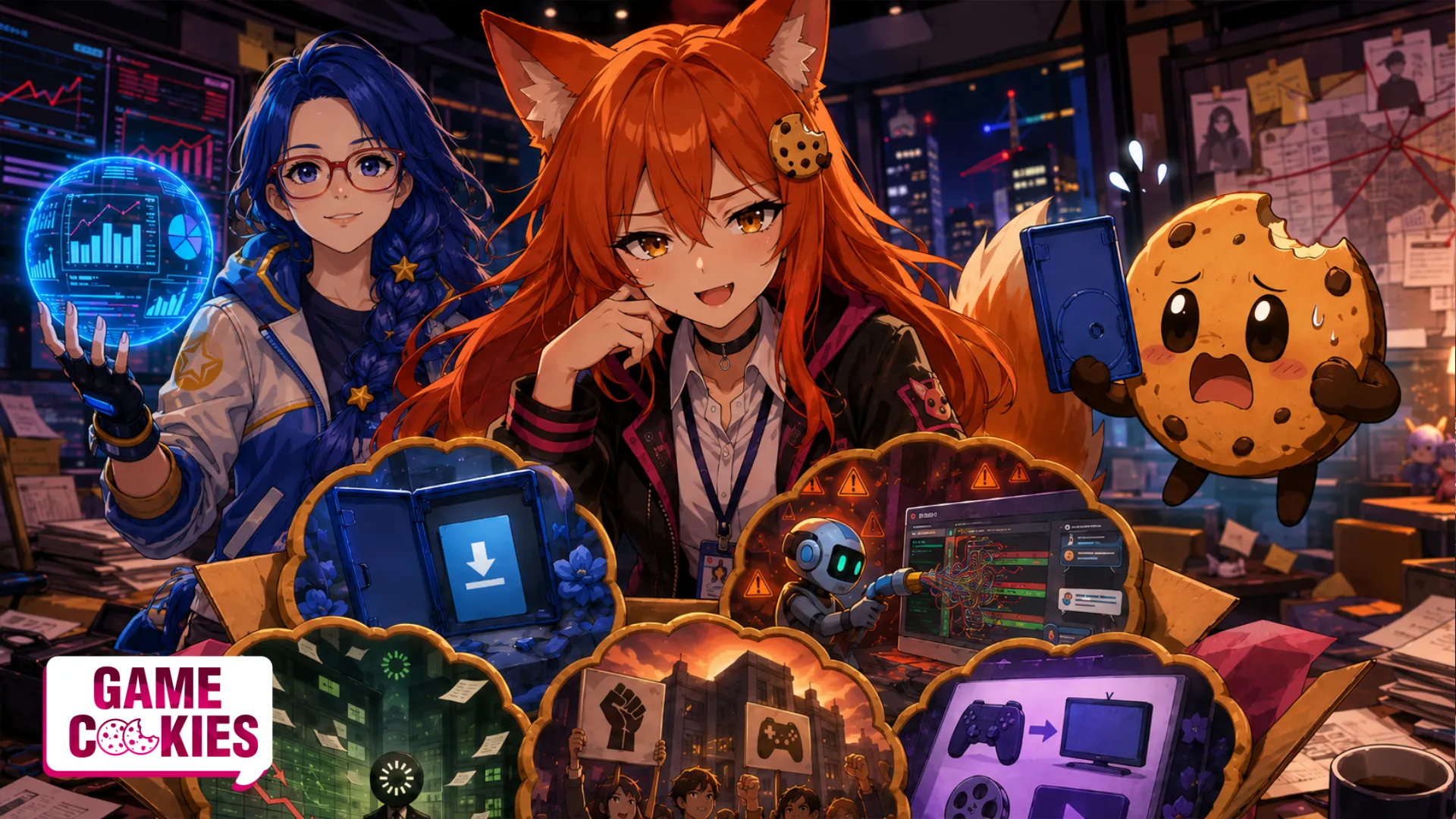
🍪 Today’s Cookie Box: PlayStation Buries Discs, Godot Blocks AI Slop, and Xbox Enters the Spreadsheet Storm

Hello there, disc collectors, AI code janitors, union lurkers, and everyone whose backlog is now apparently a licensing agreement with anime lighting. These are today’s most interesting gaming stories, and today’s cookie box is packed with corporate smoke, digital ghosts, angry workers, and at least one executive somewhere whispering “cross-media synergy” into a PowerPoint.
PlayStation is moving new games away from physical discs. Godot Engine is telling AI slop to stop clogging the pull request queue. XBOX is surrounded by another wave of layoff and strategy reports. Rockstar Games and Ubisoft workers are pushing for more protection. Meanwhile, NBCUniversal and Netflix are staring at game IP like they found the last untouched snack table at a shareholder meeting.
The bigger mood today is control. Who controls access to games? Who controls the work behind them? Who gets stuck cleaning up AI-generated messes? Who gets to decide whether a game becomes a show, a movie, a theme park ride, or a brand slide with character art attached?
Let’s open today’s cookie box.
Cookie 1: PlayStation is ending new physical game discs in 2028
Sony Interactive Entertainment announced that physical game disc production for all new games released on PlayStation consoles will be discontinued starting in January 2028. After that date, new PlayStation games will still be sold through PlayStation Store and retailers, but only in digital formats. Sony also said the change does not affect games already released, or games that will release before January 2028 in disc format.
The official explanation is consumer behavior. Sony says the entertainment industry has been shifting away from physical discs and toward digital media, and that this move follows how most of its community already prefers to access games. That part makes business sense. Digital sales have been growing for years, physical shelf space is smaller, and many players already buy games through storefronts, sales, subscriptions, and preloads.
But the emotional reaction is easy to understand because physical games were never only about convenience. They were about resale, lending, collecting, preservation, ownership rituals, and the small comfort of having something on a shelf that did not need a password, a storefront policy, and three prayers to the server gods.
This does not mean your current discs suddenly explode in January 2028. It also does not mean every disc copy becomes useless. But it does push PlayStation’s future further into a world where “buying a game at retail” can mean walking into a store and purchasing digital access with extra cardboard.
📢 Starting in January 2028, new PlayStation releases will be digital-only through PlayStation Store and retailers.
That line matters because it changes the role of physical retail. Stores may still sell PlayStation games, but the product becomes less like an object and more like a checkout lane for a digital license. The box can survive. The disc gets escorted out like it argued with finance.
🦊 Kiki: I love how the industry keeps using “consumer preference” like a smoke bomb. Yes, players buy more digital games now. Also yes, companies spent years training everyone into digital storefronts with discounts, subscriptions, preloads, day-one patches, account libraries, and disc versions that sometimes show up just to say, “Please download the rest of me, I am emotionally incomplete.”
The disc used to be proof you owned something. Now the “physical edition” is slowly turning into cardboard cosplay. You open the box, there is a code inside, and the code politely says: “Thank you for purchasing the idea of an object.”
I am not anti-digital. Digital is convenient. Digital is fast. Digital lets you buy a game at 2 AM while wearing depression socks. Lovely. But when the entire future of access depends on accounts, servers, storefront policies, licenses, and corporate memory, maybe do not sell it to players like the only thing dying here is clutter.
🍪 Chip floats beside a shelf of empty blue cases, gently placing a tiny flower in front of a disc drive.
Cookie 2: Godot is cracking down on AI slop
The Godot Foundation announced new contribution policies after facing growing problems with generative AI-assisted submissions. Godot is not banning every small use of AI. The new rules still allow limited AI help for menial work like code completion, regex, or find-and-replace tasks. The stricter stance is aimed at autonomous AI agents, vibe coding, and substantial AI-generated code.
The policy requires all code to be human-authored. If contributors use AI in some capacity while authoring code, they must disclose it in the pull request discussion. Godot is also banning AI-generated text in human-to-human communication with maintainers, while still allowing machine translation when the original message was written by a human.
That last part is important because this is not only a code quality issue. It is a human workload issue. Godot depends on volunteer contributors, maintainers, reviewers, and people willing to spend time improving the project. Pull requests do not merge themselves because a chatbot looked confident. Someone has to read the code, test the logic, find the problem, explain the issue, and decide whether the contribution helps or creates more cleanup.
AI can reduce the effort needed to submit something. It does not magically reduce the effort needed to review it. In a volunteer-heavy open-source project, that creates a very obvious problem: the submission hose gets wider, while the human review bucket stays the same size.
🦊 Kiki: Godot basically walked into the pull request queue, saw a robot spraying spaghetti code through a leaf blower, and said, “Absolutely not. The volunteers are not mopping this.”
And honestly? Fair. If a human contributor writes messy code, a maintainer can teach them, correct them, and maybe help create the next person who keeps the engine alive. If an AI agent drops 4,000 lines of mystery soup and then vanishes when someone asks, “Why did you change this?”, congratulations, you summoned a haunted intern with no shame and unlimited confidence.
The best part is the communication rule. Maintainers do not want to argue with generated text pretending to be a person. Imagine giving your free evening to review code and the reply is basically a corporate chatbot wearing a GitHub hoodie. I would start charging rent to the slop.
🍪 Chip opens a pull request titled “small fix,” sees 4,000 changed files, and slowly backs into a recycle bin.
Cookie 3: Xbox is surrounded by layoff reports again
Xbox is once again sitting in the middle of reports about cuts, project changes, and shifting priorities. Reuters reported that Microsoft layoffs are expected to affect under 2.5 percent of the company’s total workforce, citing Business Insider. With Microsoft’s workforce around 220,000 people, even a number below that percentage could still mean thousands of workers affected.
At the gaming level, the full picture is still developing. Reports have pointed to Xbox backing away from some funding deals, potential studio impacts, and new third-party Game Pass agreements being put on hold. The Game Pass piece appears to come from industry-side reporting and commentary around developers being told that deals in advanced negotiation were paused. Microsoft has not publicly turned all of this into one clean confirmed map.
So the safest read is that the final shape of the Xbox cuts is still unclear, but the direction is ugly enough that developers, partners, and players are watching closely.
This is where corporate percentage language gets slippery. “Under 2.5 percent” sounds small inside a financial sentence. It sounds very different if you are one of the people waiting to learn whether your team, project, funding deal, or job survived the strategy reset.
The Xbox story also carries a trust problem because this is not happening in isolation. Microsoft spent years expanding its gaming footprint, buying massive companies, promoting Game Pass as a central pillar, and positioning Xbox as more of a content ecosystem than a console box. When reports stack around layoffs, paused deals, studio uncertainty, and “where we invest” language, the question becomes what kind of Xbox is being built after the cuts.
🦊 Kiki: I need corporations to stop using percentages like emotional camouflage. “Under 2.5 percent” sounds tiny until you remember Microsoft is the size of a small country with Teams notifications. Thousands of people can disappear inside a decimal point when the spreadsheet is big enough.
And the Game Pass rumors are especially spicy because that service was sold as the friendly buffet. Developers got visibility, players got access, Xbox got ecosystem gravity. Now some developers are reportedly hearing that deals are on hold, and suddenly the buffet has one tired employee, three empty trays, and a sign saying “new strategy coming soon.”
To be clear, not every report is confirmed. But the vibe is not “confident platform calmly explaining the future.” The vibe is a meeting room where the roadmap changed its phone number and everyone is pretending the printer noise is normal.
🍪 Chip tries to open Game Pass, but every tile has been replaced by a loading spinner wearing a tiny business suit.
Cookie 4: Rockstar and Ubisoft show the labor pressure building underneath
While Xbox faces reports of cuts and strategy changes, other parts of the industry are showing the worker side of the same pressure. Employees are organizing, striking, and trying to secure formal protections before the next business decision lands on their desks like a surprise boss fight.
At Rockstar, the newly formed Rockstar IWGB Game Workers Union is pushing for official recognition ahead of GTA 6’s console release. According to reporting, Rockstar has 10 working days to voluntarily recognize the union, or the process may move toward the UK’s Central Arbitration Committee. The union’s stated goals include pay transparency, flexible working, and ending crunch.
This comes after Rockstar fired employees last year in a dispute the company framed around leaks and the IWGB described as union-busting. That context gives the current recognition push more weight. Workers are trying to establish formal power before one of the biggest entertainment launches on the planet, and timing matters when the product is this large.
Ubisoft Barcelona is also facing labor action. Staff are striking over proposed layoffs affecting 51 workers, with strikes scheduled on Tuesday and Thursday afternoons from June 30 into mid-July. The demands include retaining the affected staff, protection from future mass layoffs for at least five years, honoring previously agreed promotions, restoring remote work for part of the month, and reviewing salary and benefits plans.
These stories are different in legal structure and company context, but they point toward the same pressure point. The games industry keeps selling itself as a dream job while asking workers to survive instability that looks more like a seasonal weather event.
🦊 Kiki: The industry loves saying games are made by passion until the passionate people ask for job security, pay transparency, remote work, or a chair that is not located directly inside a crunch volcano.
Rockstar is heading toward GTA 6, probably one of the biggest launches in entertainment history, and workers are saying, “Cool, before the money hurricane arrives, can we get formal recognition?” Ubisoft Barcelona workers are looking at layoffs and saying, “Actually, we would like not to be treated like patch notes with rent.”
And this is the part companies hate: workers are learning the difference between being grateful and being organized. Gratitude gets you a pizza party with room-temperature soda. Organization gets you a negotiation table. Very different loot drops.
🍪 Chip puts on a tiny union vest, raises a crumb-sized sign, and immediately gets nervous because the sign says “PLEASE DO NOT PATCH OUT MY RIGHTS.”
Cookie 5: NBCUniversal and Persona show the IP machine is still hungry
While platforms, engines, and studios deal with ownership shifts, AI pressure, layoffs, and labor action, the entertainment side of the business keeps moving in a very familiar direction: games as franchise engines.
Reuters reported that NBCUniversal may explore expanding into games after its planned split from Comcast. The logic is easy to see. NBCUniversal has film, television, theme parks, streaming, sports, news, and major IP infrastructure. It already has a successful relationship with Nintendo and Illumination through the Super Mario Bros. movie ecosystem. If the company wants adjacent businesses where it has the right to play, games are sitting there with a giant neon arrow over them.
Separately, Variety reported that a live-action Persona TV series is in development at Netflix, with Christopher Monfette attached as writer and showrunner, and production companies including 21 Laps and Story Kitchen involved. Persona makes sense as adaptation bait because it has high school drama, supernatural action, stylish identity mechanics, emotional character arcs, and fan loyalty strong enough to power a city if properly harvested.
But Persona also has a very specific magic. It is not only teenagers fighting monsters. It is music, routine, social links, menus, calendars, mood, trauma, comedy, velvet-room weirdness, and the special anxiety of managing friendships while punching metaphysical problems in the face. A live-action adaptation can work, but it needs to understand the texture, not just the poster.
The NBCUniversal story is bigger business strategy. The Persona story is IP translation. Together, they show how games are increasingly valued as material for streaming, film, theme parks, merch, and investor-friendly franchise planning.
⭐ Byte: The useful pattern is that game IP is being valued less as a single release and more as a multi-format asset. That can help a franchise grow when the adaptation respects the original work. It becomes weaker when companies flatten games into brand inventory and mistake recognition for meaning. The opportunity is real, but so is the adaptation tax.
🦊 Kiki: Persona live-action could be amazing, or it could trip into traffic wearing a velvet room costume. The series has style for days, but style is not just blue lighting, one sad teenager, and someone whispering about destiny near a vending machine.
And NBCUniversal looking at games makes total sense. Everyone saw Mario print money and suddenly every executive remembered games exist. Somewhere, a meeting is happening where someone is saying, “What if Jaws, but battle pass?” and I need that person gently removed from the whiteboard before they invent Shark Pass Premium.
The problem is adaptation by spreadsheet. Games can become great shows and movies. They can also become brand soup with a theme song and a confused actor saying lore words into a green screen.
🍪 Chip looks at a pitch deck that says “Persona Cinematic Universe Phase One” and quietly hides behind a calendar.
The cookie box takeaway
Today’s stories look separate at first. PlayStation is about physical media. Godot is about AI contributions. Xbox is about reported cuts and strategy uncertainty. Rockstar and Ubisoft are about labor pressure. NBCUniversal and Persona are about IP expansion. But they all circle the same question: who keeps control when the industry changes?
Players lose leverage when access depends more heavily on digital licenses, account systems, storefront rules, and company support. Maintainers lose time when AI-generated submissions flood human review queues. Workers lose stability when companies expand, restructure, cut, and then describe the damage in soft corporate language. Creators lose creative clarity when every game becomes a possible adaptation pipeline before anyone asks what made it special in the first place.
The old world had problems too. Physical media had limits. Open source already had review bottlenecks. Game studios already had labor issues. Adaptations were always risky. But today’s cookie box shows how many pressure points are moving at the same time.
The industry wants digital convenience, AI speed, leaner teams, stronger IP pipelines, and flexible labor. Players, developers, maintainers, and workers want access, respect, stability, and some proof that the future is not just a storefront with prettier lighting.
That tension is becoming the business model.
⚙️ Stay ownership-aware like a collector hugging the last disc drive in the house.
⚙️ Keep reading the fine print like Chip discovering his “physical edition” is just a download code in a plastic witness protection box.
⚙️ And remember: if the future of games is digital-only, AI-assisted, worker-cut, and Netflix-adapted, maybe the least the industry can do is stop calling every downgrade “consumer preference.”
🦊 Kiki · 🍪 Chip · ⭐ Byte · 🦁 Leo
Tips, leaks, and suspiciously empty game boxes: contact us here!