

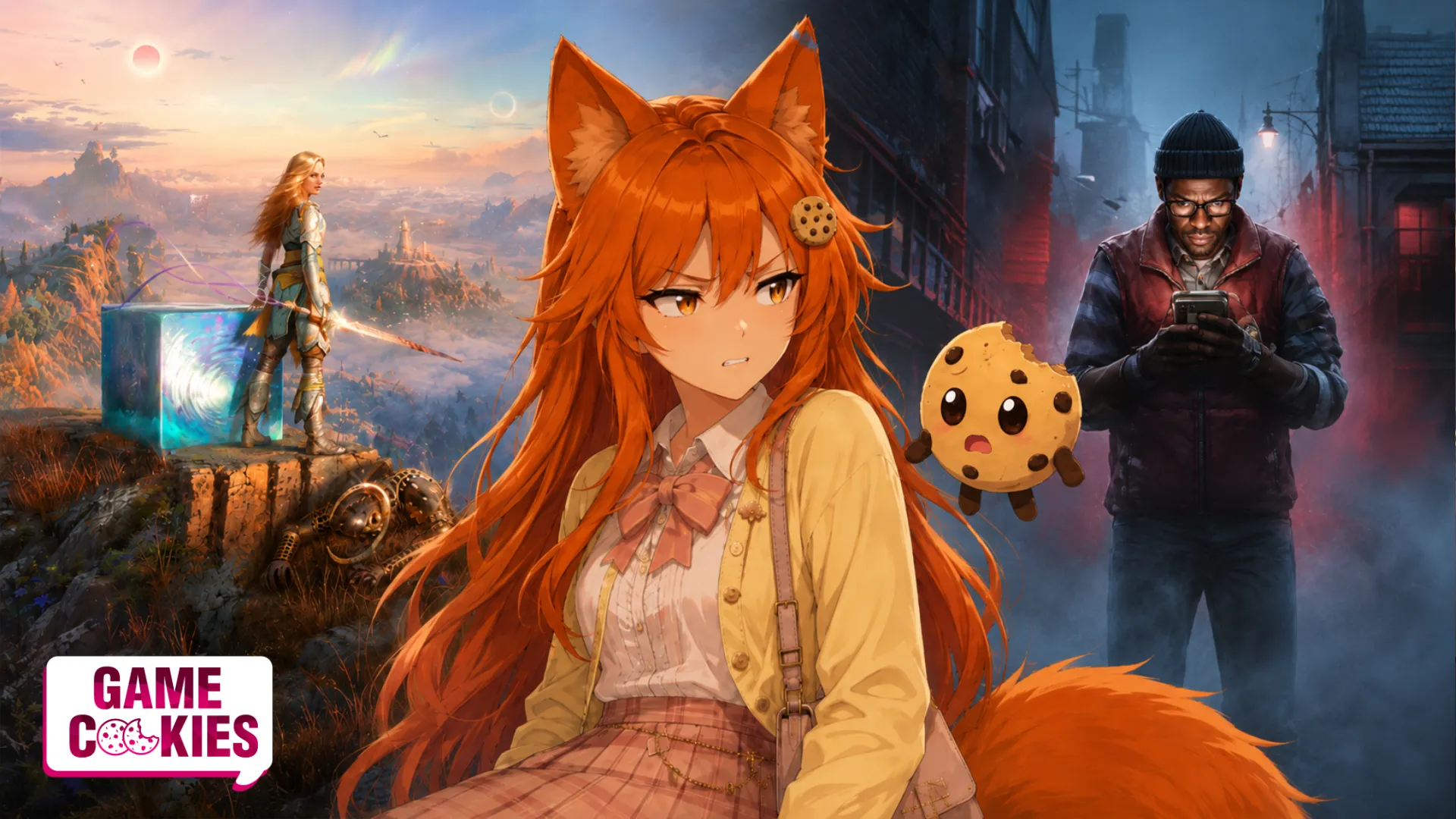
Hello there, fog walkers and angry-god enjoyers. Today we need to talk about two announcements that landed right in the most radioactive part of gaming discourse: Silent Hill: Townfall and PlayStation God of War: Laufey.
Both games are already getting pushed toward the same tired content grinder. A new protagonist appears, the internet starts yelling, and suddenly every complaint gets flattened into one headline: gamers are mad because the lead is a woman, or Black, or different from the old face on the box.
That framing is convenient because everyone gets an easy villain. Media outlets get outrage clicks. Studios get a shield against criticism. Influencers get clips. Comment sections get to turn into nuclear waste.
The problem is that the truth is usually more annoying.
Sometimes players are toxic. Sometimes people absolutely do hide behind “design criticism” when what they really mean is “I don’t want this person in my game.” That part exists, and pretending otherwise is dumb.
But there is another part the industry loves to ignore. Players have been trained to distrust aggressive franchise changes because they have watched too many studios swap leads, soften identities, chase a “modern audience,” and then ship something that feels weaker than what came before.
So when fans look at Silent Hill: Townfall and God of War: Laufey with suspicion, the more useful question is not “Are gamers just mad at diversity again?”
The better question is whether these games are proving their creative reason strongly enough.
Because a new protagonist is not a problem by itself. A weak reason for the new protagonist is.
Silent Hill: Townfall and the danger of looking too normal
Silent Hill: Townfall is taking the series to Scotland, into first-person horror, with Simon Ordell as the protagonist. He wakes up in St. Amelia with some ugly personal history, a mysterious connection to the town, and a CRTV device that acts like a strange analog tool for signals, threats, and puzzle information.
On paper, that sounds pretty Silent Hill. Ordinary person, foggy place, buried guilt, broken memory, strange object, psychological horror.
The franchise has never needed action heroes. Harry Mason was just a dad. James Sunderland looked like he had been emotionally microwaved. Silent Hill protagonists are often plain-looking people who seem one bad hallway away from collapsing completely.
So no, the issue with Simon is not simply that he is Black, even if some bad-faith people online will try to make that the whole argument. The more interesting criticism is that his design risks looking too soft, too plain, and too modern in the wrong way.
The outfit does not immediately communicate dread, decay, guilt, or psychological weight. He looks like a guy who could be waiting for a train, not someone being pulled apart by a town that knows the worst thing he ever did.
That can work if the game earns it. Silent Hill has always used normal people inside abnormal spaces. But first impressions matter, and horror fans judge silhouettes like detectives with insomnia.
Then there is the CRTV. I actually like the idea. Analog horror belongs in Silent Hill. A weird little screen that detects things through static has more personality than another generic phone UI. But presentation is everything. If players read it as “haunted mobile phone mechanic,” the whole thing starts feeling closer to a first-person indie horror trend than a Silent Hill nightmare.
That is where the anxiety comes from. Townfall can survive a new country. It can survive a new lead. It can survive first person. What it cannot survive is feeling generic.
Silent Hill fans are not guarding the franchise because they hate change. They are guarding it because this series is atmosphere held together with trauma and rust. Once it starts looking like any other spooky walking simulator with a gadget, people notice.
🦊 Kiki: Look, Silent Hill fans are professional vibe criminals. They will inspect a jacket, a hallway, a radio sound, a nurse twitching weirdly, and a dirty wall texture like they are solving a murder in a cursed Airbnb. And honestly, fair. This series trained them that every object is probably someone’s repressed guilt wearing a hat. So when Simon shows up looking like a normal guy with a little screen, people are going to be annoying about it. That does not automatically make the complaint racial. Sometimes the outfit just does not look haunted enough yet. I know that sounds stupid. It is also exactly how horror works.
🍪 Chip raises the CRTV, sees static, and slowly lowers himself behind Kiki’s tail.
God of War: Laufey has a bigger mountain to climb
God of War: Laufey is a much riskier announcement because God of War is not just a setting. It is not just mythology. For most players, God of War is Kratos.
Since 2018, it is Kratos and Atreus.
That pair rebuilt the franchise. The old Kratos was anger, punishment, blood, and spectacle. The newer Kratos is still dangerous, but now he carries shame, restraint, fatherhood, and fear. Atreus gave that transformation a reason to exist. Players did not just like the gameplay. They bought into the bond.
So when a new God of War game says, “Now you play as Faye,” resistance is predictable.
That does not mean Faye is a random diversity insert. She is not. Laufey has been central to the Norse saga since the beginning. Her death launches the 2018 game. Her secrets shape Kratos and Atreus. Her identity as a giant reframes the entire story. She is not some new character parachuted into the canon with a press release and a moral lecture.
But the emotional risk is still real.
Players love Kratos. They love Atreus. They are still waiting to see where that relationship goes after Ragnarök. Moving the controller to Faye can be fascinating, but Santa Monica has to make it feel inevitable. Faye cannot feel like a safe corporate answer to “How do we keep God of War going without using Kratos too much?”
That is the suspicion. Not because Faye is a woman. Because players have seen this pattern across entertainment.
A beloved franchise builds its identity around one core emotional engine. Then executives decide the old engine is too familiar, too male, too old, too problematic, too completed, or too hard to continue. A new lead arrives. Marketing starts talking about legacy, fresh perspectives, emotional depth, representation, modern storytelling. Then the product shows up and the writing is weaker, the stakes are softer, the visual identity is muddier, or the whole thing feels like a lecture wearing franchise armor.
Audiences remember that.
Fair or unfair, God of War: Laufey now has to fight that memory.
The good news is that Faye has actual story weight. She can carry mystery. She can carry myth. She can show us what Kratos never knew, what Atreus inherited, and what the giants were really doing behind the curtain. If the game treats her as a dangerous, flawed, mythic warrior with her own contradictions, the backlash can burn out fast.
But if the game treats her mainly as “the mother’s story” and expects players to clap because the perspective changed, the reaction will be brutal.
God of War fans did not spend years watching Kratos learn emotional restraint just to be told that caring about him is now outdated.
🦊 Kiki: This is where I get irritated because people act like fans are stupid for caring who they play as. Bro, God of War spent almost twenty years tattooing Kratos into everyone’s gamer brain, then spent two prestige games making his bond with Atreus the soul of the whole thing. You cannot move the spotlight and expect zero emotional resistance. I want the Faye game to slap. She has lore juice. She has giant secrets. She has that “dead character who clearly knew too much” energy, which is always delicious. But Santa Monica has to make her feel like the missing piece, not like a replacement sticker slapped over Kratos’ face.
🍪 Chip puts on fake Kratos face paint, sees Faye’s axe, and quietly wipes it off.
The reason players are suspicious now
The industry keeps acting surprised when players assume the worst. It should not be surprised.
Players have watched the same public-relations ritual too many times. A game launches badly. The design feels off. The writing gets mocked. The characters do not land. The gameplay is mid. The marketing misses the room. Then the explanation starts drifting away from the product.
It was review bombing. It was toxic gamers. It was anti-DEI backlash. It was franchise fatigue. It was the brand being in a difficult place. It was organized bashing. It was the audience not understanding the vision.
Sometimes those things are partly true. Online mobs exist. Bad-faith outrage exists. Racist and sexist dogpiling exists. Nobody serious should pretend every angry comment is valuable criticism.
But studios and media often use the ugliest comments as a shield against the cleaner ones. That is where trust dies.
Star Wars Outlaws and the franchise-fatigue excuse
Star Wars Outlaws is a good example because the game did not fail because players suddenly stopped liking Star Wars criminals, smugglers, scoundrels, underworld deals, dirty cantinas, and weird little creatures.
That is basically the part of Star Wars people still like.
The problem was that Outlaws arrived with the weight of Ubisoft’s formula on its back. Players criticized stealth restrictions, technical issues, mission structure, bland open-world habits, and the feeling that the game was not doing enough with the fantasy of being an outlaw in Star Wars.
Then Ubisoft leadership pointed to Star Wars being in “choppy waters.”
Sure, the brand has had issues. The Acolyte became a culture-war buffet. Disney has overused and misused parts of the franchise. Some audiences are tired.
But blaming the temperature of Star Wars is too convenient. If you give players a strong Star Wars fantasy, they show up. The Mandalorian proved that. Jedi: Fallen Order and Survivor proved that. Even Battlefront II recovered because the core fantasy still had power once EA stopped trying to squeeze people like vending machines.
Outlaws had a great premise. A criminal underworld Star Wars game should be a layup. The fact that it struggled says more about execution than about people rejecting the idea of a female scoundrel.
Kay Vess was not the problem. The problem was that the game did not make enough players feel like they were living the outlaw fantasy they imagined.
🦊 Kiki: I still cannot believe “Star Wars outlaw game” somehow became complicated. Like, you give me a blaster, a dirty jacket, a crime syndicate, a ship that barely works, and one little gremlin pet, and I should be gone for forty hours. That is free money. But if the stealth feels annoying, the missions feel stiff, and the world feels like Ubisoft put Star Wars stickers on the usual machine, players are going to smell it. Then suddenly the discourse becomes “people hate Kay” or “Star Wars is weak right now.” Nah. People wanted space crime and got space errands with a cute animal tax.
🍪 Chip hugs Nix in spirit while looking suspiciously at a failed stealth screen.
Concord and the character-design wall
Concord is the cleanest warning sign for this whole conversation.
That game did not collapse because players rejected diversity in some abstract way. It collapsed because almost nobody wanted it. The hero-shooter market was already packed. The game cost money in a genre where major competitors are free. The characters did not create instant attachment. The designs became memes before they became favorites. The marketing failed to explain why anyone needed another team shooter in their life.
Then the anti-woke discourse arrived, because of course it did. Pronouns, body types, character faces, “modern audience,” all the usual noise. Some of it was ugly. Some of it was opportunistic. Some of it was people dancing on a corpse because the corpse had a diversity sticker on it.
But reducing Concord’s failure to that noise is dishonest.
Players did not ignore Concord because one character had pronouns. They ignored Concord because nothing about it demanded attention. The roster looked like Guardians of the Galaxy had been redesigned by a committee that was afraid of charisma. The game might have had competent shooting, but competent shooting is not enough when players already have Overwatch, Valorant, Apex, Marvel Rivals, Deadlock, and whatever else is eating their evenings.
When your hero shooter launches and the heroes are the weakest part, the discourse does not need to invent a reason for failure. The reason is standing right there in the character select screen.
🦊 Kiki: Concord is painful because you can tell real people worked hard on it, and I hate when hard work gets turned into a public execution. But bro, character design is not garnish in a hero shooter. It is the product. If players see your roster and immediately start making grocery-store superhero jokes, you are already bleeding. You can yell “toxic gamers” all day, and some gamers absolutely were toxic, no debate. But if the audience does not want to main anybody, cosplay anybody, draw anybody, ship anybody, or even remember anybody’s name, your hero shooter has a medical condition.
🍪 Chip opens the Concord roster, squints, and slowly closes the menu.
Highguard and the “ragebait killed us” problem
Highguard adds a newer version of the same pattern.
The game launched in 2026 with a strong initial player spike, then got hit by brutal Steam reviews, server problems, performance complaints, balance issues, and a confusing first impression. Some defenders pointed out that people who played longer often rated it better, which is probably true. Some developers also felt the game became a joke too early and that content creators helped poison the well before players gave it a fair chance.
That is probably true too.
But a game cannot ask the market for patience after making a weak first impression in a genre built around instant adoption. Multiplayer games are not judged like novels. Players do not spend fifteen hours waiting to see if the tutorial discourse becomes fairer. They either feel the hook quickly or they leave.
Highguard may have had depth. It may have had systems players would appreciate after the rough opening. That still does not erase the product problem. If the trailer does not land, onboarding is rough, servers struggle, and the premise is hard to explain, the audience will not gently hold the game’s hand through its identity crisis.
Calling everything ragebait misses the uncomfortable lesson. Sometimes ragebait works because the product gives it material.
🦊 Kiki: Highguard is one of those cases where I feel bad and annoyed at the same time. Because yes, the internet can absolutely turn a game into a punching bag for sport. People love a public flop. It is gross. But also, if your game needs three hours before people stop hating it, maybe the first three hours are the crime scene. Multiplayer games live or die on immediate clarity. You cannot walk into a room full of exhausted shooter players, mumble “trust me bro,” and expect them to become monks of patience.
🍪 Chip checks the Steam reviews, gasps, and hides inside a tiny cardboard shield.
Dragon Age and the “players wanted something else” excuse
Dragon Age: The Veilguard is another useful example because it did not completely collapse like Concord, but it exposed the same trust problem.
The game had defenders. It had strong production value. It had polished combat. Some players loved the companions, the accessibility, and the cleaner structure.
But a lot of longtime Dragon Age fans felt like the series had been sanded down. They missed the sharper writing, the uglier politics, the religious tension, the moral discomfort, the feeling that Thedas was a place full of people who could be charming and horrible in the same conversation.
When Veilguard underperformed expectations, EA pointed toward broader audience reach and the absence of shared-world engagement. That answer landed badly because many Dragon Age fans were already worried that the series had moved away from the things that made it distinct.
Players were not asking Dragon Age to become more live-service adjacent. Many were asking it to feel more like Dragon Age.
That is why the excuse matters. It shows the disconnect. Sometimes publishers do not hear “the writing feels safer” or “the world feels less dangerous.” They hear “we failed to capture enough engagement.”
Those are not the same diagnosis.
🦊 Kiki: Dragon Age is the one that makes me tired in a very specific auntie way. Like, I played BioWare games for messy companions, terrible decisions, political rot, religious trauma, and conversations where everyone is kind of right and kind of awful. That was the food. So when fans say something feels too clean, too safe, too sanitized, and the business answer becomes “maybe it needed shared-world features,” I want to chew drywall. No, dude. Maybe your fantasy RPG audience wanted the fantasy RPG to have sharper teeth.
🍪 Chip holds a tiny approval/disapproval meter and watches it explode.
What these examples have in common
This is why the conversation around Silent Hill: Townfall and God of War: Laufey is already tense.
Players are not reacting in a vacuum. They have receipts in their memory, even when they explain them badly.
They remember games that launched with weak designs and got defended as misunderstood. They remember studios blaming brand fatigue, market conditions, or hostile players. They remember media coverage that treated product criticism like moral failure. They remember franchises that changed direction and then acted confused when the existing audience asked why.
So when Silent Hill introduces Simon Ordell with an outfit that some fans think looks bland and a gadget that risks feeling too modern, players do not simply judge Simon. They judge him through years of failed reinventions.
When God of War puts Faye at the center, players do not simply judge Faye. They judge her through years of legacy-franchise pivots where “new perspective” sometimes meant “we are bored of the thing you liked.”
That is the industry’s credibility problem.
The lazy clickbait frame helps nobody
The media version of this story is easy to write.
Gamers angry at woman protagonist. Gamers angry at Black protagonist. Gamers angry because games are diverse now.
That article basically writes itself, and it gets engagement because everyone knows their role. One side yells about woke. The other side yells about chuds. The studio says it stands by the team. The comment section becomes a sewer with lighting effects.
Meanwhile, the useful criticism gets buried.
Does Simon look like he belongs in Silent Hill, or does he look like the lead of a generic prestige horror game? Does the CRTV feel like analog dread, or like a gimmick? Does Faye’s story expand God of War, or interrupt the emotional arc players were already invested in? Does the studio understand why people loved Kratos and Atreus before asking them to love someone else?
Those are fair questions.
They are not automatically sexist. They are not automatically racist. They are also not automatically correct. Townfall and Laufey could both turn out great. Faye could become one of the best playable characters in the franchise. Simon could make perfect sense once the story reveals what St. Amelia is doing to him.
But studios do not earn that trust by scolding the audience. They earn it by showing the work.
The actual warning sign
A new protagonist is not the warning sign.
The warning sign is when the new protagonist arrives before the creative reason feels clear. The warning sign is when the design looks weak and the defense gets louder than the evidence. The warning sign is when criticism gets flattened into bigotry so nobody has to talk about whether the trailer actually looked good.
Silent Hill: Townfall needs to prove that Simon’s plainness is intentional, that the CRTV deepens the horror, and that first person makes the town feel more invasive rather than more generic.
God of War: Laufey needs to prove that Faye is not just important because the lore says she is important. She needs to be dangerous on screen, messy in motion, emotionally heavy, and worthy of a franchise that players associate with one of gaming’s most recognizable protagonists.
Players can accept change. They do it all the time when the work is strong enough.
They accepted Leon instead of Jill and Chris. They accepted Raiden eventually, even after yelling for years. They accepted Nero once Devil May Cry proved he had his own rhythm. They accepted Atreus because the story made him matter.
The audience is not allergic to new leads. The audience is allergic to being told a weak first impression is actually their moral failure.
That is the part the industry keeps pretending not to understand.
⚙️ Stay skeptical, like a Silent Hill fan judging a jacket in the fog.
⚙️ Keep watching, like Kratos pretending he is fine with someone else taking the spotlight.
⚙️ And remember, players do not need the same protagonist forever. They need a reason to believe the new one belongs there.
🦊 Kiki · 🍪 Chip · ⭐ Byte · 🦁 Leo