

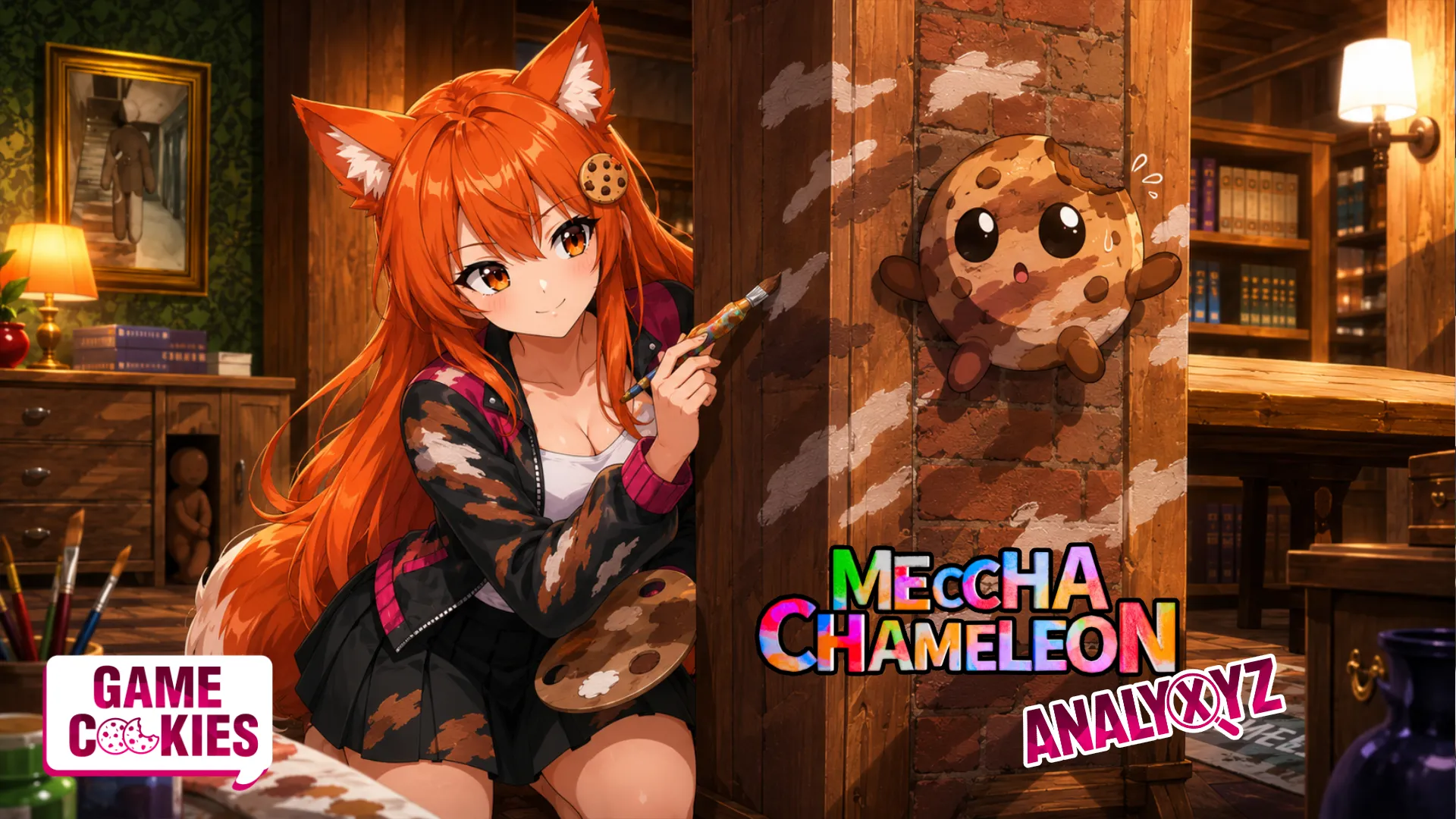
Hello there, Steam chart detectives, Discord lobby survivors. Today we are talking about MECCHA CHAMELEON, a tiny-looking hide-and-seek game that suddenly started moving like a kaiju on Steam, and the very funny possibility that one of the biggest lessons in multiplayer design right now came from a painted little guy pretending to be a brick wall.
MECCHA CHAMELEON launched on Steam in early June and immediately started climbing. First it was tens of thousands of players. Then more. Then more again. The SteamDB chart now shows more than 100,000 players online and a 24-hour peak above 230,000, which is the kind of number that usually makes publishers start saying “community-first experience” in meetings until someone asks where the actual community is.
The sales curve is just as ridiculous. The game reportedly hit 1 million copies sold in four days, 2 million in five days, and has now passed 3 million sales. For a small indie multiplayer game built around painting your body to hide from other players, that is not normal. That is “someone at a large publisher just reopened a rejected prototype folder” territory.
The simple read is that MECCHA CHAMELEON blew up because streamers found it. That is true, but incomplete. Streamers did not magically make the game interesting. The game gave streamers a format that produces jokes, panic, betrayal, stupid confidence, and instantly readable clips without needing a twenty-minute tutorial or a lore glossary written by a committee.
That is the real story. MECCHA CHAMELEON is not succeeding because it looks expensive. It is succeeding because the idea is instantly understandable, cheap to try, funny to fail at, and built around moments people want to show other people.
What actually happened
MECCHA CHAMELEON is a multiplayer hide-and-seek game from Japanese indie developer lemorion_1224. Players split into hiders and seekers. The hiders start as plain white characters, find a spot in the environment, then use painting tools to color their bodies so they blend into walls, floors, furniture, shadows, signs, plants, or whatever cursed hiding spot their confidence chooses.
The pitch is painfully easy to understand: Prop Hunt, but instead of turning into an object, you become the worst art student in camouflage school.
That simplicity matters. A player can understand the joke from one screenshot. A viewer can understand the danger from one clip. A streamer can explain the premise in one sentence while already doing something stupid on screen. That is powerful packaging, and no, that does not mean the game is shallow. It means the first five seconds do their job.
Reports say lemorion_1224 had experimented with similar hide-and-seek and disguise concepts in Epic Games Fortnite before bringing the idea to Steam. That detail is important because it makes the launch feel less like random lightning and more like an idea that had already been tested in social play. The Steam version may have been made quickly, with some reports saying around two months, but the instinct behind it had practice.
📢 “Paint yourself to blend in.”
That is the whole pitch. Not a franchise roadmap. Not a cinematic universe. Not a “next evolution of social stealth interaction.” Just paint yourself and pray your friends are blind.
🦊 Kiki: I love how clean this is. You do not need twelve trailers, a lore bible, and a developer diary explaining the emotional meaning of paint. You see a player lying on the floor disguised as carpet and your brain goes, “Okay, I get it, this person is either a genius or needs supervision.”
And that is the thing a lot of expensive multiplayer projects keep missing. The first laugh is not extra. The first laugh is onboarding.
🍪 Chip paints himself like a brick wall, floats proudly in the middle of an empty hallway, and is immediately found.
Why it spread so fast
The game has the four ingredients every viral party game wants: a low price, a simple pitch, social embarrassment, and repeatable clips.
The low price lowers the friend-group argument. Nobody needs to hold a budget meeting to try it. When a game is around the price of a snack, the Discord math changes. It becomes less “should I buy a new game?” and more “fine, I will join for one round.” That one round is where the trap closes.
The simple pitch makes it easy for viewers to enter mid-stream. You do not need to know patch history, classes, builds, map rotations, or ranked meta. Someone is hiding badly. Someone else is hunting them. Everyone watching understands the stakes immediately.
The social embarrassment does the rest. MECCHA CHAMELEON is funny because players are not only hiding from the seeker. They are hiding from judgment. Every bad disguise is a public confession. Every good disguise is an act of psychological violence. If you walk past a player who painted themselves as a wall crack, the game does not need a kill cam. Your friends will provide the damage.
That is why it works on Twitch, YouTube, TikTok, and Discord. The game constantly creates tiny stories: the perfect hiding spot, the suspicious shadow, the overconfident artist, the seeker who misses the obvious, the player who becomes a chair and somehow develops an ego.
🦊 Kiki: Streamer-friendly design is not just “streamers can play it.” That bar is underground. A spreadsheet can be streamed if someone has enough caffeine.
Streamer-friendly design means the game keeps producing readable situations without needing the creator to do all the work. MECCHA CHAMELEON gives people a setup, a timer, a visual gag, and social pressure. That is content machinery disguised as hide-and-seek.
🍪 Chip sets up a tiny streaming desk, goes live, forgets to hide, and gets eliminated before saying hello.
The “friendslop” label is useful, but also lazy
Players have been calling games like MECCHA CHAMELEON part of the “friendslop” wave: cheap, chaotic, social multiplayer games made to be played with friends, clipped online, and abandoned or revisited depending on the group chat’s attention span.
The label is funny, but it can also make the success sound accidental or disposable. That misses the design discipline underneath.
Lethal Company, Content Warning, R.E.P.O., PEAK, and now MECCHA CHAMELEON all understand something bigger games often overcomplicate: friends do not always need a perfect game. They need a good excuse to gather, a clear way to mess with each other, and enough unpredictability to create stories afterward.
That is not low design. That is focused design.
The risk is retention. These games can spike hard and fade fast if the novelty runs out, the servers struggle, moderation becomes messy, updates slow down, or the community discovers the optimal way to make the game less funny. A viral launch gets attention. Long-term survival requires maps, tools, bug fixes, lobby stability, community management, and enough variety to keep the joke from drying out.
MECCHA CHAMELEON already has some rough edges. Players and press have pointed to technical friction, and that is expected from a small team suddenly managing a player base that looks like it arrived by meteor. The next few weeks matter because novelty buys time, but it does not replace maintenance.
🦊 Kiki: This is where everyone needs to calm down a little. A huge launch does not automatically mean “forever game.” It means the first loop worked so well that the internet dragged everyone into the lobby at once.
That is amazing. It is also terrifying. Because now the developer has to patch a rocket while riding it, and the rocket is full of people painted like toilets.
🍪 Chip checks the Steam chart, puts on a tiny construction helmet, and slowly backs away from the server room.
What AAA keeps missing
Large publishers keep chasing streamer attention as a marketing outcome. MECCHA CHAMELEON treats it like a design condition.
That difference matters.
A lot of expensive multiplayer games launch with creator campaigns, sponsored streams, cinematic trailers, beta drops, roadmap graphics, and enough branded vocabulary to make a normal person crave silence. Then the actual game asks players to grind through systems before anything funny happens.
MECCHA CHAMELEON starts with the funny thing.
It does not need the player to unlock the comedy. The comedy is the tool. The comedy is the disguise. The comedy is the moment someone paints themselves the exact wrong shade of beige and insists they are invisible.
This is where small games have an advantage. They can be rude to complexity. They can build around one strong interaction and let players abuse it. Big studios often polish away the rough social edges because rough edges scare production pipelines, brand teams, ratings concerns, moderation teams, platform requirements, and executives who want the next Lethal Company but also want it to behave like a premium franchise pillar.
That contradiction is where a lot of “viral multiplayer” strategies die. You cannot safely manufacture chaos until all the chaos has been removed.
MECCHA CHAMELEON also shows how important visual readability is. The game’s white character model, painting tools, and obvious environments create immediate contrast. A viewer can scan the screen and participate mentally: “I see him.” “He is the wall.” “How did they miss that?” That spectator participation is part of the loop.
A game that makes the viewer feel smarter than the player is already halfway to a clip.
The bigger industry pattern
The current indie multiplayer wave is not only about cheap games. It is about games that understand how players socialize now.
People do not just play. They watch. They clip. They narrate. They argue in Discord. They send a friend one stupid video and say, “We are playing this tonight.” The purchase decision often starts outside the store page.
That does not mean every game should become a meme factory. Most games should not. Please, nobody needs a turn-based RPG where the wizard screams because a streamer might clip it. But multiplayer games that depend on friend groups need to think about how the idea travels from one person to another.
MECCHA CHAMELEON travels cleanly. The title is weird. The mechanic is visible. The failure state is funny. The price is low. The player count creates urgency. The clips explain the game better than a trailer.
That is not luck. That is a product shape that fits the current internet.
Byte would probably put it like this: the game reduces every step in the social conversion funnel. See it, understand it, laugh at it, buy it, invite friends, generate another clip. That loop is very hard to fake with a $70 price tag and a login screen that asks you to create an account before the joke starts.
What to watch next
The next question is whether MECCHA CHAMELEON becomes a lasting party-game fixture or a beautiful Steam comet that burns through one chaotic month and leaves behind funny clips.
The signs to watch are simple: update speed, new maps, mod support, server stability, anti-cheat and moderation tools, and whether the community keeps inventing new hiding strategies instead of solving the game into boring efficiency.
The good news is that the core is strong. The bad news is that success at this scale can crush a small developer almost as fast as failure. Players who paid five dollars can still become very dramatic when matchmaking breaks. Streamers who helped build the wave will also move on quickly if the game stops producing new moments.
Still, the industry should pay attention. Not because MECCHA CHAMELEON has the answer to every multiplayer problem, but because it exposes how many bigger games confuse scale with appeal.
Sometimes the better pitch is not bigger. Sometimes it is sharper.
Sometimes the billion-dollar lesson is a guy painted like a wall.
⚙️ Stay camouflaged: inspired by every player who looked directly at a suspicious floor stain and said, “seems fine.”
⚙️ Keep checking the Steam charts: inspired by every publisher trying to understand how a painted blob outran their quarterly strategy deck.
⚙️ And remember: if your multiplayer game needs a 40-slide onboarding plan before anyone laughs, the cookie with a paint bucket may already be ahead of you.
🦊 Kiki · 🍪 Chip · ⭐ Byte · 🦁 Leo
Tips, leaks, and suspiciously human-shaped brick walls: contact us here!