🍪 $17.5M, 499 Players, and One Very Confused “Indie” Game

Hello there, magical girl roguelite survivors, Steam wishlist optimists, and everyone who thought “indie game” stopped meaning anything around the third pitch deck.
Today we are talking about Starlight Re:Volver, Pahdo Labs, $17.5 million in funding, and the kind of collapse that makes players ask a very fair question:
Was this game the dream, or was the game just the wrapper?
This one is different for Game Cookies because we actually saw Starlight Re:Volver before it became a postmortem.
At PAX 2025, we interviewed Helen Wang from Pahdo Labs. She described it as a magical-girl-inspired co-op roguelike with a town hub inspired by Club Penguin, Animal Jam, and the early days of MapleStory. The game had just launched into Early Access with two biomes, three difficulty levels per biome, four playable characters, and a fifth character planned.
At the booth, the pitch made sense.
Bright anime style. Co-op runs. A social hub. Fishing. Hoverboards. Magical girls beating things up with friendship and probably too many particle effects.
Then players started looking past the booth pitch.
The game was real
Let’s get this out of the way before the comments start chewing drywall: Starlight Re:Volver was not vaporware.
It launched. People played it. Developers worked on it. The art direction had personality. The social hub idea had a hook. The team clearly wanted the game to become something bigger than another disposable Early Access release.
That is why “scam” is too lazy as the main explanation.
The sharper problem is that Pahdo had a real game, but the public story around the company made players question the pitch. Starlight Re:Volver was being sold as a magical-girl co-op roguelite, while the company narrative pointed toward something much larger: an anime social platform, a UGC (User Generated Content) toolset, and a venture-backed attempt to build the next anime Roblox.
That mix made the game harder to trust. Players were not only judging the Early Access build in front of them. They were judging whether the game was actually the priority.
Starlight Re:Volver entered Early Access on August 27, 2025. Before launch, Pahdo had strong demo attention, Steam Next Fest momentum, creator collaborations, a TikTok-friendly art style, and more than enough wishlist interest to look like a breakout candidate.
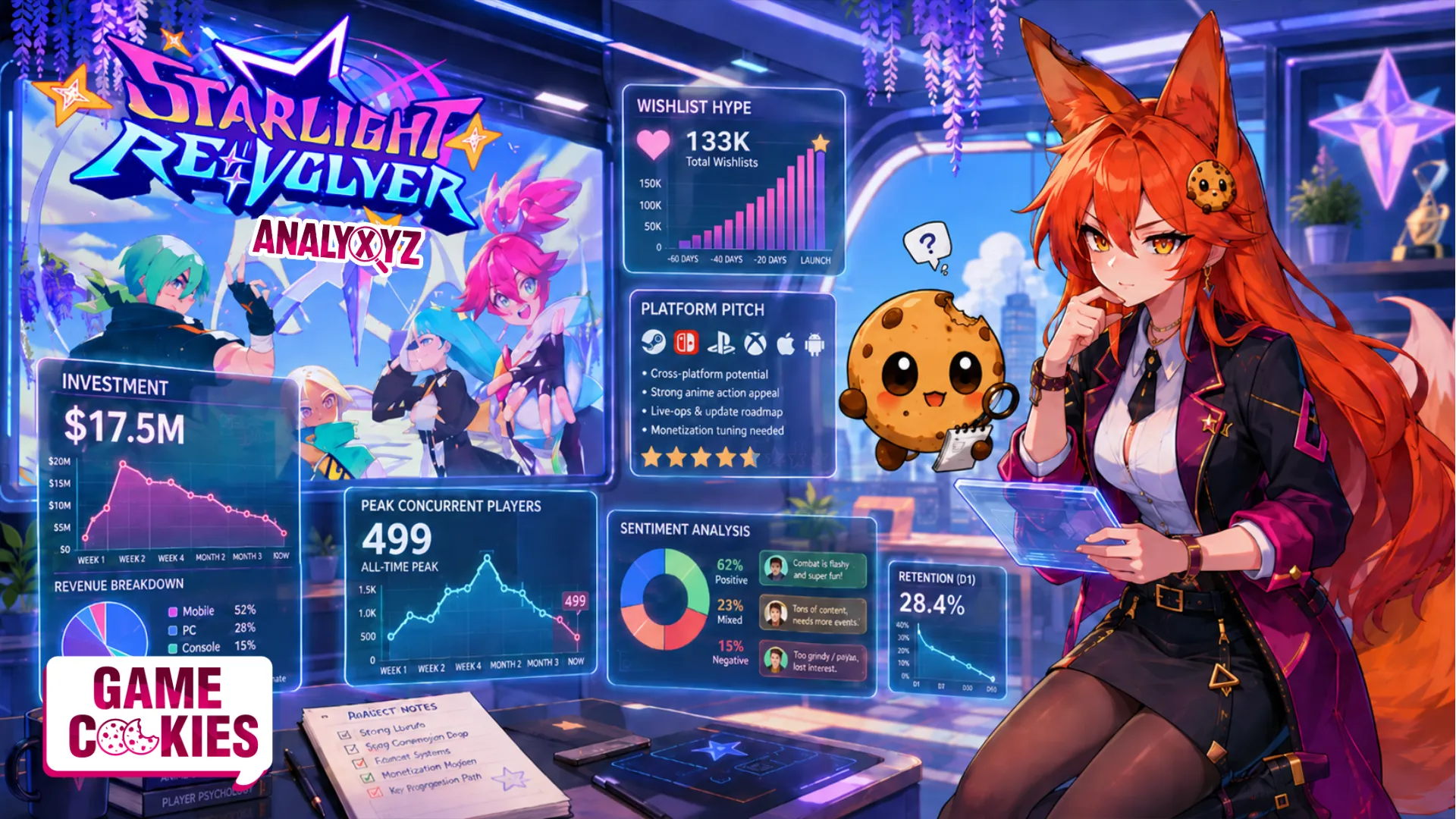
Then the game peaked at 499 concurrent players.
For a tiny hobby project, that number would not automatically mean disaster. For a studio carrying more than $17 million in funding and a much bigger platform dream, it looks like someone pulled the fire alarm in investor country.
🦊 Kiki: Wishlists are not purchases. Views are not community. “That looks cute” is not the same thing as “I am buying this and convincing three friends to join me.”
That is the part the industry keeps pretending not to understand. A wishlist is not a blood oath. It is a sticky note from someone’s future self, and future self is a liar with 400 games in the backlog.
🍪 Chip holds up a giant sign that says “100K+ WISHLISTS,” flips it over, sees “499 PEAK PLAYERS,” and quietly lowers himself into a tiny cardboard coffin.
“Indie” became the wrong word at the wrong time
A lot of the backlash came from one word: indie.
Some players saw “indie” next to “venture capital” and rejected the label immediately. Others argued that indie only means independent from a major publisher, so outside funding does not automatically disqualify a studio.
Technically, that second group has a point. A studio can be independent if it is not owned or published by a major publisher.
But players do not react to technical definitions. They react to the expectation a label creates.
When people hear “indie,” they usually expect a smaller creative project, visible risk, and a team building something because they are obsessed with it. They do not usually picture Andreessen Horowitz, AI-assisted tools, and language about turning IP into endless game franchises.
That gap is where the comments got ugly.
This was not only jealousy over money. It was a trust problem created by mixed signals. The player-facing side had indie warmth. The investor-facing side had platform ambition. Once both stories were public, people compared them.
And players can read now. Terrible news for pitch decks.
🦊 Kiki: Look, call it indie, AA, startup-core, anime Roblox pre-trauma, whatever helps the spreadsheet sleep at night. The problem is not the label alone. The problem is selling one emotional fantasy to players and a completely different financial fantasy to investors.
Players heard “cute magical girl roguelike.”
Investors heard “anime UGC platform with AI upside.”
Those are not the same sandwich.
🍪 Chip opens a tiny lemonade stand labeled “INDIE.” A venture capitalist drops $15 million on the counter and asks if the lemonade can scale into a creator economy.
The UGC pitch poisoned the room
The most damaging part was not simply that Pahdo raised money.
Games cost money. Developers need salaries. Artists need time. Servers are not powered by hope. Outside funding does not automatically turn a studio into a villain.
The problem was what the funding story seemed to reward.
Pahdo was not only being discussed as the studio behind Starlight Re:Volver. It was also framed around a broader UGC platform where players could create anime-style mods and worlds, with AI and procedural generation in the mix.
That may sound great in an investor memo. To players, it can sound like the game is not the main dish.
There is a reason words like AI, procedural generation, creator economy, UGC, democratizing, and platform make people nervous now. Tech companies have dragged those words through enough nonsense that they arrive pre-covered in slime.
Put that language next to a cute anime roguelite, and every bug starts looking suspicious.
Bad onboarding stops being just bad onboarding. Co-op issues stop being just co-op issues. Missing polish stops being only missing polish. The player starts wondering whether the team was building a game or building proof of concept for something investors liked better.
That does not prove bad faith. It does explain the temperature of the reaction.
🦊 Kiki: This is where companies get cute and then act shocked when players get suspicious.
You cannot tell investors you are building the future of anime creation, then turn around and tell players, “No no, don’t worry, we are just a cozy little indie team with a magical girl game.”
The internet has tabs. The investor blog is public. The LinkedIn post is public. The old company copy is public. The raccoons found the trash can.
🍪 Chip sees the phrase “AI-assisted UGC,” puts on a tiny hazmat suit, and starts spraying the Steam page with disinfectant.
The pitch had too many jobs
The PAX version of Starlight Re:Volver had a clear hook. A magical-girl co-op roguelike with a MapleStory-ish social hub is easy to understand. It has flavor. It has a real audience fantasy.
The problem is that every piece of that fantasy needs serious execution.
A roguelite needs strong combat, readable progression, enemy variety, and enough mechanical bite to make another run feel worth it. A co-op game needs stable sessions, clean invites, and enough clarity that your friends do not quit before the fun starts. A social hub needs identity, expression, rituals, and enough active players that it does not feel like a mall after closing.
Then add paid Early Access on top of that.
Now the game is asking players to spend money, bring friends, tolerate rough edges, and believe the community will survive long enough for the roadmap to matter.
That is a hard sell even without the UGC platform shadow hanging over it.
Starlight Re:Volver needed to prove the core loop first. Instead, the conversation kept drifting toward the company behind it, the money behind the company, and the platform dream behind the money.
The game had a vibe. The launch needed trust.
Those are not the same thing.
🦊 Kiki: Vibes are great. I love vibes. Vibes get you a trailer share, a wishlist, maybe one comment saying “omg need.”
But vibes do not fix matchmaking.
Vibes do not make your friend group buy three copies.
Vibes do not survive a bad first session where someone gets stuck, someone disconnects, and someone says, “Can we just play something else?”
At that point, the vibe is wallpaper. Cute wallpaper, expensive wallpaper, but still wallpaper.
🍪 Chip puts up magical girl wallpaper, steps back proudly, and the entire wall collapses to reveal a bug report behind it.
The marketing made noise, not commitment
The comments around the video show a weird split.
Some people say they saw Starlight Re:Volver everywhere: TikTok, Reddit ads, YouTube recommendations, Steam Next Fest, all of it. Others say they were roguelite fans, anime fans, or exactly the kind of player who should have been targeted, and they never heard about the game until it was already being dissected.
Both can be true.
Marketing can create awareness pockets without building a launch wave. A campaign can make people recognize a game without making them trust it enough to buy. A demo can create curiosity without turning into a community.
Several comments described the same failure pattern: they saw the demo, wishlisted the game, forgot about it, and only heard about it again when the collapse videos arrived.
That is not a marketing win. That is a funnel with a trapdoor.
The price made it worse. A paid Early Access co-op game does not only cost $20. It costs $20 plus the effort of convincing friends, coordinating sessions, surviving onboarding, and hoping nobody says, “Let’s just play something else.”
Meanwhile, anime service-game audiences are surrounded by free-to-play giants with constant updates, polished character pipelines, and zero entry cost.
Charging money is not wrong. But if a game is paid, co-op-focused, and unfinished by design, the first impression has to be clean enough that players feel safe recommending it.
Starlight Re:Volver did not get there fast enough.
🦊 Kiki: Co-op games have a hidden price tag.
It is not just twenty dollars. It is twenty dollars, plus convincing your friends, plus explaining the game, plus surviving the first session, plus pretending you are not responsible when everyone has a worse night because you recommended the anime VC game.
And players are very brave online until it is time to tell the group chat, “Trust me, this Early Access game is worth it.”
🍪 Chip sends three party invites. All three come back with “maybe later.” He stares at the screen like a cookie who just discovered churn.
The scam label is loud, but too clean
A lot of people jumped straight to “scam.”
It is short. It is angry. It works in comments. It also skips the more useful failure.
Pahdo seems to have tried to build a game, a social space, a future platform, and a studio story big enough for investors before the first product had earned enough player trust.
That does not require cartoon villains. It requires bad sequencing.
The team may have cared. The funding may have been raised with real ambition. The game may have had a valid audience fantasy. None of that guarantees a healthy launch.
Players judge the build they can buy, not the version the studio hopes to reach later. If that first version cannot hold enough people, the long-term vision becomes irrelevant very quickly.
🦊 Kiki: The scam label makes the story too easy. Villains over there, victims over here, roll credits.
The uglier possibility is that people believed the plan.
That is worse, because it means the plan itself was the problem.
Nobody needs to twirl a mustache for a project to go wrong. Sometimes the roadmap walks into the room wearing ten hats, calls itself a platform, and trips over the actual game.
🍪 Chip places a tiny bandage on a server rack. The server rack catches fire politely.
Wishlists are not a community
This is probably the most useful part of the whole collapse for other developers.
A wishlist is not a sale. It is not a friend group. It is not a Discord community. It is not retention. It is not proof that players will forgive your rough launch.
A wishlist is a maybe.
Someone saw the art, liked the trailer, clicked one button, and handed responsibility to a future version of themselves. That future version might see Mixed reviews, check the price, notice nobody is playing, and decide the drama video is cheaper than the game.
For an online co-op title, that gap can become lethal fast. Low population hurts matchmaking. Weak matchmaking hurts retention. Weak retention hurts reviews. Mixed reviews scare off new buyers. Then the loop starts eating itself.
Starlight Re:Volver did not fail because the concept was impossible. The magical-girl action pitch worked. The social hub had charm. The PAX explanation made the project sound like it knew what feeling it wanted.
The launch just did not earn enough confidence before the bigger story swallowed it.
Maybe the game needed to be smaller. Maybe the social hub needed to wait. Maybe the UGC platform should have stayed locked in the investor basement until players loved the core game. Maybe paid Early Access was the wrong door for this audience.
Failed games rarely die from one clean wound, but this one had a visible pattern: a promising game idea got inflated into an ecosystem before the game had enough oxygen.
🦊 Kiki: This is the part every studio with a giant wishlist number should tattoo on the inside of the office fridge:
Interest is cheap.
Commitment is expensive.
A player can wishlist your game while eating cereal at 1 a.m. That does not mean they will buy it, install it, convince friends, survive bugs, write a positive review, and become the unpaid community infrastructure your co-op game needs to breathe.
🍪 Chip clicks “wishlist” on 37 games, forgets all of them, then acts personally betrayed when one shuts down.
The warning is mixed signals
Starlight Re:Volver had art. It had visibility. It had money. It had a pitch that sounded good when Helen Wang explained it at PAX.
What it did not have, when it needed it most, was enough player confidence.
The audience saw indie charm. The investors saw platform potential. The marketing sold vibes. The product needed retention. The comments turned the whole thing into a fight over what “indie” even means anymore.
Funding changes the story around a game. Platform language changes it even more. Once players start wondering whether the game is the point or just the wrapper for a larger investor dream, the launch is already fighting uphill.
Starlight Re:Volver may be gone as a live-service dream, but the warning is useful:
If your game needs to become anime Roblox before the combat feels good, put the pitch deck down and fix the hitboxes.
⚙️ Stay demo-skeptical like every player who wishlisted a game and forgot it existed until the autopsy video.
⚙️ Keep checking the funding story like every “small indie dream” that somehow arrives with a venture-backed platform roadmap.
⚙️ And remember: real devs can still get trapped inside a bad strategy deck.
🦊 Kiki · 🍪 Chip · ⭐ Byte · 🦁 Leo
Tips, leaks, and suspicious investor decks. Contact us here!