🍪 ESA Called Minecraft Private Servers “Piracy,” And Accidentally Made Game Preservation Look Smarter

Hello there, server goblins, EULA readers, and everyone who has ever hosted a Minecraft world for three friends and one cousin who only logs in to steal diamonds. Today we are talking about the Entertainment Software Association, California’s Protect Our Games Act, private servers, and the rare public-hearing moment where the industry lobby tried to swing at piracy and somehow bonked itself with server.jar.
At a California State Senate hearing over AB 1921, also known as the Protect Our Games Act, ESA vice president for state government affairs Jennifer Gibbons made a statement that immediately escaped containment. When Assemblymember Chris Ward pointed to Minecraft and Call of Duty community servers as examples of private server models already existing in games, Gibbons cut in and said they were “illegal.” She also said they were not affiliated with Microsoft, and later said the ESA considers them piracy.
That is a spicy claim on its own. It gets even spicier when the example is Minecraft, a game whose official website literally provides a Java Edition server download for people who want to run multiplayer servers. Minecraft’s own EULA also says that for the server version of Minecraft: Java Edition, players can install it on a server and host online play.
So no, “private server” is not automatically code for “pirate cave with broadband.”
That does not mean every private server is legal, safe, or acceptable. Some private servers do infringe IP, dodge subscriptions, monetize copyrighted material, or recreate live services without permission. That part is real. But the problem is that the ESA’s wording collapsed all of that nuance into one giant legal blender, and the smoothie came out tasting like corporate panic.
What actually happened
AB 1921 is a California bill aimed at digital games and “ordinary use.” In its amended form, the bill would apply to digital games first sold or rereleased from January 1, 2028 onward. It would require operators to notify players before shutting down services necessary for ordinary use and then provide one of several options: an independent playable version, a patch, a refund, documentation for private or community servers, or server software when applicable.
That matters because the bill is not simply “publishers must run official servers forever while a skeleton crew cries in a basement.” The text gives publishers multiple possible routes. Some of those routes are difficult, some could be legally complicated, and some games may be built in ways that make preservation ugly. But the argument is more specific than the industry’s favorite nightmare version.
The ESA’s broader opposition is that bills like this misunderstand how online games work. Its public argument is that modern online games rely on infrastructure, moderation, licenses, patches, and systems that can be expensive or legally complicated to maintain. That concern is not automatically nonsense. Licensed music expires. Server architecture ages. Moderation has real costs. Security risks do not magically disappear because players love a game.
The issue is that when the response to “could community servers help?” becomes “that is piracy,” the industry starts sounding less like it is explaining a technical burden and more like it is rejecting the idea that players should ever have an exit ramp.
📢 Key line: The preservation debate is not really about forcing every publisher to run every live service forever. It is about what obligation exists when a paid game becomes unusable because the company controls the switch.
🦊 Kiki: Okay, beautiful. Let’s slow the corporate horse down before it gallops through the courtroom wearing a Minecraft helmet.
A private server can mean very different things depending on the game, the code, the assets, the monetization, and the license. A shady server selling stolen access to an MMO is one thing. A Minecraft Java server with three friends, one creeper farm, and a child screaming because someone touched their house is another thing.
Putting both in the same “piracy” bucket is like calling every kitchen knife a murder weapon. Yes, technically one could be used badly. But if your legal argument starts by arresting the sandwich, maybe your framing needs a patch.
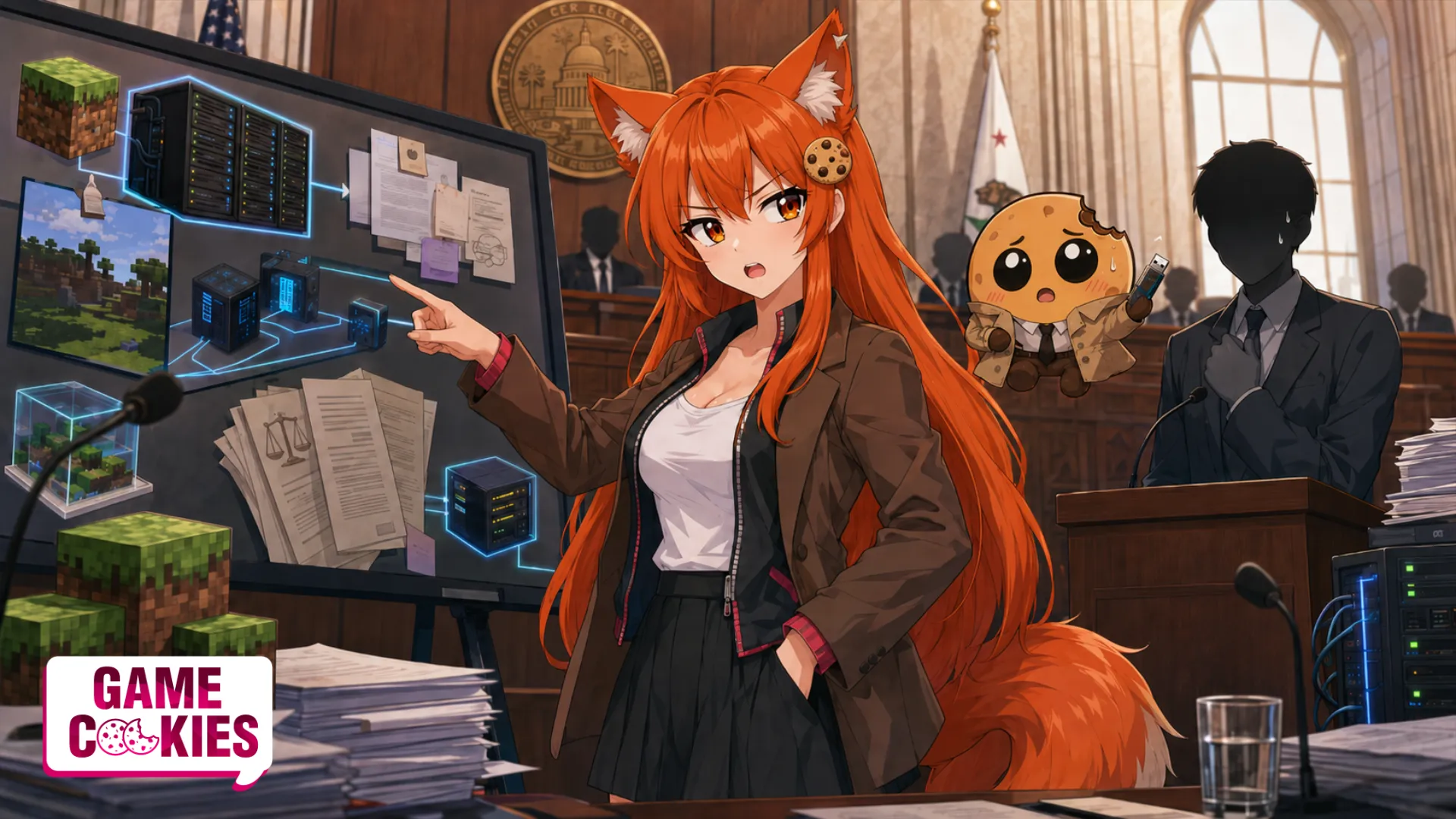
🍪 Chip slowly hides a tiny “WORLD BACKUP” folder behind his cookie body and pretends he has never touched multiplayer settings.
Why the Minecraft example exploded
Minecraft was probably the worst example to toss into this argument because community hosting is part of the culture and infrastructure around the game. The official Minecraft site tells users how to download the Java Edition server software. It also points users toward third-party servers through an official server listing site, with those listed servers reviewed against standards and community guidelines.
That does not make every Minecraft server official. It does not make every Minecraft server compliant. It does not mean Microsoft endorses whatever chaos happens inside someone’s private block kingdom. But it absolutely undercuts the idea that “private server” equals “illegal” as a category.
There is also an important difference between unaffiliated and illegal. Most fan communities are unaffiliated. Most mods are unaffiliated. Most Discord servers, wikis, fan art archives, speedrunning tools, and community guides are unaffiliated. Unaffiliated does not automatically mean black market. It means the company did not make it, run it, or officially bless it.
That distinction matters a lot when lawmakers are trying to understand games. If lobbyists explain the industry using categories that are too broad, lawmakers walk away with a worse map of the problem. And if the map is bad, the law will probably be bad too.
🦊 Kiki: This is where the whole thing gets dangerous, because legislators do not live inside our weird little ecosystem. They hear “private server” and they need someone to explain the difference between legitimate community hosting, unsupported fan infrastructure, modded play, reverse-engineered preservation, and actual piracy.
Instead, they got “black market videogames,” which sounds like a guy in a trench coat whispering, “Psst, kid, want some unauthorized Minecraft?”
And listen, if somebody is selling access to copyrighted content they do not own, fine, bring the legal hammer. But if the example on the table is Minecraft, the game whose server software is basically sitting there like a free cookie sample, maybe do not declare the bakery illegal.
🍪 Chip puts on a tiny trench coat, opens it, and it is just full of backup saves, LAN party snacks, and one very scared chicken.
The ESA still has a serious argument buried under the mess
The annoying part is that the ESA does have real points it could make. Online games are not all built the same way. Some depend on licensed content. Some use backend systems that cannot be safely handed to the public. Some live games are giant moving machines full of accounts, matchmaking, purchases, moderation tools, platform rules, anti-cheat systems, telemetry, and legal obligations.
Preservation advocates should not pretend every server shutdown can be solved by pressing the “community mode” button. That button does not exist for a lot of games, and adding it after launch can be expensive or technically messy. Developers know this better than anyone, especially the ones who inherited live service architecture held together with duct tape, fear, and one engineer named Marco who left in 2021.
But the serious version of the industry argument needs precision. It needs to say: “Some private server models are safe and legitimate, some are not, and here is where the legal and technical boundary sits.” That is a stronger position than saying the entire concept is piracy, especially when the bill itself includes several possible compliance paths beyond community servers.
The moment the industry overstates the danger, it feeds the exact distrust that Stop Killing Games is built on. Players already feel like digital purchases are becoming temporary permissions dressed up as ownership. When the official response sounds like “you bought access, but please do not ask what happens when we turn it off,” people do not become calmer.
They start saving receipts.
What the simple version gets wrong
The simple internet version of this story is going to be: “ESA says Minecraft servers are illegal.” That is funny, and it is also too small. The bigger issue is how quickly the industry can frame community-controlled continuity as a threat instead of a possible part of the solution.
The preservation debate needs more categories, not fewer. There are official servers, community servers, private servers, self-hosted tools, modded servers, reverse-engineered projects, illegal replicas, fan preservation builds, peer-to-peer options, offline modes, and patched end-of-life versions. Treating all of that as one big pirate blob is convenient for lobbying, but it is useless for policy.
It also ignores the obvious design lesson. If publishers do not want emergency preservation fights at the end of a game’s life, they need to think about end-of-life earlier. Not after the shutdown post. Not after the store delisting. Not after the community starts rebuilding the game in a garage with three GitHub issues and righteous anger. Earlier.
A game does not need to live forever as an official service. But if a company sells a paid game whose core use depends on company-controlled systems, the end-of-life plan should not be a shrug wearing a legal disclaimer.
🦊 Kiki: This is the part publishers hate because it sounds boring and expensive, which means it is probably the real problem.
Players are not asking every company to maintain a dead MMO until the sun explodes. They are asking not to buy a game in 2028 and discover later that “purchase” meant “temporary museum ticket to a building we may demolish.”
If the answer is “sorry, preservation is too complex,” then explain the complexity honestly. If the answer is “we cannot provide server tools because security, licenses, or architecture,” then say that clearly. But do not point at Minecraft, one of the most server-friendly games on the planet, and yell “piracy” like a villager just saw copyright law for the first time.
🍪 Chip opens a tiny legal dictionary, sees the word “ordinary use,” and immediately needs a nap.
Why this matters beyond one hearing
This story lands because it sits on top of a bigger digital ownership problem. Players are buying games that increasingly depend on servers, accounts, licenses, storefronts, and backend systems they do not control. The industry wants flexibility to shut things down when the business no longer works. Players want some guarantee that a paid product will not evaporate completely when the spreadsheet gets bored.
Both sides can make valid points, but only one side has the kill switch.
That imbalance is why Stop Killing Games keeps getting attention. The movement is not powered only by nostalgia. It is powered by the fear that the industry’s preferred model is drifting toward “you paid, you played, now please accept the disappearance quietly.” Every bad shutdown, every vague store page, every always-online product with no end-of-life plan makes that fear easier to sell.
The ESA could have used the hearing to draw careful lines. It could have separated illegal private services from legitimate community hosting. It could have argued that preservation obligations need to be scoped by genre, architecture, security risk, and license structure. It could have admitted that players have a reasonable concern while still opposing the bill’s implementation.
Instead, the clip people will remember is “Minecraft servers are illegal.”
That is not a great look when your argument is that lawmakers misunderstand games.
What to watch next
AB 1921 reportedly failed to advance out of committee, so this specific California push appears to have hit a wall for now. But the debate is not going away. Game preservation has already become a consumer rights issue, a legal issue, a developer workload issue, and a PR issue. That is a very annoying boss fight because it has multiple health bars.
The next version of this fight will probably be sharper. Preservation advocates will use moments like this to argue that the industry is not negotiating in good faith. Publishers and lobbyists will keep warning that broad legal mandates could create impossible technical and legal obligations. Somewhere in the middle are developers who may agree with preservation in principle but know exactly how cursed their backend stack looks.
The smartest industry response would be to stop treating preservation as a hostile demand and start treating it as product planning. If a game is sold as dependent on online services, say what happens when those services end. If a community server option is impossible, explain why. If it is possible, design for it before the shutdown clock starts ticking.
Because after this hearing, one thing is very clear: if your anti-preservation argument accidentally makes Minecraft server admins look like underground criminals, maybe the message needs a hotfix.
⚙️ Stay source-aware like every player who checked the official server download before accepting lobbyist DLC.
⚙️ Keep reading the fine print like Chip trying to find out whether his cookie body is licensed or owned.
⚙️ And remember: if your game can die from a server switch, players are going to ask who gets the keys before the lights go out.
🦊 Kiki · 🍪 Chip · ⭐ Byte · 🦁 Leo
Tips, leaks, and suspicious server.jar trench coats: contact us here!