🍪 Japan Wants AI to Beat Anime Pirates, and Video Games Should Be Nervous

Hello there, subtitle warriors, localization goblins, and every JRPG fan who has ever stared at a Japanese menu like it was an Elden Ring boss fog. Today we are talking about Japan’s reported AI translation subsidy push, the piracy panic behind it, and why videogames should not sit there pretending this anime fire won’t reach the controller shelf.
The story starts with a reported plan from Japan’s Ministry of Economy, Trade and Industry. According to Kotaku’s coverage of Yomiuri Shimbun’s reporting, METI is reportedly preparing an overseas promotion subsidy package worth about 11.5 billion yen, roughly $70 million, for 15 entertainment companies. The reported goal is to expand Japanese media overseas while encouraging generative AI translation so official releases can arrive faster in foreign markets.
The likely names are not tiny background NPCs either. The report says Crunchyroll, SHUEISHA GAMES Inc., Kodansha Ltd., Square Enix, and 株式会社バンダイナムコエンターテインメント Bandai Namco Entertainment(Japan) are among the companies expected to be offered support. Kotaku also notes that METI had not officially revealed the subsidy program at the time of its report, so the safe read is “reported plan,” not “finalized government rollout.”
The reason this matters for Game Cookies is simple: this is being framed as an anti-piracy move. The logic is that unofficial translations, fan subs, scanlations, and pirate releases often reach international audiences faster than the official version. If official anime and manga can arrive faster, in more languages, piracy loses one of its strongest excuses. That sounds clean on a government slide. The moment you bring in real fans, real translators, real release pipelines, and real quality control, the slide starts sweating.
What actually happened
The reported subsidy package is meant to cover overseas promotion costs, including AI-assisted translation, advertising, and international events. Kotaku says nine of the 15 companies would be anime and manga publishers, while six others would come from music, gaming, and live-action. That is where the videogame alarm starts blinking, because Square Enix and Bandai Namco are not just anime-adjacent companies. They are also major videogame publishers with global audiences, huge IP portfolios, and plenty of localization pressure.
Piracy is the pressure point. Dexerto reported that a METI study found content worth 5.7 trillion yen was pirated overseas in 2025, roughly $37 billion, nearly triple the amount reportedly pirated in 2022. The same report says counterfeit character goods added another estimated 4.7 trillion yen, bringing the combined total to 10.4 trillion yen, or about $73 billion.
Complex’s coverage of Toei Animation’s lobbying adds another piece of context: anime executives have been pushing Japanese lawmakers to act because overseas consumption has become a critical growth engine. Complex reported that overseas anime revenue has crossed $13 billion and now accounts for roughly one-third of Japan’s total overseas content earnings, while Japan’s wider content industry has a $130 billion international sales target by 2033.
📢 The important line is not “AI translation is coming.” The important line is: Japan sees speed, piracy, and overseas growth as the same battlefield.
That is the part videogames should be watching. Because when a government starts funding faster localization for anime and manga, the obvious next industry thought is: why not games?
🦊 Kiki: Of course the pitch sounds perfect in a boardroom. “Piracy is fast, so we will be faster.” Very clean. Very powerful. Very “someone made this in PowerPoint while eating convenience store pudding.”
The problem is that translation is not a microwave burrito. You cannot just press “Spanish,” wait 40 seconds, and get emotional damage with correct gender agreement. Anime fans already know when subtitles smell like a robot fell down the stairs. Gamers are even worse. We will notice if the item description says “Sword of Wet Uncle” instead of “Stormcleaver.” Then someone will screenshot it, the meme will outlive the patch, and congratulations, your official translation became unpaid marketing for piracy.
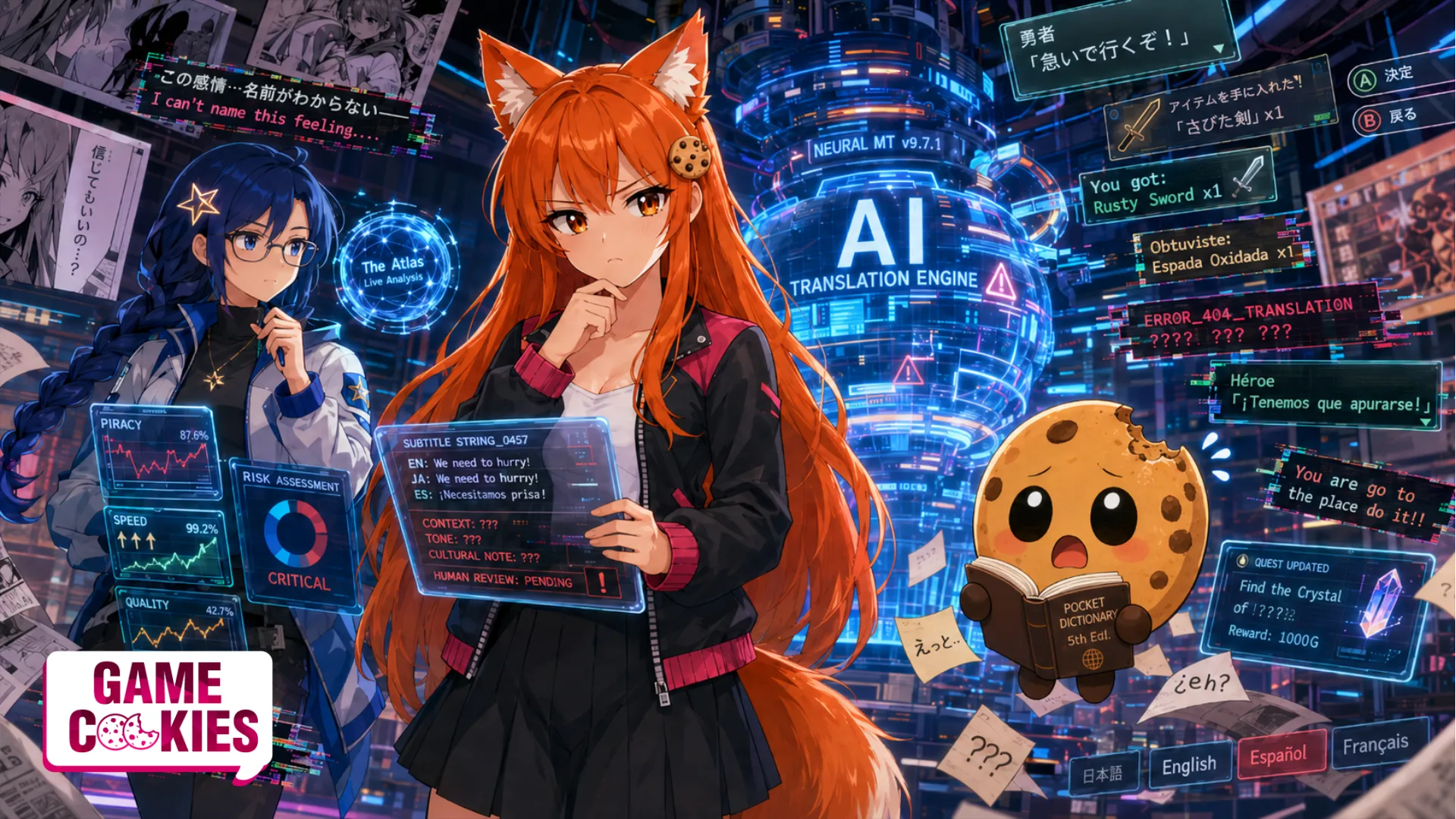
🍪 Chip floats beside a giant “AI TRANSLATION PIPELINE” chart, sees one arrow labeled “human review later maybe,” and quietly hides behind a dictionary.
Why fans are split
There are two reactions happening at once, and mixing them together makes the debate useless. Some fans understand the speed problem. If the official version arrives months late, region-locked, badly promoted, or missing a language entirely, pirates do not need to win on morality. They only need to win on availability.
That part is real. A fan who wants to read or watch something in their language today is not always making a philosophical argument about copyright. Sometimes the legal path is slow, expensive, fragmented, or simply not available. That does not make piracy good, but it does explain why “just don’t pirate” often lands like a loading screen tip written by a lawyer.
The second reaction is the quality fear. Fans are not only worried that AI translation will replace humans. They are worried that companies will use “AI + review” as a polite way to say “cheaper, faster, worse, and someone underpaid can clean it before launch.” That fear is not invented out of thin air. In games, localization already has a long history of rushed schedules, missing context, awkward UI constraints, and translators getting text strings without enough information about who is speaking or what is happening.
IGDA’s localization guidance is very direct about this. It says game text mixes technical and creative writing, depends on each game’s systems, setting, and characters, and is constrained by UI limits like character and line restrictions. It also warns that no two games are the same in design or text.
That matters because games are not linear scripts. A single line can be a quest hint, a joke, a lore clue, a combat warning, a UI label, a tutorial instruction, or a romance flag that launches a thousand Reddit threads. If AI gets the sentence “right” but misses the role the sentence plays inside the game, the translation can still fail.
🦊 Kiki: This is where the “AI first pass, human review” phrase needs a little fox-girl side-eye. Because sure, that can work in a mature workflow with good context, trained linguists, proper rates, real QA, style guides, term bases, and enough time to fix things.
But if the workflow is “machine spits draft, exhausted translator gets paid in crumbs, LQA finds the body after launch,” then we are not solving piracy. We are speedrunning distrust.
Gamers do not care that your pipeline was innovative if the healer’s ultimate becomes “Grandma Blessing Explosion.” They paid for the official version. If the fan patch sounds better, the publisher has entered the clown dungeon with no map.
The videogame angle is not hypothetical
The cleanest reason to connect this to videogames is that the reported list already touches gaming. Square Enix and Bandai Namco are both named among likely subsidy recipients, and Kotaku specifically points out that six non-anime/manga companies would reportedly come from music, gaming, and live-action. Kotaku also notes that because Square Enix and Bandai Namco are videogame publishers, METI may be expecting companies to overlap across sectors.
That does not mean Final Fantasy XVII is about to be translated by a haunted spreadsheet. It does mean that the business incentive is visible. If a public subsidy makes AI-assisted localization cheaper, faster, and politically aligned with Japan’s export strategy, publishers will at least test where it fits.
There are legitimate uses. AI can help with terminology suggestions, repetitive UI strings, internal documentation, glossary matching, first-pass triage, support content, and faster previews for teams that need to understand a build before full localization begins. For huge live-service games with constant updates, patch notes, seasonal content, item descriptions, and support articles, speed matters.
But the danger starts when executives treat every text string as equal. A login error is not a confession scene. A support article is not a character ending. A patch note is not a boss monologue. A shop button can survive being boring. A story-heavy RPG cannot have every character speak like they were assembled from airport signage.
⭐ Byte: The pattern is cost compression under the language of access. The stated goal is to reduce piracy by improving availability, but the implementation risk is that “faster access” becomes a budget argument instead of a quality argument. For videogames, the safest model is not AI replacing localization. It is AI inside a controlled pipeline with source context, terminology databases, style guides, human translators, editors, and LQA. Without that structure, the tool does not remove work. It moves the work downstream, often to the people with the least time and the least authority.
What the simple narrative gets wrong
The simple pro-AI narrative says piracy wins because official translations are too slow, so AI speed fixes the problem. That is partly true, but incomplete. Piracy also wins when legal access is fragmented, prices are awkward across regions, releases are delayed, platforms are inconsistent, and official versions feel lower quality than fan work.
The simple anti-AI narrative says AI translation is automatically trash, so the whole plan is doomed. That also misses something. The problem is not that every use of AI in localization is cursed. The problem is companies using AI as a replacement for expertise, then acting surprised when fans reject the output.
IGDA’s article argues that machine and AI translation are not suitable for creative game text as a replacement for professional translators. It also explains that post-editing machine output is not just “make it sound good”; it requires checking meaning, style, characterization, and terminology consistency against the source.
That is the labor trap. If post-editing takes nearly as much care as translating from scratch, but gets treated as cheaper cleanup, quality falls and translators burn out. Then publishers get the worst of both worlds: angry fans, exhausted linguists, and a localization process that looks efficient only if nobody checks the final product too closely.
🦊 Kiki: The funniest part is that companies keep trying to make “translation” sound like a plumbing issue. Move text from Pipe A to Pipe B. Done. Launch the language pack. Everybody clap.
But localization is closer to surgery performed during a circus fire. You need context, tone, space limits, cultural references, platform rules, age ratings, voice direction, UI behavior, and sometimes a developer explaining that the word “apple” is actually the name of a cursed moon god from Chapter 7.
AI can help carry the tray. It cannot be the surgeon, the nurse, the patient, and the hospital administrator because Kevin wants the French build by lunch.
🍪 Chip is now wearing a tiny hard hat, staring at a UI string that says “Press Button for Emotional Sandwich,” and reconsidering his career in cookies.
The bigger industry pattern
This story is bigger than anime subtitles. Japan is treating global media access as an economic strategy, not a side hobby. Anime, manga, games, music, live-action, events, streaming subscriptions, character goods, and international fandom are all part of the same export machine. That is why piracy is being discussed with such massive numbers, and why AI is being positioned as both a protection tool and a growth tool.
For videogames, this fits a larger pattern we are already seeing: publishers want more simultaneous global launches, more languages, more live updates, more regional marketing, and lower operational costs. Localization sits right in the middle of that pressure. It is essential for growth, but often treated like a cost center until something goes wrong publicly.
The most important lesson for games is that speed only helps if the official version feels worth trusting. If a player waits for the legal release and gets awkward dialogue, broken UI, mistranslated skills, or deadpan machine jokes where character writing should be, the company has not beaten piracy. It has taught the audience that the official version is the slow version with a nicer logo.
The smarter path is boring but necessary: use AI where it supports human teams, not where it hides the removal of human judgment. Give translators context. Pay editors properly. Run LQA with enough time to fix meaning, not just typos. Build term bases and style guides before the machine starts vomiting confidence. Use speed to support quality, not replace it.
What to watch next
The next thing to watch is whether METI publishes formal details for the subsidy program, including eligibility rules, quality requirements, and whether human review is mandatory. The second thing to watch is which companies actually receive support and whether gaming companies use it for marketing, back-catalog localization, anime tie-ins, manga apps, live-service content, or full game scripts.
If this becomes a serious government-backed pipeline, it could reshape how Japanese entertainment reaches global audiences. That could be good for fans who rarely get official access in their language. It could also be bad for translators if “AI-assisted” becomes a prettier label for lower rates and rushed review.
For games, the warning is simple: do not copy the anime solution without respecting the extra complexity of interactivity. A manga panel gives visual context. An anime scene gives timing and voice. A game string might arrive alone in a spreadsheet, separated from the quest, character, UI, and emotional stakes. That is already hard for humans. Pretending AI magically understands the missing context is how you ship “Everyone is rice” as a boss subtitle.
🦊 Kiki: I actually want official releases to be faster. I want fans in Latin America, Europe, Southeast Asia, everywhere, to get legal access without waiting like the localization is being delivered by Chocobo mail.
But if the industry uses piracy as the scary monster to justify lazy AI pipelines, fans will smell it instantly. Gamers can forgive a delay. They can forgive a typo. They cannot forgive paying premium money for dialogue that sounds like a printer having a panic attack.
So yes, fight piracy with speed. But fight it with quality too. Otherwise the pirate version will not win because it is free. It will win because the official version showed up wearing a government-funded clown nose.
🍪 Chip holds up a tiny sign that says “PLEASE LOCALIZE RESPONSIBLY,” then gets buried under 4,000 untranslated item descriptions.
⚙️ Stay context-aware like every translator who asked who is speaking before touching the line.
⚙️ Keep checking the official details like Byte watching a subsidy spreadsheet grow suspicious little anime ears.
⚙️ And remember: if your anti-piracy plan makes the pirate translation sound more human, the pirates did not win the race — you tripped over the finish line.
🦊 Kiki · 🍪 Chip · ⭐ Byte · 🦁 Leo
Tips, leaks, and suspiciously robotic subtitles: contact us here!