🍪 Overwatch’s $35 Ultra Skins Turn Cat Café Cosmetics Into a $100 Pricing Test

Hello there, wallet survivors, cat café casualties, and everyone who opened the shop expecting cute skins and accidentally walked into a small luxury boutique. Today we are talking about Overwatch Ultra Skins, the Nyan Café bundle, and the moment a pink cat paw animation started doing premium pricing cosplay.
Blizzard Entertainment recently introduced Ultra Skins as a new cosmetic category for Overwatch, describing them as a way to give players more expressive cosmetics while giving artists more room to create skins with custom spectacle. According to Blizzard’s own breakdown, Ultra Skins are meant to include custom visual effects, sound effects, elimination effects, reload details, and other features that go beyond standard Legendary skins. The first examples are the Nyan Café skins for Kiriko and Sierra, a cat café-themed collection full of feline effects, cute barista energy, and enough pink to make the shop look like it got sponsored by a magical girl espresso machine.
The official explanation focused on creativity. Blizzard said Mythic Skins are more about customization, while Ultra Skins are about ready-made spectacle that works immediately when equipped. The company also said effects like elimination graphics or sounds are only visible in kill cams, which is important because cosmetic flair should not mess with competitive integrity. That part makes sense. Nobody wants to lose a ranked match because someone bought a $35 tactical glitter grenade.
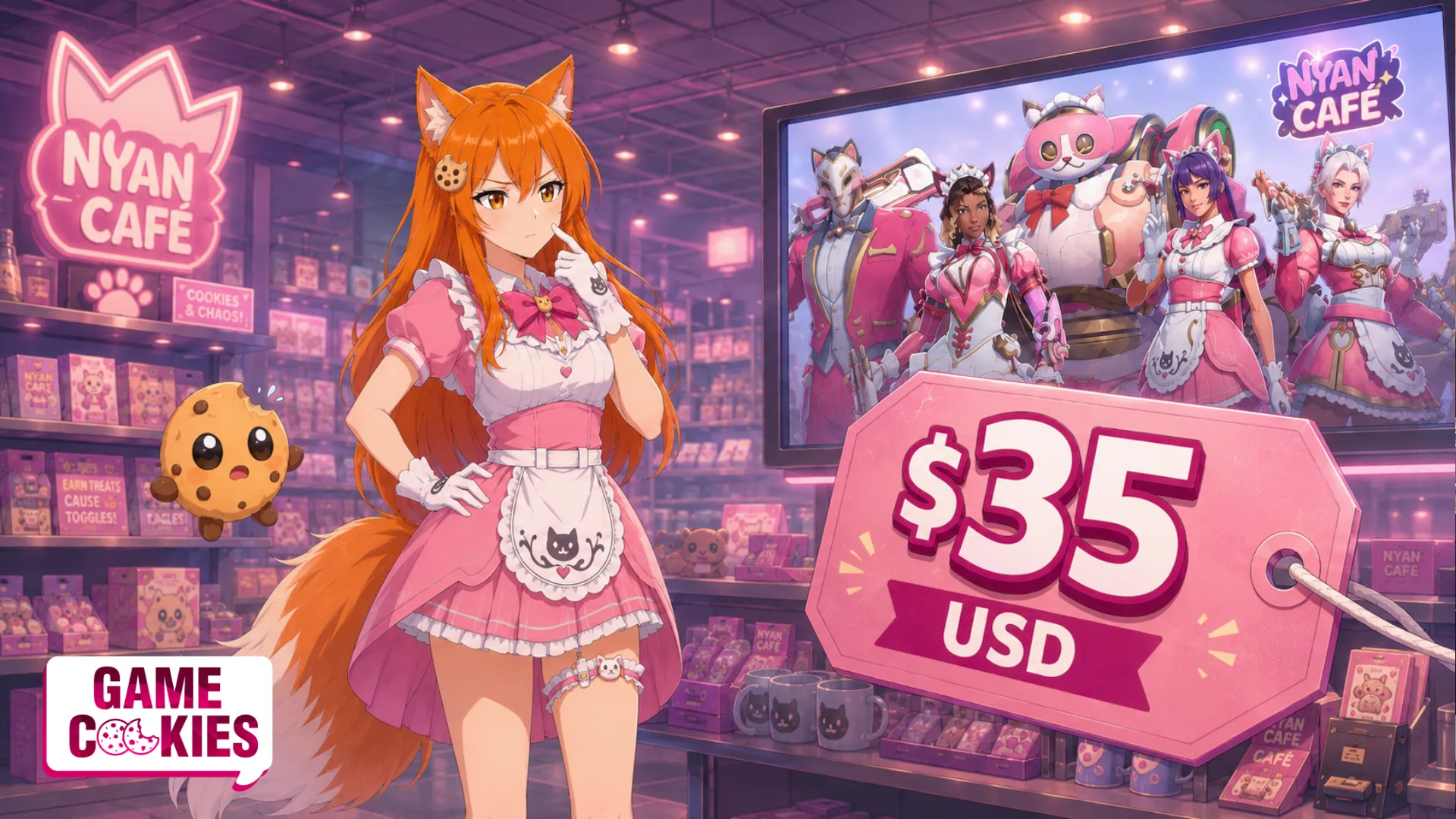
The part that detonated the community conversation was the price. The Nyan Café Ultra skins for Kiriko and Sierra cost 3,500 Overwatch Coins each, roughly $35 per skin. Individual bundles with extra cosmetics cost 4,500 Coins, around $40, while the full Nyan Café collection reaches 9,900 Coins, which effectively pushes players toward a $100 coin purchase. Dexerto framed the comparison bluntly: the full bundle costs more than the $80 needed for GTA 6.
What actually happened
Blizzard created a new premium cosmetic tier and launched it with a very marketable theme: cute cat café skins for popular heroes, extra VFX, custom sound work, and little details like cat-themed elimination effects. The pitch from Blizzard is that Ultra Skins give artists more freedom because they are not bound by the same customization requirements as Mythic Skins. In simple terms, Mythic is “choose your options,” while Ultra is “look at this finished premium skin doing extra stage effects.”
That creative argument is not empty. The Nyan Café skins do appear to have more production work than a standard recolor. Blizzard’s post describes custom elimination visuals, paw print details, themed reload effects, sound design, and even cat noises recorded from a developer’s real pet. There is actual craft here. The controversy is not that artists made something lazy. The controversy is that the price turns the art into a live-service stress test.
GosuGamers reported the shop pricing as 9,900 Coins for the full Nyan Café bundle, 6,900 Coins for the Kiriko and Sierra Ultra bundle, 4,500 Coins for each individual Ultra bundle, and 2,400 Coins each for the Reaper, Orisa, and Ashe skins. The Ultra Skins themselves cost 3,500 Coins individually, which puts them around $35 each.
📢 Key cookie crumb: Blizzard explained the new skin tier before players saw the actual price. Once the price appeared, the conversation stopped being about “artist freedom” and became about whether Overwatch just introduced a new ceiling for cosmetic pricing.
🦊 Kiki: I respect good artists. I respect animation polish. I respect a cat café skin that looks like someone in the VFX department had twelve coffees and a dream. But $35 for one skin is where my fox ears start detecting spreadsheet perfume.
Because the pitch is cute. The effect is cute. The cat paw is cute. The price tag walks in wearing a tiny finance department blazer and suddenly the whole café smells like quarterly targets.
And yes, before someone starts typing with Dorito fingers, cosmetic skins are optional. Congratulations, detective. Optional things can still be overpriced. A $35 cupcake is also optional. I am still allowed to stare at it like the baker has declared war on math.
🍪 Chip floats beside the shop screen wearing a tiny barista apron, sees the 9,900 Coin bundle, and immediately drops the imaginary latte.
Why players reacted so loudly
The backlash is not only about one skin costing more than some full games during a sale. It is also about the direction players think this points toward. GosuGamers noted that players quickly compared the price of a single Ultra Skin to the price of other games, while Reddit and social media discussions questioned whether future cosmetics would keep moving effects, animations, and premium details into higher-priced tiers.
That is the important split. Some complaints are simple sticker shock: $35 feels too expensive for one cosmetic. Other complaints are about tier inflation: if Ultra Skins become the home for the cool visual effects, then players worry Legendary skins will feel worse over time. When a company adds a new premium shelf above the old premium shelf, players naturally start checking whether the old shelf is about to get dustier.
There is also the live-service currency problem. Overwatch Coins, like many virtual currencies, do not map cleanly to exact purchases in the way normal money does. Once a bundle costs 9,900 Coins, the discussion is no longer just “is this worth $99?” It becomes “how much do I need to buy, how much is left over, and why does my wallet feel like it just got hit by a Reinhardt charge in a cosmetics store?”
🦊 Kiki: The phrase “it’s optional” has become the industry’s little cardboard shield. Publishers hold it up every time players notice the horse armor is now wearing designer shoes.
Yes, it is optional. So is ordering the giant nachos at the movie theater. But if the nachos cost more than the movie, people are going to look at the cheese with suspicion.
The player reaction is not mysterious. A lot of people can accept premium cosmetics. They have already been trained by Fortnite, Valorant, Apex, League, Overwatch, and every other live-service vending machine with lore. What annoys them is watching “premium” become “extra premium,” then “ultra premium,” then eventually “please finance this Mercy recolor over six convenient payments.”
🍪 Chip tries to calculate Coin conversion on a napkin, gets to “bonus currency,” and quietly lies down like a cookie who has seen too much.
The price is the headline, but the precedent is the payload
The real industry tension is that cosmetic pricing has become one of the safest places for publishers to push revenue. Raising the base price of games creates an obvious public fight. Everyone understands $70 becoming $80. Everyone sees it on the store page. Everyone argues about it before launch.
Microtransactions are more slippery. A publisher can adjust bundle contents, currency amounts, rarity tiers, event passes, shop rotations, and “value” packages without saying, “Hello, we increased prices.” The increase arrives wearing a cute theme, a bonus coin pack, a temporary offer, and three UI pop-ups gently whispering that you are technically saving money if you spend more.
GamesIndustry.biz spoke with analysts about pricing pressure going into 2026, and Ampere Analysis’ Piers Harding-Rolls specifically pointed to in-app purchases and in-game monetization as areas where further inflation could happen. His reasoning is simple: most spending across the games market comes from IAPs, and publishers can more easily alter bundle value than raise the headline price of a base game.
That makes Overwatch’s Ultra Skins relevant beyond Overwatch. This is not only a fandom argument about whether a cat maid Kiriko skin is worth the price. It is a live example of how publishers can create a new cosmetic category, define it as artistically special, and test whether the audience will accept a higher price floor.
⭐ Byte: The business pattern is clear. The global in-game purchase market was estimated at $144.1 billion in 2025, with projections reaching $346.8 billion by 2034. That includes consumables, subscriptions, durables, cosmetics, upgrades, and other in-game spending categories. The report also notes that free-to-play models rely heavily on in-game purchases as the primary revenue stream, especially for cosmetics and personalization.
In the U.S., total video game content spending reached $52.3 billion in 2025, including full games, DLC, microtransactions, and subscriptions. That means cosmetic pricing is not a side show anymore. It is part of the main economy of games. When a major shooter tests a higher cosmetic tier, other publishers do not just laugh from the balcony. They take notes. Some use pens. Some use calculators. The scary ones use dashboards.
🦊 Kiki: This is where the cat café becomes a boardroom. Somewhere, an executive sees a $35 skin and does not see Kiriko. They see “ARPU uplift.” They see “premium segmentation.” They see “high-intent payer cohort.”
Gamers see a cute skin. Finance sees a whale detector with ears.
And that is why people get loud. Because if this works, the next conversation is not “should skins cost $35?” The next conversation is “what tiny sparkle do we add to make $45 feel inevitable?” A reload animation? A victory pose? A pet? A little hologram that appears over your corpse and says, “Thank you for supporting shareholder confidence”?
Why the “cosmetic only” defense feels weaker now
Cosmetic-only monetization used to feel like the polite version of live-service pricing. If a skin did not affect gameplay, many players accepted it as the lesser evil. Better a $20 outfit than a paid weapon that ruins balance. That logic still matters. It is good that Ultra Skin effects do not appear to affect competitive play, and Blizzard was right to address that point directly.
The problem is that “cosmetic only” no longer ends the discussion. Cosmetics are part of identity, status, social display, event participation, and fandom. Players care about how their heroes look. Publishers know they care. That is why cosmetics are priced, bundled, timed, and marketed with such precision.
A skin can be non-pay-to-win and still be part of a pricing strategy that players dislike. Those are different complaints. One is about fairness in the match. The other is about fairness in the shop. Overwatch’s Ultra Skin controversy sits almost entirely in the second category.
There is also a trust problem caused by live-service history. Players have watched games reduce earnable rewards, add more currencies, create premium passes, create premium shop rotations, then create premium versions of premium cosmetics. After enough cycles, a new tier does not land as “more artist freedom.” It lands as “ah, the vending machine evolved again.”
🦊 Kiki: The word “cosmetic” is doing Olympic-level gymnastics. It used to mean, “relax, this does not affect gameplay.” Now it often means, “relax, the expensive thing only affects the part of the game you stare at for hundreds of hours.”
Great. Very soothing. My character identity, event hype, favorite hero fantasy, and social flex are all safely locked behind the small door labeled “optional.” Wonderful. Somebody give the door a little hat.
Nobody is saying artists should work for free. Nobody sane wants worse skins. But players can smell when a new rarity tier is less about solving a creative problem and more about giving the shop permission to stand on a taller chair.
🍪 Chip opens the “optional” door, sees five more doors labeled “bundle,” “bonus,” “limited,” “premium,” and “ultra,” then slowly backs out without blinking.
What to watch next
The next question is not whether the internet is angry. The internet is always angry. The next question is whether enough players buy the Ultra Skins to make the backlash irrelevant from a revenue perspective. GosuGamers reported that some players were already seeing the new Kiriko skin in matches soon after the update, and some commenters predicted that big spenders would support the tier regardless of criticism.
That is the uncomfortable business math behind almost every cosmetic backlash. A thousand angry comments can look loud, but a smaller number of high-spending players can still make the pricing work. If Ultra Skins sell well, expect more of them. If they sell well enough, expect other games to study the shape: add a new tier, attach extra effects, market it as creative freedom, price it above the old ceiling, and wait for the revenue chart to answer the Reddit thread.
The better version of this future is simple: premium skins stay premium because they offer genuinely premium work, clear value, and fair pricing. The worse version is also simple: every cool effect slowly migrates into higher tiers while ordinary cosmetics feel thinner. Overwatch is now testing which version its players will tolerate.
For Blizzard, the risk is not only one bad week of social media. It is that Overwatch already has a long and complicated relationship with monetization, player trust, and the shift from a boxed game identity to free-to-play live-service economics. Ultra Skins might be creatively fun, but the price makes them part of a much bigger industry argument about how far cosmetic monetization can stretch before the word “microtransaction” becomes a historical joke.
⚙️ Stay coin-aware like every player doing currency math with one hand and guarding the uninstall button with the other.
⚙️ Keep checking the bundle contents like Chip inspecting a $100 cat café menu for actual food.
⚙️ And remember: if the cat paw costs $35, your wallet is allowed to hiss back.
🦊 Kiki · 🍪 Chip · ⭐ Byte · 🦁 Leo
Tips, leaks, and suspicious shop bundles: contact us here!