

Hello there, ocarina loyalists, Hyrule wanderers, and impossible-to-please nostalgia hoarders…
We will probably buy it. We will probably enjoy it. We already wish Nintendo had aimed higher. That is the uncomfortable Game Cookies reaction to the September 8 Zelda anniversary Direct and its closer look at the Ocarina of Time remake, coming to Nintendo Switch 2 on November 5.
Plenty of viewers are delighted. Today’s trailer discussion contains praise for the environments, bosses and character designs, while the gameplay thread includes enthusiasm for a faithful return with modern conveniences. This is our hot take from inside that celebration. The comments cited here illustrate reactions, not a representative verdict on what most players think.
Our worry runs deeper than Link’s porcelain face, although Kiki has prepared complaints for that department too. Ocarina once made Hyrule feel astonishing. A remake could let the people who know its secrets discover a larger, richer adventure and give a new generation its own sense of possibility. Today’s showing left us expecting a familiar journey we will enjoy, finish and move on from, rather than another moment that changes what Zelda can be.
That is a prediction about its ambition, not a finished-game review. It comes from loving Ocarina with an unreasonable amount of our souls. The frustrating possibility is that Nintendo may have made something we want to buy while leaving the remake we hoped for unexplored.
What Nintendo actually added
Nintendo’s product description confirms rebuilt visuals, voiced cutscenes, expanded dialogue and orchestral music. It also lists jumping, dashing and modern camera controls. Those are real changes, even if none is the additional dungeon or substantial new quest a returning player hoped to see.
The official UK game page adds motion aiming, microphone-based ocarina input and Threads of Time, a way to follow the story and objectives. These features deserve evaluation on their own terms. A recap system can improve usability without creating a new questline.
The material examined here has not established substantial new regions, new dungeons or a comprehensive restoration of abandoned content. Expanded dialogue could deepen familiar scenes; the adventure’s full scope remains unconfirmed.
The complaints behind the argument
– Link’s porcelain finish. In today’s Ocarina subreddit discussion, TheWhistlerIII compares Link to a “porcelain doll.” Other participants object to glossy skin. The complaint concerns how a living character reads on screen, rather than a measurable shortage of graphical detail.
– The market and principal cast seem to follow different rules. In the first-look discussion on r/zelda, slash450 objects to the contrast between Link’s detailed clothing and smoother townspeople. cmcg18 likes the Castle Town NPCs but dislikes Link, Zelda and Saria. Calling the market faces the same N64 polygons goes beyond the evidence: apparent simplicity cannot establish that Nintendo reused the original geometry.
– Zelda and Saria divide viewers. The same first-look thread includes criticism of Link’s facial proportions, including round cheeks and widely spaced eyes. Our objection is the soft, doll-like treatment of the central cast. Yet in the gameplay discussion, wirelesswizard64 dislikes Link’s plastic-looking face while praising Saria’s expression. Even people unhappy with Link do not necessarily dislike the same characters.
– Epona’s face and mane. The Epona comparison thread includes objections to an uncanny or dopey expression and a mane that some find awkwardly shaped. Defenders read the design as a modern version of the original’s whimsy. We find the result odd, too; a stylized horse does not have to look realistic, but its face, proportions and hair still have to persuade us that they belong together.
– Kokiri clothing feels overdesigned to some viewers. In the reveal highlights discussion, Divinakra dislikes the knitted look and glossy skin, while matiko92 questions the hat’s flowers and adult Link retaining the material. A reply argues that handmade clothing suits forest inhabitants. Divinakra accepts that logic while preferring linen. The disagreement is about taste and storytelling through costume, not a proven rule that Kokiri must wear undecorated fabric.
– Extra detail can weaken a familiar silhouette. Replies in the r/zelda discussion disagree over whether the faces honor the original drawings. That is a more useful question than whether the new version has more detail. An added surface pattern can communicate culture; it can also compete with the shape that made a character instantly legible.
– Some familiar friction may survive. The gameplay thread also contains complaints about item scrolling and transitions, alongside requests for an option to disable voice acting. These are reactions and requests. They do not establish the final control options, the absence of a voice toggle or the performance of the shipping game.
🦊 Kiki:
This porcelain finish sucks. Link looks ready to save Hyrule provided nobody knocks him off the mantelpiece. Then the market crowd arrives with those much simpler faces, and suddenly I am trying to work out which characters belong to the same game. Zelda and Saria get the same complaint from me: all that softness is sanding away the character I wanted to recognize. Epona makes me want to pause and rearrange the mane. Yes, whimsical designs can work. I love that freedom. Give the entire cast a coherent set of rules and let the faces act within it. At the moment, I keep expecting the Master Sword to arrive wrapped in tissue paper.
🍪 Chip slides a folded cloth beneath a small ceramic hero and backs away from the shelf.
The people celebrating have a real case
– The world is winning people over. In the Switch 2 release discussion, supporters welcome a realistic but whimsical Hyrule and a look distinct from Breath of the Wild and Tears of the Kingdom. A remake has room to pursue its own identity, even when that identity divides returning players.
– Familiar oddness can be deliberate. Some r/zelda commenters see fidelity to the original drawings where critics see strange proportions. Secret_Drawer4588 likes the leaf clothing because it suggests children living in the woods. That reading deserves an answer, rather than dismissal as blind loyalty.
– Expression and atmosphere can land independently of Link. The gameplay discussion includes praise for Saria’s emoting, landscapes and adult Ganondorf. Disliking a lead character’s face does not require pretending every shot fails.
– Preservation has a design argument. In the Ocarina subreddit, FillySteveSteak defends the streamlined structure that makes classic Zelda replayable. Boodger describes the remake as what they wanted. Extra traversal and longer quest chains could become padding if they interrupt the original’s momentum. A familiar, carefully modernized adventure can be a valid goal.
🦊 Kiki:
The Kokiri outfits are doing too much for my taste. I wanted a raw, practical tunic with a clean silhouette, and now I am inspecting trim while a giant tree has an urgent medical situation. The leaf-and-handmade defense is perfectly reasonable. Forest children can make beautiful things. I am withdrawing the imaginary law against woodland embroidery before someone makes me defend it. My complaint survives that correction: the ornamentation pulls my eye toward the costume when I want the character and the forest to do the work. Nintendo can tell me something about Kokiri life through clothing. I would prefer that message to arrive without Link looking dressed for the launch of an artisanal woodland collection.
🍪 Chip catches a dangling ribbon on a twig and slowly unwinds it from the branch.
The fan projects made us imagine another Hyrule
RwanLink’s Castle Town film, originally published in 2023 and now titled What if Zelda Looked Like a Ghibli Movie?, offers a Ghibli-inspired environment and animation made in Unreal Engine 5. In the scenes we examined, Link and the townspeople share outlined faces, broad clothing colors and cel-like shadows. That consistency supports our preference for its illustrated world. This is a fan film and environment showcase, not a complete playable replacement for Ocarina of Time.
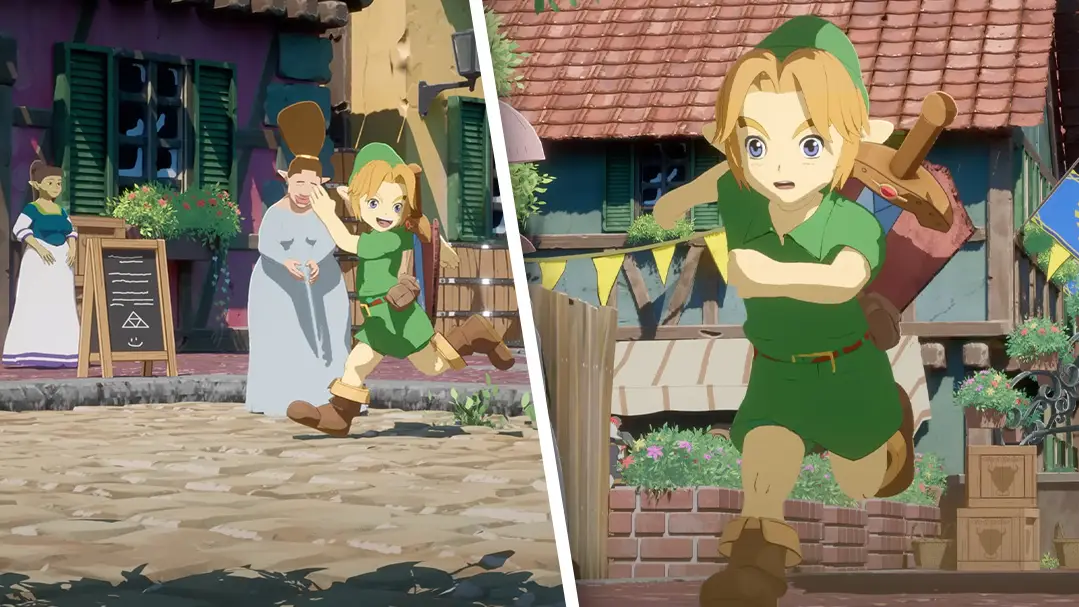
CryZENx’s project catalogue documents playable recreations, including dungeon and boss work. That gives the comparison more substance than an attractive still. It still does not establish a finished commercial game with every area, system and supported hardware condition accounted for.
Game Cookies prefers RwanLink’s unified storybook direction. Different production obligations limit the comparison, but the visual alternatives deserve discussion.
There is an inconvenient receipt for anyone trying to recruit the fan creators into the backlash: CryZENx welcomed Nintendo’s announcement in June. He later said his Ocarina project had stopped. Those posts do not establish that Nintendo forced him to stop, and his June enthusiasm should not be presented as a reaction to today’s gameplay.
🦊 Kiki:
RwanLink gives me a stronger artistic answer. I can look at that Castle Town and understand the picture the project wants to become. That is what I wanted Nintendo to make me feel. CryZENx went further into playable spaces, which makes the usual shrug at fan work especially irritating. Fine, a finished retail adventure carries obligations that a showcase does not. Keep that distinction. Now explain why acknowledging it should cancel the visual comparison. Nintendo can survive being compared with people who love its game enough to rebuild it. And CryZENx praising the official reveal is allowed to annoy my argument. I wanted better character art; I did not order a fan creator to testify for the prosecution.
🍪 Chip turns two miniature stage sets toward the same lamp and props up the one that starts to wobble.
The audience has explored a different kind of Zelda
Nintendo’s older games were designed for the hardware, conventions and expectations of their own moment. Their strengths can endure while the market around them changes. Our concern is that a faithful return inherits the original’s boundaries as well as its brilliance. Nostalgia can make familiar places feel enormous to us; a first-time player does not arrive with that memory doing part of the work.
Breath of the Wild invites players to choose their routes, climb and glide across Hyrule. Tears of the Kingdom extends exploration through sky islands, the surface and the Depths, with tools for constructing and combining objects. Those games can shape what someone expects when the next box says Zelda, even if Ocarina belongs to a different design tradition.
A player arriving from those adventures may experience a closely preserved Ocarina as smaller or more restrictive, perhaps even as a step backward. That risk concerns freedom and discovery as much as acreage. Someone who already knows the route may race through beloved moments and move to the next game. Neither response is inevitable; both are reasons we wanted Nintendo to show more ambition.
The strongest objection is that a compact world with carefully authored dungeons can offer exactly what sprawling games sometimes lack. More terrain can dilute pacing. We are asking for discoveries worth making and characters worth knowing better: optional routes, encounters with consequences and deeper relationships. Empty fields would make a bad answer to this criticism.
Star Fox is the warning hanging over this return
Star Fox returned on June 25 with new cinematics, challenges, control options and multiplayer features. It still prompted a familiar tension. Game Informer’s review enjoyed the remake while wishing the series could move beyond another retelling; GameCritics’ July 27 review likewise praised the enduring play while criticizing its cautious ambition.
Our fear is the Star Fox pattern: a burst of recognition, an enjoyable reunion and the lingering wish that Nintendo had taken us somewhere new. The comparison concerns creative ambition, rather than equal campaign lengths or proof that either audience stopped caring. An arcade shooter built for repeat runs and a Zelda quest earn their replay value differently.
For Ocarina, familiarity could be enough to sell us the return and too little to recreate the original’s historical impact. We expect plenty to enjoy. We are much less convinced that the remake shown today will become the kind of landmark its inspiration was. Nintendo still has the chance to make that prediction look foolish; we would welcome the embarrassment.
This was the chance to make the legend feel bigger
The opportunity feels painfully obvious: preserve Ocarina’s emotional spine while expanding what happens around it. Make the kingdom more epic through events we participate in, make its people deeper through time spent with them, and let experienced players lose their bearings somewhere new. Today’s presentation feels like an opportunity slipping away, even though the final extent of its additions remains unconfirmed.
The wish for more exploration is visible in today’s Ocarina discussion: blayne1992 wanted restored material and greater expansion, while NotawoodpeckerOwner wanted activities or small dungeons in Hyrule Field. That is a concrete demand for new things to do, beyond renewed presentation.
There is real historical support for unrealized ambition. In Nintendo’s Iwata Asks interviews, Shigeru Miyamoto describes uncertainty over how much the team could fit within the Nintendo 64’s fixed memory. Another original-developer discussion recalls planned horseback duels that did not make Ocarina and later appeared in Twilight Princess. It also describes persistent-footprint ideas for the 64DD and the importance of fast data access to Link’s animation. Storage capacity was only part of the development problem; those accounts do not describe a complete extra campaign waiting to be unpacked.
Our wishlist would start with optional side stories that deepen Saria and the Kokiri, changes in familiar places that make the passage of time hit harder, and worthwhile spaces along Hyrule Field’s routes. A new dungeon should develop a strong mechanic. A longer road should lead to an encounter worth the ride. These are proposals, not announced features or a list of documented cuts.
Abandoned ideas still need evaluation: restore what enriches the adventure, redesign what needs work, and consider a bonus gallery for the rest. Substantial optional additions could preserve the original campaign route while giving returning players more to discover.
Halo: Campaign Evolved added a three-mission adventure and expanded its sandbox. That makes it a relevant comparison for the risks of changing a classic, but the feature list cannot settle whether those additions worked. Disliking Halo’s execution does not prove that expansion is doomed, and liking the idea of expansion cannot excuse bad pacing. Each new section has to justify its place in the game it joins.
🦊 Kiki:
I am angry because I love this game enough to want another historic moment from it. Give me more Kokiri life before the world changes. Make the seven-year leap hurt. Let Hyrule Field lead to something I cannot navigate from memory. Instead I am bracing for my Star Fox cycle: buy it, grin, complain, finish, move on. I can hear myself becoming that Star Wars fan who loves a universe so much every new thing arrives for an interrogation. Fine. I will probably buy this, enjoy it and hate what it could have been. Put all three reactions on the customer survey. My purchase will tell Nintendo that nostalgia worked; it will barely register the adventure I wanted. I wanted to get lost again. Stop giving me guided tours of a house whose keys I already own.
🍪 Chip unrolls a familiar map, reaches its worn edge and nudges a blank sheet underneath it.
Let us be wrong about the next chapter
We expect to enjoy this remake and still wish it had become another defining moment. People celebrating the reveal deserve their excitement. Our affection comes with less comfortable expectations.
Perhaps the movie will create a fresh wave of discovery around Hyrule. Nintendo now plans its worldwide theatrical release for April 30, 2027. We are skeptical that the film will supply the epic reinvention we wanted from this game, but its quality and influence remain open questions. A great adaptation could bring new people to Zelda; the remake would still have to win them over through what they can actually play.
We wanted veterans to find new memories and newcomers to feel the wonder we keep describing. Today’s reveal has not convinced us it will go that far. Let the finished adventure prove these annoyed old fans wrong.
🍪 Missed part of the gaming week?
The Sunday Cookie Box delivers five handpicked Game Cookies stories in one free Sunday email.
⚙️ Stay demanding of the worlds you love.
⚙️ Keep your nostalgia close and your standards awake.
⚙️ And remember: loving a legend leaves room to want another.
🦊 Kiki · 🍪 Chip · ⭐ Byte · 🦁 Leo
Tips, leaks, and suspicious Kokiri tailoring: contact us here!