


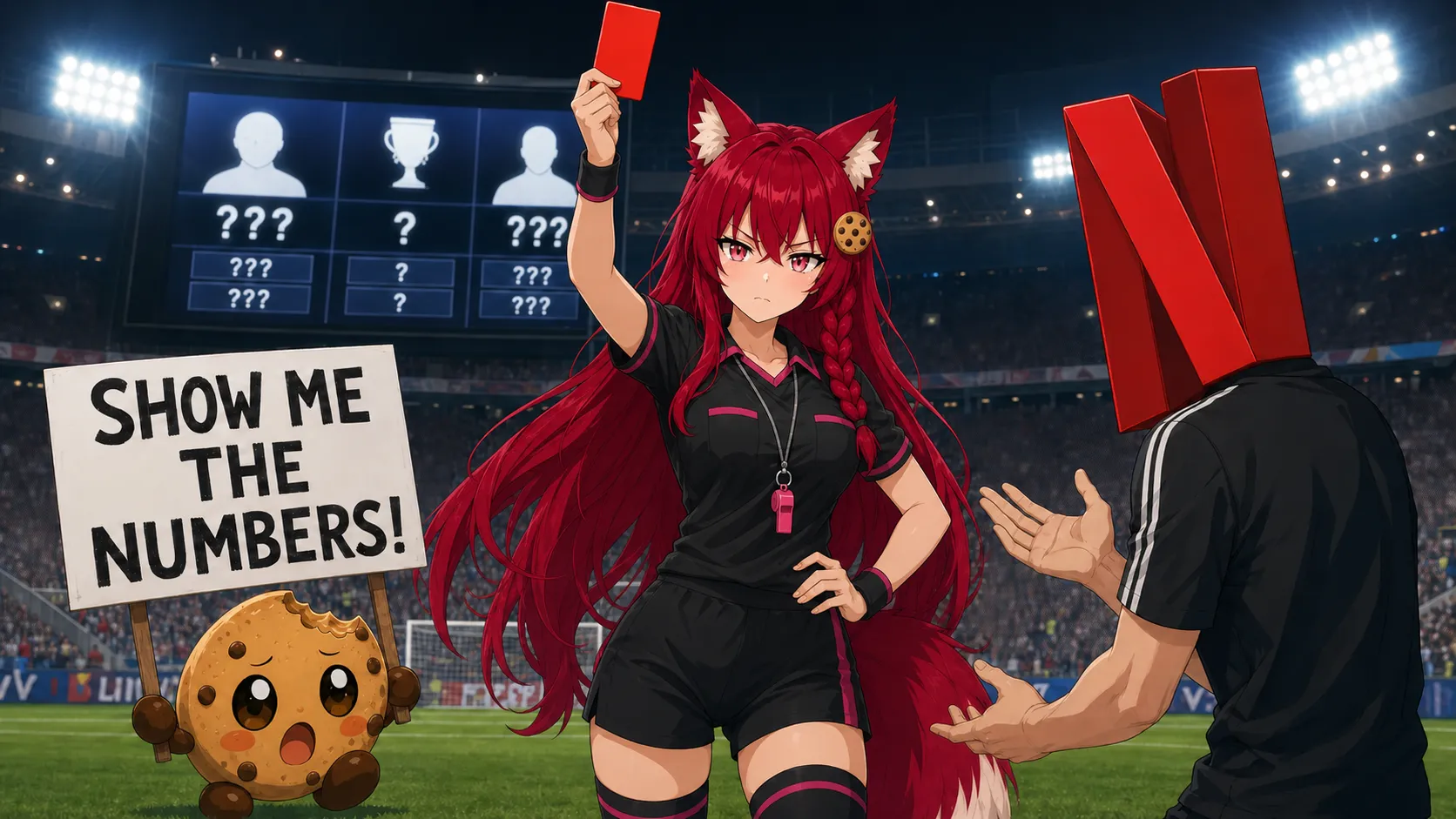
Hello there, cookie munchers, football romantics, cloud believers, and everyone who has ever watched a company celebrate a victory while keeping the scoreboard pointed at the wall.
Netflix used its second-quarter 2026 earnings update to praise FIFA World Cup: Launch Edition. Co-CEO Greg Peters said FIFA and Unhinged produced the company’s two most successful cloud-game debuts and placed them in the “top tier” of game performance on Netflix. He also said monthly active players for Netflix cloud games had increased 11 times since the company scaled the initiative in October 2025.
Those claims arrived beside one stubborn omission. Netflix did not provide the number of monthly players, gameplay hours, repeat sessions, match completions, or the retention result behind “higher retention value.” Game Developer highlighted the same gap: the company supplied impressive multipliers and rankings without the raw totals required to test them.
🦊 Kiki: Top tier. Beautiful. Netflix graded its own homework, hid the questions, then put the gold star in the earnings deck.
Eleven times more players than… a number it will not disclose. By that math, I am eleven times richer than the cash I refuse to show you. Somebody alert Forbes.
🍪 Chip asks for the scoreboard. Netflix sends a pie chart titled Vibes.
The game was easy to start and hard to defend
Netflix launched the game on June 11, alongside the World Cup’s opening day. It was included with a Netflix membership and built around an unusually accessible pitch: open Netflix on a television or computer, use a phone as the controller, and play alone or with as many as four people. The official package included 48 national teams, 1,248 players, and 16 tournament stadiums.
The friction was low. The critical response went in the opposite direction. VGC awarded the game 1 out of 5, criticizing weak artificial intelligence, unreliable commands, dated presentation, three limited modes, and the absence of difficulty options. FourFourTwo described an awkwardly retro experience with repeated commentary and no traditional gamepad support. Aftermath went considerably harder, calling the whole experience an embarrassment.
Netflix had already built an escape hatch into the name. “Launch Edition” described a streamlined starting point that would gain depth, complexity, and technical improvements over time. Netflix’s own explanation framed the release as a kickoff rather than a finished destination. Players, however, could only judge the match placed in front of them during the tournament it was designed to accompany.
Netflix won the metric it chose
“Most successful cloud-game debut” is a relative ranking inside Netflix’s own young catalog. It does not compare FIFA with EA Sports FC, eFootball, console launches, Steam releases, or the wider sports-game market. It says two June releases outperformed Netflix’s earlier cloud debuts according to an internal measure the company did not define publicly.
The 11-times figure is broader. Peters said monthly active players across Netflix cloud games had grown elevenfold over eight months and that adoption was progressing faster than the company’s earlier mobile-game rollout. Netflix also said retention was stronger. None of those statements identifies FIFA’s individual audience, how often those players returned, or whether the World Cup game kept them after the novelty of using a phone as a controller wore off.
⭐ Byte: An 11-times multiplier establishes direction, while the missing starting value hides scale. Growth from 1,000 monthly players to 11,000 and growth from 1 million to 11 million produce the same multiplier and describe completely different businesses. Monthly active players also count qualifying users, not hours per person, matches completed, satisfaction, or next-month retention. Netflix confirmed acceleration. It did not disclose the size or durability of FIFA’s contribution.
A weak review and a strong debut can coexist
The reviews and Netflix’s engagement claim answer different questions. A review examines the game placed in front of a critic. A debut metric can measure how many people opened it, sampled it, or returned within a chosen window. Huge distribution, a famous license, tournament timing, and no additional purchase at the point of play can generate curiosity even when the product disappoints the people who try it.
Netflix controls an enormous discovery surface. The game sat inside a service members already used, arrived during the world’s biggest football event, and needed no console purchase or separate game transaction. Netflix also promoted it through its own stars and a live Couch Cup. Every layer reduced the distance between seeing FIFA and starting a match.
That funnel can create a real launch success. The unanswered question begins after activation. How many curious members finished a match? How many returned the following week? How many played after the World Cup final? How many would recommend the game if it carried a separate price? Netflix’s public language stops before those answers.
🦊 Kiki: Of course people clicked it. FIFA was on the box, the World Cup was on the calendar, and the price at the door was zero. People also press the red button marked DO NOT PRESS. Curiosity is not a standing ovation.
Netflix watched the QR code scan and called it love. Calm down, Casanova. We opened the game. We did not write our vows.
🍪 Chip opens the game, scores from midfield, and checks whether the goalkeeper has finished buffering.
Eleven times an unknown number is still an unknown number
Netflix’s wider gaming update repeated the same presentation style. The company said Netflix Playground, its children’s game app, had tripled daily players since April. It also reported 600% year-over-year growth in engagement for children’s mobile games, while acknowledging that the growth came from a small base. The direction is encouraging. The audience size remains unavailable.
Relative growth works well during an early experiment because it highlights momentum before the absolute business becomes large. It also lets incompatible measures sit together. Daily players, monthly active players, adoption curves, engagement, and retention each describe a different part of the funnel. Stack them into one celebratory paragraph and they sound like a completed strategy.
Reach. How many Netflix members saw the game and could access it on a compatible device?
Activation. How many started a session, connected a controller, and completed the opening steps?
Engagement. How many matches and gameplay hours came from each active player?
Retention. How many returned after one day, one week, one month, and the end of the tournament?
⭐ Byte: Netflix disclosed three multipliers across its gaming update: 11 times for monthly cloud players, 3 times for Netflix Playground daily players, and 600% year-over-year growth for children’s mobile-game engagement. Each uses a different population, period, and measurement. They cannot be combined into one growth rate, and none reveals FIFA’s raw player count. The safe conclusion is that Netflix gaming activity increased across several internal measures.
🦊 Kiki: Eleven times. Eleven times what? Three cousins and a Chromecast? A Tuesday support group?
Corporate percentages are house cats: they look enormous when photographed next to a tiny cup. Show Byte the denominator before this kitten gets announced as a lion.
🍪 Chip enters 11× into the calculator. The answer comes back: please provide a number.
FIFA supplied the event, Netflix supplied the funnel
Netflix is testing a distribution advantage rather than competing only through traditional game quality. A television app already installed in millions of homes can turn entertainment into a menu choice. A phone removes the need for extra controllers. A subscription removes the price decision. A global sports license supplies instant recognition. The company can place a game beside shows, films, and live programming without asking a player to visit a specialist storefront.
Netflix’s support page describes FIFA as a cloud game for televisions and computer browsers with no offline play. That delivery model gives Netflix direct visibility into every supported session. It can see discovery, activation, device behavior, play length, return patterns, and abandonment more clearly than an outside analyst. The company possesses the scoreboard. It simply chose to publish the cheering section.
Peters also described Netflix’s current gaming investment as very small relative to its overall content spending. That context changes the internal definition of success. A modest cloud game can validate device support, phone controls, discovery, and household multiplayer without matching the economics of a major console release. Netflix may have learned something valuable even if FIFA never became a beloved football game.
The next update needs a public scoreboard
Netflix can protect sensitive detail and still publish raw monthly active players, total gameplay hours, average hours per active player, and a defined retention window. Those figures would establish scale and durability.
Netflix should also define the benchmark: all service games, cloud-only titles, quarterly launches, or results adjusted for regional and device availability. A World Cup promotion should not share an unlabeled comparison pool with quieter catalog titles.
Session data proves arrival. Surveys, support complaints, reviews, and long-term retention help show satisfaction. Distribution can generate sampling. Product quality decides whether that convenience becomes a habit.
🦊 Kiki: Netflix owns the stadium, the broadcast, the turnstile, the controller, and now the referee. Naturally, Netflix won.
Show us the score. Until then, “top tier” is the business equivalent of a kid yelling 10-0 while carrying the ball home.
🍪 Chip requests VAR. Netflix classifies the replay as proprietary engagement data.
In the end…
FIFA World Cup: Launch Edition may genuinely rank among Netflix’s strongest gaming launches. Its famous license, World Cup timing, and subscription placement created a powerful funnel. Several critics still found the game thin, dated, and undercooked. Both results can coexist.
Eleven-times growth without a starting number shows acceleration without scale. Higher retention without the rate shows direction without durability. The cloud experiment deserves attention, and the victory lap needs receipts. Netflix holds the player, session, and retention data. Until some of that scoreboard becomes public, “top tier” remains confidence without a benchmark.
⚙️ Stay curious when a company celebrates a result without showing the scoreboard.
⚙️ Keep separating reach, activation, engagement, and retention before calling any launch a success.
⚙️ And remember: a percentage without a denominator is a victory parade looking for a final score.
🦊 Kiki · 🍪 Chip · ⭐ Byte · 🦁 Leo
Tips, corrections, and performance metrics that escaped the earnings deck: contact us here!