


Hello there, claw sharpeners, fence inspectors, and frustrated mutant escape artists…
Marvel’s Wolverine arrived on PlayStation 5 on September 15, bringing Insomniac Games’s version of Logan into a single-player, story-led adventure. PlayStation describes the game as a deliberately bounded experience rather than an open world. That choice leaves a sharper question than map size: how convincingly does its world respond to the character players are controlling?
A superhero game makes a promise every time it puts extraordinary abilities in your hands. Its levels, enemies, and obstacles determine how much of that promise survives outside a cutscene. Wolverine’s reception offers a useful case study: reviewers can enjoy the violence and spectacle while finding the opportunities to act surprisingly narrow.
The fence that exposes the bargain
TechRadar’s Matt Cabral describes a specific inconsistency: Logan can climb trees yet sometimes cannot scale fences, crates, or walls. Cabral still enjoyed the combat and narrative, while criticizing the limited depth and heavily scripted structure. His favorable assessment gives the traversal complaint weight without turning it into a universal verdict.
Every action game draws boundaries. A believable obstacle helps players understand the space and choose a response. An ordinary object that becomes impassable only when the designer needs it to can pull attention away from the fiction and toward the invisible rules underneath it. For a hero defined by physical capability, that interruption carries an extra cost.
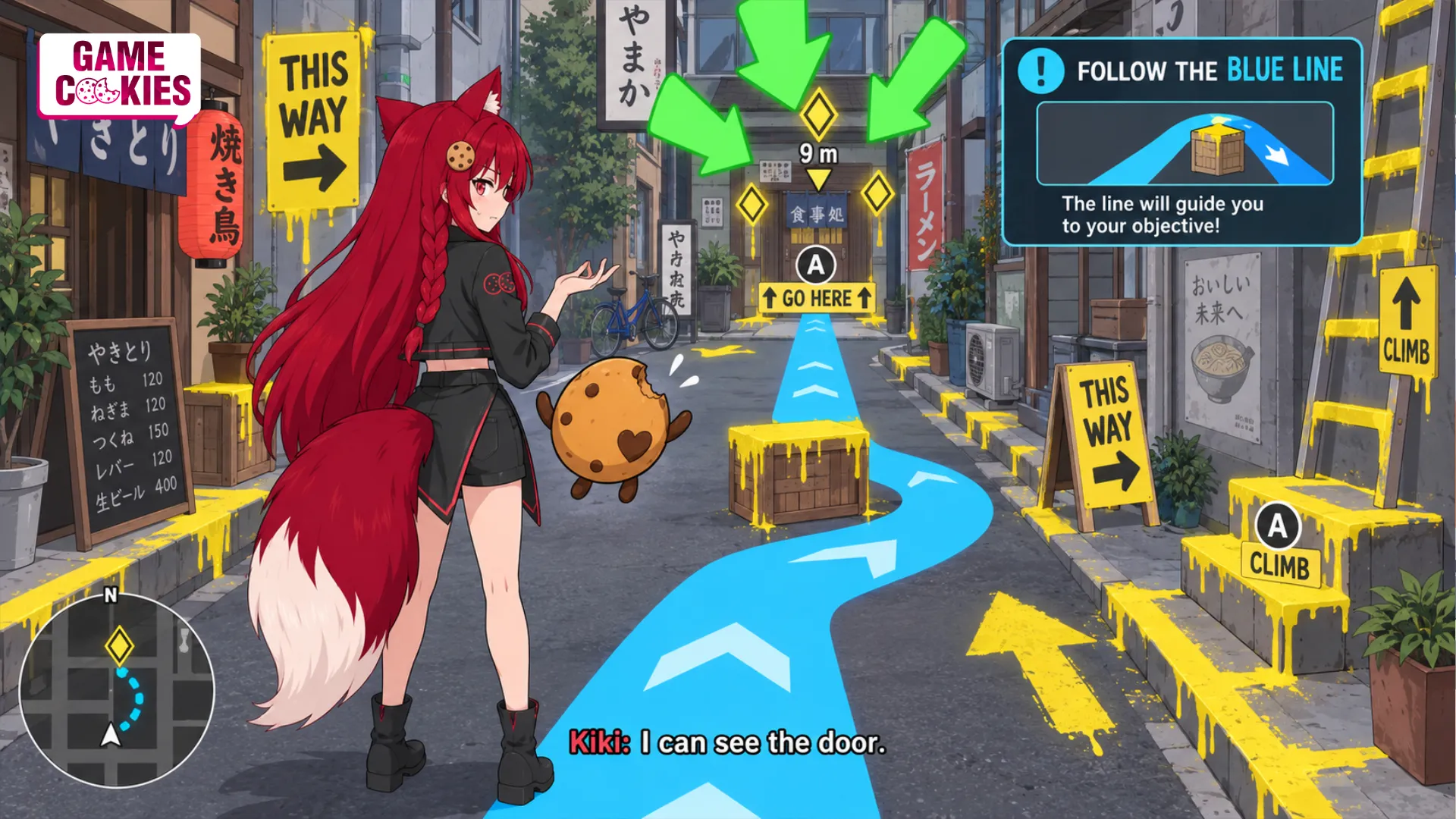
🦊 Kiki: Give Logan a fence he cannot climb and you have created a very expensive question. Those claws were apparently cleared for dismemberment but rejected by the traversal department. I can accept a locked route. Show me a collapsed tunnel, an active threat, something that makes the restriction belong in the world. A perfectly ordinary barrier asks me to pretend I have forgotten the character on the box. And yes, I am exactly petty enough to spend longer testing the fence than following the objective. Congratulations, the mission is now a building inspection. Let the level challenge his abilities. Making him wait for permission turns the claws into rented equipment.
🍪 Chip unfolds a tiny stepladder beside the fence.

Teach the player a rule worth trusting
Visual guidance is part of this bargain. A repeated color, surface treatment, or movement cue can teach players where an action works. Once they learn that language, they reasonably test similar-looking objects. Consistency lets them concentrate on timing and decisions; inconsistency makes them stop to ask which exception the designer intended.
That principle does not require every yellow object to be climbable, or every failed jump to count as a design error. Context, camera framing, prior instruction, and available settings all affect what a scene communicates. A short failure clip can raise a question, but it cannot by itself establish how the entire game teaches traversal.
For Wolverine, the independently reported movement restrictions provide a firmer starting point. The useful test is whether the player can anticipate an obstacle’s behavior before colliding with it. A linear game can pass that test beautifully. Freedom to make a meaningful decision can exist inside a small room.
🦊 Kiki: I am happy to learn your game’s rules. I will even tolerate the glowing breadcrumb trail while I learn them. But once you teach me that a particular surface means “try this,” I am going to try it. That is the bargain. If the answer changes, give me a reason I can see. Otherwise we are playing a guessing game in which the correct answer lives in somebody else’s level editor. Accessibility cues can help enormously; using them consistently is the whole point. My controller came with buttons. The telepathy attachment must have been sold separately.
🍪 Chip holds a yellow paint swatch against the fence and tilts it sideways.
When progression postpones the good part
GamesRadar+ reviewer Leon Hurley identifies a different restriction: the ability to parry multiple simultaneous attacks arrives relatively late. He describes a substantial improvement once that skill becomes available. Hurley also praises the Tokyo section for giving exploration, investigation, and combat a stronger sense of purpose, despite finding much of the wider experience underwhelming.
Those observations suggest a more precise criticism than simply asking for a bigger map or more unlocks. Progression needs to make the developing combat system rewarding along the way. If an upgrade resolves friction players have endured for hours, its arrival can feel like relief as much as growth. That judgment depends on the encounters before it, not merely the size of the eventual move list.
🦊 Kiki: An upgrade should make me excited about what I can do next. I get suspicious when its main achievement is making an earlier annoyance disappear. “Keep playing, it gets good” is a remarkable sales pitch for something already occupying my evening. I understand teaching moves gradually. Dumping the entire combat manual on the opening fight would be miserable. But the starter version still needs to feel deliberately satisfying. Let me grow into a monster; give me interesting choices while I get there. Do not make the exciting part of the character a loyalty reward for surviving the less exciting part.
🍪 Chip tries to pin an oversized gold star onto a locked toolbox.
Logan can have feelings and still need better scenes
In PlayStation’s interview with the development team, narrative director Walt Williams describes the importance of Logan’s compassion alongside his rage. Creative director Marcus Smith says Wolverine’s identity led the team toward a different experience from Spider-Man. Their stated ambition includes emotional connection as well as physical ferocity.
That ambition is defensible. A wounded, conflicted hero can carry an extraordinary action story. The critical questions concern execution: whether relationships develop through consequential choices, whether humor fits the speaker, and whether scenes give an emotional payoff enough preparation to land. Disliking a scene does not establish why an individual writer made it, much less prove a demographic theory about the production.
The reviews also resist a simple consensus. Cabral responds positively to the characterization; Hurley finds the plot less coherent. Both readings can inform a discussion of the game without pretending either one measures every player’s response. The article’s criticism rests on identifiable design decisions and attributed assessments, not an invented referendum.
🦊 Kiki: Let Logan care about people. Give him something to lose. Then trust the scene enough to let us feel it. I want characters making choices that cost them, not a running explanation of which emotion deserves my attention next. And the comedy has to belong to the person saying it. A joke can reveal a character, dodge an uncomfortable truth, or simply land beautifully. When everyone sounds ready for the same trailer montage, somebody needs to leave a little silence in the script. I am extremely available for unnecessary commentary. The man with the claws can afford to take a shift off.
🍪 Chip lowers a miniature microphone into a padded box and closes the lid.
What the claws should buy you
Wolverine does not need unrestricted movement or an endlessly branching story to deliver its fantasy. It needs boundaries that make sense, readable opportunities to act, and a combat system whose early stages justify the time spent reaching its later ones. Its emotional story deserves the same scrutiny: judge what the scenes accomplish, with room for honest disagreement.
Enjoying a game does not invalidate a specific criticism. Finding a weak mechanic does not erase someone else’s enjoyment. The strongest case here survives both concessions: when a game puts extraordinary power in the player’s hands, ordinary interactions should help sustain the illusion. Otherwise the scenery gets the last laugh.
🍪 Missed part of the gaming week?
The Sunday Cookie Box delivers five handpicked Game Cookies stories in one free Sunday email.
⚙️ Stay curious about the rules hiding behind the spectacle.
⚙️ Keep testing whether the world respects the abilities it gives you.
⚙️ And remember: the fence should never be the most convincing villain.
🦊 Kiki · 🍪 Chip · ⭐ Byte · 🦁 Leo
Tips, leaks, and suspicious unclimbable fences: contact us here!