

Hello there, marshmallow astronauts, reckless pilots, and anyone who has ever paused a game to ask why the marker is pointing at a wall. Today we’re talking about Outer Wilds and the surprisingly low-tech way its creators tested whether you’d want to solve its biggest mystery.
An early version of Outer Wilds already let people fly around a small solar system. But a player could have fun exploring it without ever piecing together the mystery Alex Beachum and his collaborators had in mind. Most of that story wasn’t in the alpha. Building it all into the game would be a lot of work, and the team still had to find out whether players could make the right connections without someone pointing them toward the answer.
Beachum reached for paper. Then he made a text adventure.
A marshmallow was enough to start with
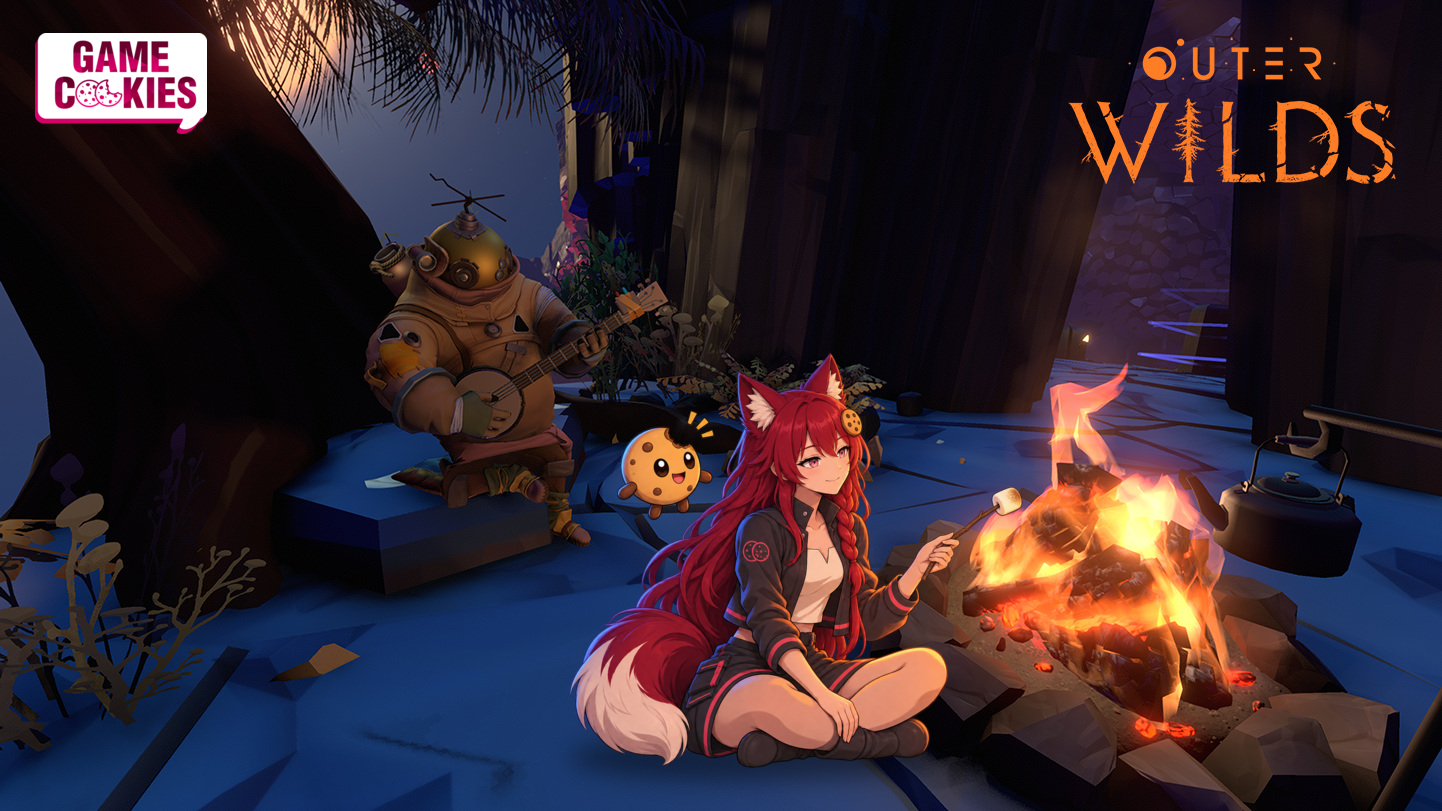
Outer Wilds began as Beachum’s graduate thesis at USC. In the Mobius team’s account of development, some of its first experiments were tiny: lift off in a shuttle, find a cabin that moves when you look away, or roast a marshmallow on a small moon while watching a supernova. That last one gets at the mood better than a page of marketing copy. You’re doing something wonderfully ordinary while the universe reminds you how small you are.
It’s easy to imagine a demo getting a great reaction to that moment. It’s harder to know what anyone will do five minutes later. Will they fly toward something they noticed, or wait for a mission to pop up? A striking scene can make someone want to play. A question they can pursue gives them a reason to keep playing.
🦊 Kiki: “I can make an explosion look expensive and you’ll probably look at it. The interesting part is what you do when it’s over. Are you thinking about the strange thing you saw on the way in, or are you opening the map to see which icon pays out next? I like a good map. I just don’t want it doing all my wondering for me.”
🍪 Chip: Holds a tiny marshmallow up to a star, then quietly backs away.
The alpha could take you to space. The paper test could take you through the story.
In his notes on the prototype, Beachum says the team had planned much more of the main story than the alpha contained. He first made a paper version to test whether players could connect the clues across the whole mystery, then turned it into a graphical text adventure in 2014. The important part is what he took out of the test: you didn’t need the full 3D game to find out if a clue in one place would make somebody rethink what they’d seen somewhere else.
Think of a playtester who gives up on a lead. In a polished build, you might blame the lighting, the route, or the fact that they crashed their ship getting there. In a text prototype, you have a better chance of spotting a different problem: they read the clue and didn’t see why it mattered. That’s a cheaper time to rewrite a clue or move it. There’s no reason to finish a planet around a connection you haven’t tested yet.
Beachum credits Kelsey Beachum and Loan Verneau with helping shape the story, along with other collaborators who heard out ideas along the way. The text build eventually did another job: Mobius used it to show new hires what the team was trying to make. Today you can still download it from the studio. Save it until after you finish the game: it contains an early playable version of the ending.
🦊 Kiki: “Put a note on a table and watch what somebody does with it. If they read it and keep walking, ask what they thought it meant. Maybe your brilliant clue sounds like a weather report. And if they stop, turn around, and decide they need to revisit a place from an hour ago? Now we have something. Please do this before twenty people spend a month making the table.”
🍪 Chip: Moves a clue card out from under an elaborate model planet.
What the finished game asks you to notice
The released game still needs its planets. There’s a place where rising sand can shut off a route, and another where pieces of the landscape break away. Mobius describes both without spoiling the solutions. The timing matters because you can observe what changes and return with a better idea of when to go. Think about how different that feels from getting a higher-level ship. The next run works because you know something you didn’t know before.
That design comes with a trade-off. A player who wants a clear mission may feel lost, and there’s nothing wrong with wanting a game to point you somewhere after a long day. For a game that wants discovery to feel like your own, though, the job is to offer clues worth following and let you decide which hunch to chase. That’s much harder than turning off a waypoint.
🦊 Kiki: “I don’t need every game to strand me in space and make me take notes. But if you promise I’m an explorer, let me have the good bit. Let me notice the thing, make the wrong guess, come back, and get it right. A waypoint can save me time. It can also steal the exact moment I bought the game for. Know which one you’re doing.”
🍪 Chip: Folds the route map and looks up at the sky.
In the end…
Outer Wilds won Best Game, Game Design, and Original Property at the 2020 BAFTA Games Awards. My favorite part of the story is still the paper version. Before asking a team to build everything the player would discover, Beachum found a way to watch someone try to make that discovery. If your game promises a feeling, what’s the smallest version you could hand to someone to see whether they actually feel it?
🍪 Missed part of the gaming week? Open your Sunday Cookie Box for five handpicked Game Cookies stories in one free Sunday email.
⚙️ Stay curious like an astronaut with one more hunch.
⚙️ Keep testing the fun before you polish the planet.
⚙️ And remember: a prettier arrow still only tells you where somebody else wanted you to go.
🦊 Kiki · 🍪 Chip · ⭐ Byte · 🦁 Leo