

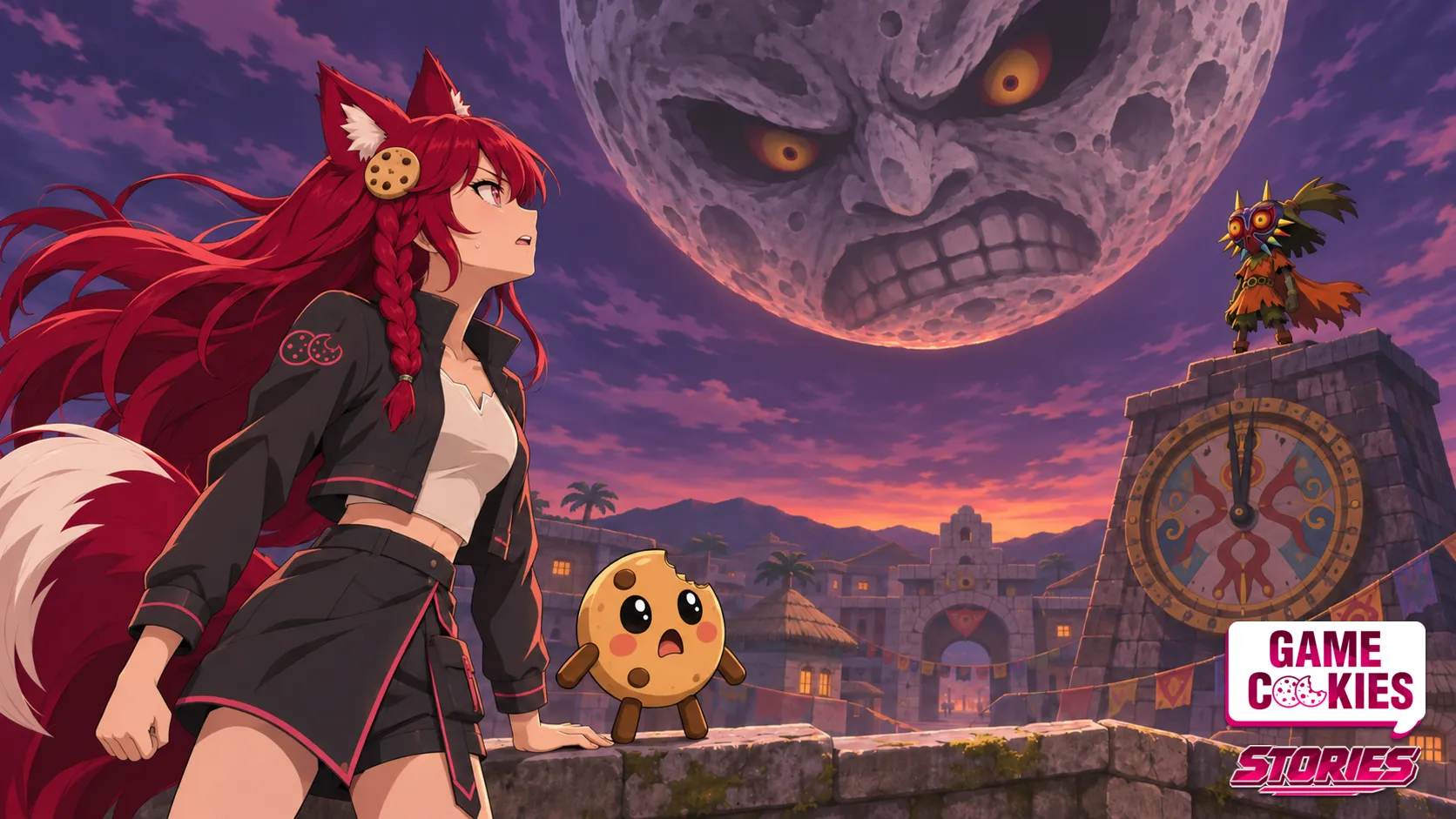
Hello there, moon watchers, deadline survivors, and Zelda fans who have never fully trusted a smiling mask salesman. Today we are talking about Majora’s Mask, the director who rejected more time, and a game where even the moon looks like it has read the production schedule.
A boss offers more time. The director gets angry.
That is the strange little production story behind The Legend of Zelda: Majora’s Mask. In Nintendo’s 2015 Iwata Asks interview, Eiji Aonuma recalled Shigeru Miyamoto offering to delay the game near the end of development. Aonuma had become so invested in meeting their one-year challenge that he rejected the escape hatch.
“There’s no way we can do that now!”
That was Aonuma’s recollection of his response, roughly fifteen years after the original game. The interview appeared alongside the 3DS remake, rather than during the Nintendo 64 production itself. Nintendo’s interview, contemporary coverage from February 2015
It is a wonderful headline. It also deserves more care than the familiar conclusion that great games happen when talented people suffer enough.
The interesting question is how this team made a very different Zelda with so much of the previous one still underneath it.
Aonuma wanted a new game
After Ocarina of Time, the assignment was initially to rework its dungeons for the Nintendo 64DD project that became associated with Master Quest. Aonuma, who had worked on those dungeons, struggled to get excited about rearranging them. He wanted to build something new.
In an earlier Iwata Asks conversation about Spirit Tracks, he described Miyamoto’s trade-off: deliver a new Zelda in a year, and it would not have to be the remixed version. The compact, repeating world subsequently gave the team a workable direction. That account credits both Miyamoto and fellow director Yoshiaki Koizumi in developing the three-day approach. Nintendo’s Spirit Tracks interview
That distinction matters. Majora’s Mask did not begin with a confident team calmly executing a finished masterpiece in miniature. There was a creative disagreement to resolve and a game to discover.
🦊 Kiki: “I understand wanting to get away from the assignment that makes your soul quietly leave your body. You just built these dungeons, you think they work, and somebody says, wonderful, now rearrange the furniture. Of course the new idea looks more exciting. But agreeing to a terrifying deadline because it buys creative freedom is a dangerous bargain. The calendar does not care how inspired you felt in the meeting. Eventually Tuesday arrives, the thing is still broken, and your brilliant argument has become everybody else’s production schedule. I can admire the nerve without wanting that deal in my own contract.”
🍪 Chip hovers between a fresh sketchbook and a calendar, then cautiously pushes the calendar farther away.
Reusing the foundation made room for a different adventure
Miyamoto’s proposal depended on work Nintendo had already done. In the 2015 account, Aonuma describes reusing Ocarina’s painstakingly built 3D models. Koizumi, meanwhile, had been considering another game based on repeatedly playing through a compact world. Ocarina already had a system for time passing. Those ingredients could support something new without rebuilding every foundation. Nintendo’s Majora’s Mask development interview
A separate developer Q&A, identified by its N-Sider archive as an October 2000 Nintendo Online Magazine interview, offers a useful perspective from the release period. Miyamoto pointed to the existing engine and familiarity with Nintendo 64 hardware as reasons development could move faster. The starting point was to use that foundation for a substantially different game. Archived developer Q&A
For players, asset reuse is easy to spot. The creative benefit is harder to count. A familiar face can serve a different story. An established movement system can support a different kind of problem. Technical continuity does not have to mean emotional repetition.
We should judge what a game does with its resources. Rebuilding something merely so the sequel can advertise that everything is new is a poor substitute for having a reason to return.
Three days gave the world a different shape
The time loop originally covered a week. Aonuma explained in 2015 that repeating seven days felt cumbersome, while tracking everybody’s activities across that span was too much to remember. The team compressed its plans into three days. He also agreed that filling a whole week would have made the one-year goal impossible. Nintendo’s account of the three-day system
That is a more useful production detail than a story about heroic willpower. The team reduced the scope of the cycle. The smaller version was easier to build and easier for players to understand.
In the release-period Q&A, Miyamoto described time as an additional dimension of exploration: players would learn the sequence of events as they had previously learned the landscape. Aonuma explained that arriving at a place at a different time could produce a different result. Archived developer Q&A
The same street can become interesting again because you understand it differently. That is a powerful alternative to making the street longer.
🦊 Kiki: “This is the part I want pinned above every meeting where somebody proposes a bigger map before explaining what happens on the current one. Give me a town worth paying attention to. Give me a reason to notice who leaves a building, who does not show up, what changes when I come back. I do not need another beautiful field whose main purpose is separating two objectives by six minutes of jogging. Bigger can be brilliant. It can also be a very expensive way of making me hold forward. If your world gets more interesting when I understand it better, you have my attention.”
🍪 Chip folds an enormous blank map into a small square and draws a clock in the middle.
The reset makes your knowledge matter
The original instruction booklet spells out the bargain. Playing the Song of Time returns Link to the first morning. Major items are retained, but cleared events and dungeon puzzles reset, and other characters do not remember meeting him. Nintendo’s original manual
That structure changes what progress feels like. You can lose a completed task while keeping the understanding that made it possible. The player’s memory becomes part of the adventure.
It also gives the game an uncomfortable emotional texture. Helping someone feels different when you know that your shared history can disappear at the next reset. A town becomes more than a collection of services around a quest marker when you begin paying attention to the people living there.
This is our reading of what makes the design so effective: repetition creates familiarity, and familiarity gives the impending disaster something personal to threaten.
🦊 Kiki: “I can forget a villain’s entire speech about destroying the universe before the cutscene finishes. Show me one ordinary person trying to get through a bad day, though, and suddenly I have priorities. That is the kind of emotional manipulation I willingly signed up for. Let me learn the place. Let me get attached to its ridiculous little routines. Then make me choose how to spend the time I have. You do not need a character announcing that the stakes are personal when the game has already made me care who is going to be there tomorrow.”
🍪 Chip circles a tiny appointment in his notebook and looks up nervously at the moon.
A good game does not make the pressure a good idea
Aonuma’s refusal of extra time was not the only revealing memory in the 2015 conversation. He recalled a Deku chasing him in a dream and waking up screaming. Iwata suggested Miyamoto had been worried about the team’s exhaustion, but that was his interpretation, not a documented explanation from Miyamoto. Iwata also acknowledged that tight deadlines had gone badly on other projects. Nintendo’s interview
Success does not let us isolate the deadline as the ingredient that made everything work. Nor does one director’s remembered determination tell us how every person on the team experienced the schedule.
There is also a useful counterpoint in that Spirit Tracks interview. Aonuma said he had requested three extra months for Phantom Hourglass and described the game improving during that period. His own history leaves room for both a fast, tightly focused sequel and a project that benefited from more time. Nintendo’s Spirit Tracks interview
🦊 Kiki: “Please do not take a beloved game, remove every sensible production decision from the story, and hand me a motivational poster about pressure. That is how somebody ends up explaining why the team should be grateful for another ruined weekend. I want ambitious games. I also want the people making them to be able to say the plan needs changing without being treated like they failed a character test. If the project needs a smaller scope, make the decision. If it needs more time, discuss the time. Pride is a feeling. It is a terrible replacement for a workable plan.”
🍪 Chip covers a motivational poster with a smaller note that says “Let people sleep.”
The lesson worth keeping
The angry refusal makes Majora’s Mask a memorable development anecdote. The design choices make it worth studying.
An existing foundation supported a different experience. A smaller cycle concentrated the action. Repeated visits gave the player more to understand rather than simply more ground to cover.
Those are choices another team can examine. The hope that exhaustion will somehow produce something extraordinary is much harder to defend.
Majora’s Mask asks players to pay attention to the time they have. Its development story gives us a reason to do the same for the people making our games.
⚙️ Stay curious like a Zelda fan wondering why the deadline has teeth.
⚙️ Keep checking the scope like Chip counting how many days actually fit on the calendar.
⚙️ And remember: you can recycle the polygons. Please do not recycle the burnout.
🦊 Kiki · 🍪 Chip · ⭐ Byte · 🦁 Leo
Tips, leaks, and suspiciously ambitious production calendars: contact us here!