
Hello there, space hoarders and refund-history archaeologists. Today we have one of the strangest business stories in modern games: a title that launched as a warning label, spent ten years giving players free updates, and somehow reached the point where fans see another update and respond with the most unnatural sentence in gaming.
“Please take my money.”
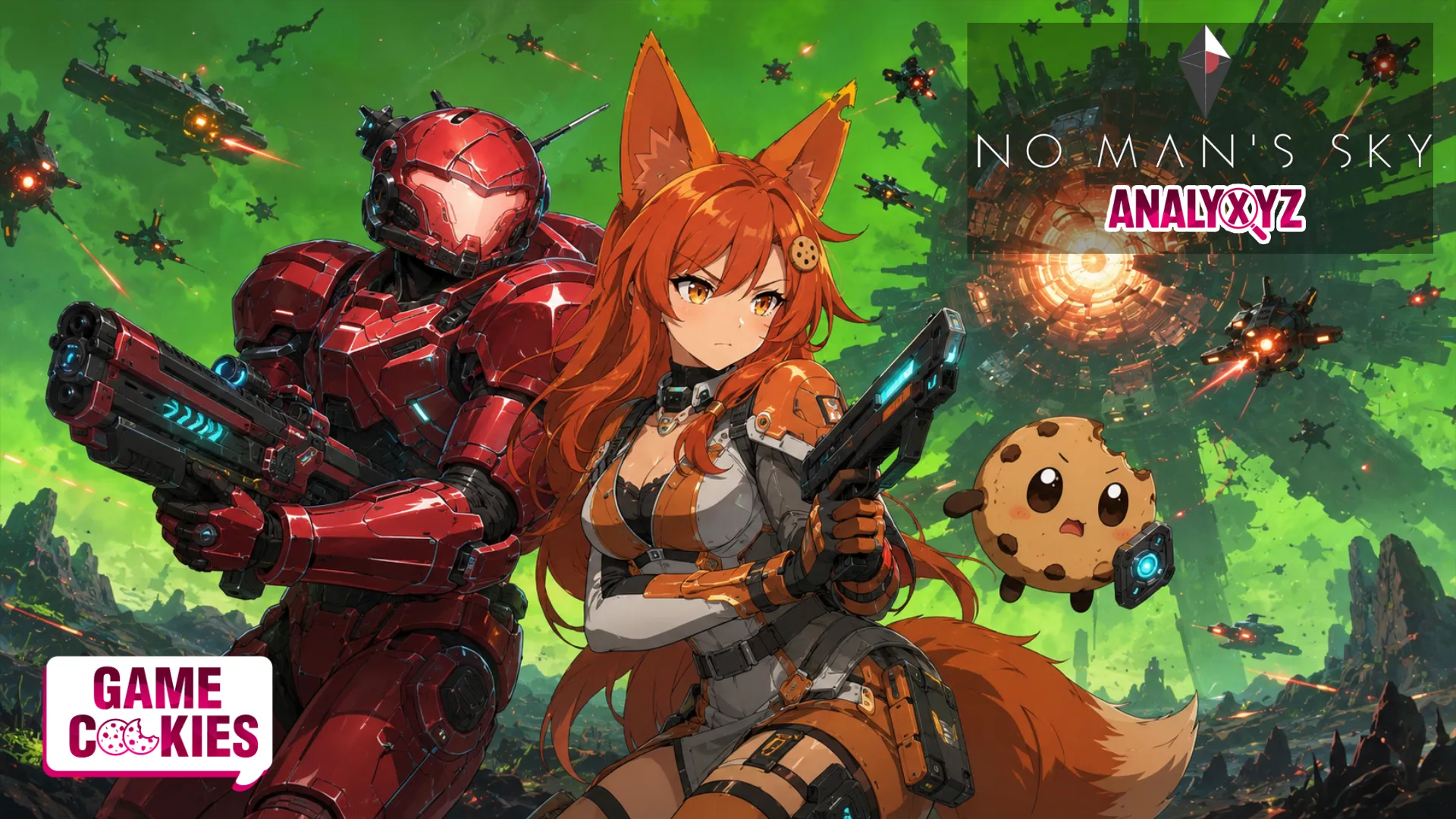
No Man’s Sky just received another major update called The Swarm, and this one is not a polite anniversary cupcake with a decal and some patch notes taped to it. The update throws players into a community war effort against the Hive of Glass, a massive construct hanging over planets like a space nightmare with rent problems. Players take a personality test, get divided into three factions, contribute to a war effort from the Nexus, fight swarms of robotic drones, salvage wreckage with the Gravity Gun introduced earlier this year, and try to stop what Hello Games describes as the largest weapon ever seen in No Man’s Sky.
That weapon can destroy freighter fleets and maybe even objects the size of space stations.
Normal tenth-anniversary behavior, obviously.
The Swarm also arrives after Remnant, which added a gravity gun, salvage crews, waste processing plants, trucks, haulers, and a whole new loop around dragging junk across alien planets. Before that, Xeno Arena turned alien creatures into collectible, trainable, breedable battle companions, with arenas, abilities, rare variants, daily challenges, and player-hosted tournaments.
So in one anniversary year, No Man’s Sky went from space junk trucking, to Pokémon-style alien pet battles, to a faction war against a Death Star hive thing.
And all of it is free.
That is the story. Now here is the actual issue.
The wild part is not only that Hello Games keeps updating No Man’s Sky. The wild part is that the studio has trained players to treat free updates as proof of trust, not as a content obligation. Most games spend years trying to extract more money from loyal players. No Man’s Sky has spent years making loyal players feel weirdly guilty that they are not being charged.
That does not happen by accident.
The latest update only works because the old story changed
No Man’s Sky turning ten should have been an easy nostalgia beat. A studio could post a thank-you video, release a cosmetic pack, maybe run a sale, and call it a celebration. Hello Games did something more revealing. It used the anniversary year to show how elastic No Man’s Sky has become.
The Swarm is not just a space combat patch. It is a community event, a faction contest, a progression chase, a lore drop, a combat showcase, and a reminder that the game can still absorb new genres without collapsing. Remnant added industrial salvage and vehicle hauling. Xeno Arena added creature battling. The Swarm adds mass-scale coordinated warfare.
That sounds messy when written out. Inside No Man’s Sky, it somehow makes sense because the game has spent a decade becoming a sci-fi toybox with survival, exploration, trading, base building, ship collecting, expeditions, companions, fishing, settlements, freighters, custom ships, and now pet tournaments and galactic war logistics.
A lot of games call themselves platforms. No Man’s Sky slowly became one without using the word every two minutes.
That is why the newest update gets the reaction it does. Players are not looking at The Swarm in isolation. They are looking at it as the latest entry in a very long receipt pile. Every update changes the emotional math around the game. Every time Hello Games adds something that could have been paid DLC, the old launch discourse loses a little more oxygen.
No Man’s Sky used to be a game people brought up when they wanted to talk about broken promises.
Now people bring it up when they want to ask why everyone else is charging money for less.
🦊 Kiki: I keep thinking about how annoying this must be for studios still trying to sell one seasonal skin bundle like they personally invented generosity. Hello Games just wandered in with a gravity gun, pet battles, and a giant murder hive in the sky, and then acted like, yeah, sure, this is just what we are doing this quarter. I remember when No Man’s Sky was basically the “don’t trust trailers” game. You could not say the title without someone emotionally opening a lawsuit in their head. Now the same game gets an update and people start acting like Sean Murray forgot to put a payment terminal in the Space Anomaly. That reversal is so stupidly rare it almost feels like a bug.
🍪 Chip checks under a space rock for a hidden battle pass and finds only more free patch notes.
The launch backlash is still the reason this story has weight
No Man’s Sky’s 2016 launch still matters because the comeback only works with the wound attached. The game arrived with enormous expectations: a practically endless procedural universe, alien planets, survival, trading, combat, mystery, and the fantasy of stepping into science fiction cover art and never hitting the edge.
The launch version had pieces of that dream. It also had a lot of missing emotional weight. Some promised or implied features were absent, some systems felt thinner than players expected, and the gap between the marketing fantasy and the released game became one of the most infamous industry stories of that decade.
The backlash was brutal. Players were angry, press coverage turned harsh, and No Man’s Sky became shorthand for overpromising. For a smaller studio, that kind of launch can bury the next ten years of work before it even starts.
Hello Games did the thing people online rarely know what to do with: it stopped arguing and started shipping.
Foundation added base building, new modes, farming, storage, and freighters. Path Finder added vehicles, base sharing, ship classes, improved visuals, weapon specialization, and permadeath. Atlas Rises added a longer story, portals, better missions, lore, and early multiplayer presence. NEXT made multiplayer feel closer to the original dream. Beyond expanded multiplayer again and added VR. Origins rebuilt planets with more variety. Expeditions turned the community into a recurring live-event structure.
Then the updates kept coming. Frontiers, Outlaws, Sentinel, Endurance, Fractal, Interceptor, Echoes, Omega, Orbital, Worlds, Voyagers, Remnant, Xeno Arena, The Swarm. The list reads like a studio trying to win an argument by exhausting the person arguing.
That is why “redemption arc” is still accurate, but it also feels too small now. The game did not just become acceptable. It became bigger, stranger, more generous, and more difficult to compare with its launch version.
🦊 Kiki: The old launch anger was not fake. People were mad for reasons, and pretending the whole backlash was just gamer hysteria is lazy. But the comeback is also real, and that is where the internet gets uncomfortable because it loves permanent sentencing. Once a game becomes a punchline, people want the punchline to stay frozen forever. Hello Games basically spent ten years kicking the joke in the ribs until it stopped moving. At some point you have to admit the current game is not the 2016 version wearing a fake mustache.
🍪 Chip holds up a dusty 2016 complaint folder, then quietly adds three more update pages to the back.
The money story is stranger than “they give everything away”
The financial angle is where No Man’s Sky gets more interesting, and also where people should be careful not to turn admiration into fantasy.
Hello Games is not a public company doing quarterly earnings calls. We do not have the clean investor-deck breakdown of No Man’s Sky revenue by platform, discount window, subscription deal, console split, Mac sales, Switch sales, Game Pass arrangement, or long-tail Steam performance. Companies House shows Hello Games Ltd as an active private limited company in the UK, incorporated in 2008, with the latest public accounts made up to October 2024 and full accounts filed in January 2026.
That tells us the studio is real, active, filing, and operating as a private business. It does not tell us exactly how many copies The Swarm helped move last week or how much revenue came from lapsed players returning after Xeno Arena.
So the better financial question is not “how much money does every update make?”
The better question is how the model works without paid expansions.
No Man’s Sky is still sold as a premium game. On Steam, the base game page lists all major updates since launch as included, from Foundation and Pathfinder through Worlds Part II, Voyagers, Remnant, Xeno Arena, and The Swarm. It also shows a large review base and a Very Positive user rating profile. That public store page is basically the sales pitch: buy the game once, receive a decade of accumulated content.
That creates a very different kind of live-service economy.
Hello Games is not charging each existing player for every new update. Instead, each update becomes marketing, reactivation, goodwill, and proof of value. A lapsed player sees The Swarm and comes back. A new player sees ten years of updates included and finally buys. A skeptical player sees the community praising the studio and starts trusting the product. A future Light No Fire customer sees the support history and thinks, okay, maybe this studio will keep building.
That is still business. It is not charity. Free updates cost money, time, opportunity, and staff attention. The difference is that the transaction feels less hostile because the player sees the value growing before the ask.
The ask is not hidden inside a battle pass screen.
The ask is the base game, the wishlist for Light No Fire, the long-term reputation of Hello Games, and the belief that buying into one of its worlds means the world might keep evolving.
🦊 Kiki: This is where I get twitchy when people say “they just do it for love,” because, okay, sure, maybe they love it, but payroll is not paid in vibes and space whale stickers. Free updates are also marketing. They are retention. They are catalog sales. They are reputation repair. They are future customer acquisition for Light No Fire. The difference is that the player actually gets a mountain of game out of the arrangement, so it does not feel like someone trying to milk your wallet with a sci-fi straw. That is why the goodwill hits differently.
🍪 Chip opens a cash register and finds a tiny note that says “please wishlist Light No Fire.”
“Take my money” is really about trust becoming awkward
The “take my money” reaction around No Man’s Sky is funny because it flips the usual relationship between players and monetization. In most modern games, players are defensive. They expect the store tab. They expect the deluxe edition. They expect the paid expansion. They expect the premium currency with a conversion rate that feels designed by an ancient goblin accountant.
With No Man’s Sky, some players have started asking for the thing they usually complain about.
That does not mean everyone wants the game monetized more aggressively. It means the emotional balance has changed. Players feel like Hello Games has given enough that paying more would feel less like exploitation and more like support.
That is a rare position for a studio.
The danger is that people can misread it. The lesson is not that every studio should release ten years of free updates and hope the catalog sales cover everything. That is not realistic for every project, team size, genre, budget, licensing deal, or corporate structure. No Man’s Sky has a special advantage because its universe is elastic. Almost anything sci-fi can be poured into it if the systems bend enough.
The stronger lesson is about accumulated trust. Players notice when a studio keeps doing the expensive thing. They notice when updates are meaningful. They notice when the game they bought years ago keeps gaining value. They notice when the studio does not treat every returning player like a wallet that wandered back into range.
That is why the community joke lands. “Take my money” is not a pricing suggestion as much as it is an emotional receipt.
Players are exhausted by being sold fragments. No Man’s Sky keeps handing them chunks.
🦊 Kiki: There is something very broken about the market when players are begging a studio to charge them because the free stuff is too generous. Like, that is not normal behavior. That is gamers trying to restore cosmic balance because every other live-service game trained them to expect a toll booth. You log in, you see a new event, your hand already reaches for the wallet out of trauma. Then No Man’s Sky goes, no, just play it, and everyone starts panicking like the vending machine gave two snacks.
🍪 Chip shakes a vending machine and three free updates fall out.
Light No Fire is now carrying the benefit and the risk of that trust
No Man’s Sky is no longer only a product. It is the reputation engine behind Hello Games’ next big bet: Light No Fire.
The official pitch for Light No Fire is enormous again. Hello Games describes it as a game about adventure, building, survival, and exploration together, set on a fantasy planet the size of Earth, bringing role-playing depth to survival sandbox freedom. That is the kind of sentence that makes imagination sprint ahead of confirmed mechanics, and Hello Games should know better than anyone how dangerous that can get.
This time, the studio has something it did not have in 2016: proof of long-term support.
Light No Fire does not need to borrow trust from trailers alone. It can borrow trust from No Man’s Sky’s update history. Every free patch, every expedition, every system added years after launch, every weird “how did they add this too?” moment becomes part of the Light No Fire sales argument.
That is powerful. It is also risky.
Players may be more forgiving because Hello Games has earned goodwill, but they may also be more intense because the studio’s second mega-ambitious procedural world now has myth attached to it. People are not just waiting for a fantasy survival game. They are waiting for the studio that supposedly learned from No Man’s Sky to prove it can launch ambition in a healthier state.
The smartest thing Hello Games has done so far is keep Light No Fire relatively quiet. The official page focuses on the core fantasy: one enormous planet, survival, building, adventure, exploration, and shared discovery. It does not drown people in feature checklists. It does not invite the internet to write a fake game in its head, at least not more than the internet will inevitably do anyway.
No Man’s Sky updates may also be doing double duty. Systems like large custom ships, ocean traversal, community expeditions, physics manipulation, and social structures can function as content for current players and as technical or design learning for what comes next.
That makes the current No Man’s Sky support cycle feel like both a thank-you and a bridge.
Hello Games is keeping one universe alive while quietly preparing players to trust another.
🦊 Kiki: Light No Fire scares me in the fun way and the business way. Fantasy planet the size of Earth, dragons, building, survival, exploration together, yeah, my inner idiot is already packing snacks and choosing a mountain to emotionally attach to. But the adult part of my brain is sitting there with a clipboard muttering, please do not let the internet design this game before it comes out. Hello Games earned trust the hard way. Great. Now it has to survive the weird version of hype that comes from people loving you again.
🍪 Chip wears a tiny explorer hat, then checks whether dragons accept liability waivers.
The industry keeps copying the wrong part of the No Man’s Sky comeback
No Man’s Sky is often used as proof that a bad launch can be fixed later. That is technically true, and also a terrible lesson if taken too casually.
A bad launch can recover when the studio survives, the core idea is expandable, the engine and tools can support years of additions, leadership keeps funding the work, and the audience has enough remaining belief to return. That is a narrow bridge. Plenty of games launch badly and never recover because there is no flexible foundation underneath the mess. Some get one apology patch, one roadmap, and then quietly disappear into internal postmortems nobody wants to quote.
No Man’s Sky had an unusual structure. Its original promise was too big, but that same size made the game expandable. Base building fit. Vehicles fit. Freighters fit. VR fit. Expeditions fit. Settlements fit. Creature companions fit. Salvage trucks fit. Pet battles fit. A giant hive weapon in the sky somehow fits.
The premise can absorb weirdness.
That is why No Man’s Sky could compound. The updates did not feel like disconnected DLC packs taped to a finished campaign. They felt like more toys added to a universe that was always supposed to be bigger than the player understood.
The better industry lesson is not “launch broken and fix it later.”
The better lesson is “if you want long-term trust, the product has to keep getting visibly better in ways players can feel.”
That takes patience. It takes money. It takes humility. It takes restraint around monetization. It also takes a game structure capable of holding years of expansion without turning into soup.
Most companies like the redemption headline. Fewer like the work behind it.
🦊 Kiki: Every executive should have to stare at No Man’s Sky for five minutes before saying “player trust” in a meeting. Trust is not a slide with blue arrows. It is not a community sentiment dashboard someone exports before lunch. It is the annoying pileup of players watching you do the expensive thing again and again when you could have done the cheap thing and blamed “market realities.” No Man’s Sky looks generous because the work kept showing up. That is the part everyone wants to quote and nobody wants to budget.
🍪 Chip points at a roadmap labeled “trust” and finds that every milestone just says “ship actual stuff.”
The current No Man’s Sky is almost inconvenient for the rest of the market
No Man’s Sky now occupies a strange moral space in games. It is not perfect. It still has repetition. It still has systems that do not land for every player. Some people bounce off it hard because procedural exploration can feel thin if the loop does not click. The game is huge, sometimes messy, and occasionally more impressive as an accumulation of ideas than as a perfectly focused experience.
That honesty matters because turning No Man’s Sky into a saint story makes the analysis weaker.
The game did not become important because it solved every design problem. It became important because it changed the relationship between a studio and its players through sustained effort. It gave players enough over time that the conversation shifted from “give me back my money” to “please let me give you more.”
That is an insane swing.
And in the current market, it creates an uncomfortable comparison. Players are looking at premium games with aggressive stores, live-service projects that shut down after selling cosmetics, early-access launches that monetize before they stabilize, and sequels that arrive with less content than their predecessors. Then they look at No Man’s Sky receiving The Swarm ten years later with no expansion price attached.
Of course the reaction gets emotional.
The affection around Hello Games is not only about No Man’s Sky. It is also about relief. Relief that one studio, at least, keeps proving the product can get bigger after purchase without every improvement becoming a separate transaction.
That does not mean the model is easy. That does not mean it should be copied blindly. It means the emotional contrast is real.
Players can feel when a game is being supported.
They can also feel when a game is being harvested.
🦊 Kiki: I do not want every conversation about No Man’s Sky to turn into “why can’t every studio be like Hello Games,” because that is how we get dumb arguments with no production reality in them. But also, come on. Some publishers deserve to be embarrassed by this. If a small studio can make a ten-year-old game feel newly alive without turning every update into a checkout flow, then maybe the billion-dollar companies can stop acting like generosity is a forbidden spell. Maybe. I am not optimistic, but I enjoy the fantasy.
🍪 Chip lights a tiny candle for every live-service game that charged $20 for blue pants.
No Man’s Sky stopped being only a redemption story
The phrase “redemption arc” still works, but it has started to undersell the current version of No Man’s Sky. Redemption was Foundation, Path Finder, Atlas Rises, NEXT, and Beyond. That was the studio proving the game could become what players expected.
What came after is something else.
Now No Man’s Sky is a long-tail premium business model, a procedural playground, a player-retention machine, a technology testbed, a community ritual, and a reputation bridge to Light No Fire. It is the kind of game that makes normal update language feel too small. Patch, expansion, season, DLC, live-service drop: none of those words quite explain why The Swarm feels funny to talk about.
It is another free update.
It is also ten years of changed expectations arriving at the same time.
The financial story is not that Hello Games forgot how to charge money. The financial story is that the studio found a way to make players want to pay by making the original purchase feel better over time. That is a much harder thing to fake than a trailer.
The launch will always be part of No Man’s Sky. It should be. The recovery only matters because the failure was real. But the current version of the game has outgrown the old warning label. It now warns the industry about something else.
Players remember who keeps showing up.
And sometimes, if a studio keeps showing up long enough, the wallet stops feeling like a defensive weapon and starts feeling like a thank-you note.
⚙️ Stay stubborn, Hello Games.
⚙️ Keep making the update list look like a dare.
⚙️ And remember: when players beg you to take their money, the money usually stopped being the point a long time ago.
🦊 Kiki · 🍪 Chip · ⭐ Byte · 🦁 Leo