

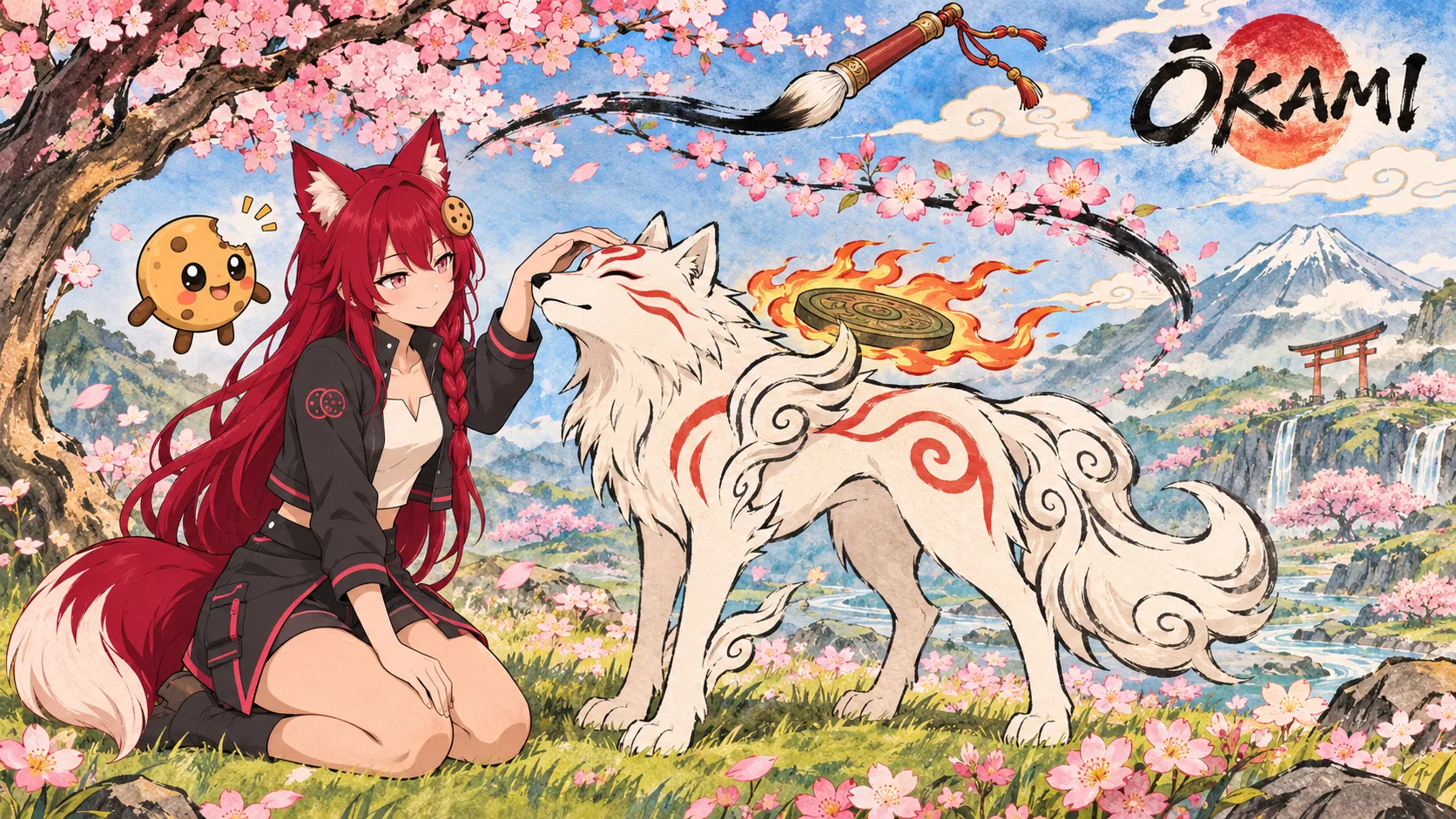
Hello there, celestial doodlers, wolf enthusiasts, and everyone whose best idea arrived immediately after the original plan fell apart. Today we are talking about Ōkami, a beautiful game that had to discover what players would actually do, and the awkward difference between having a gorgeous trailer and having a game.
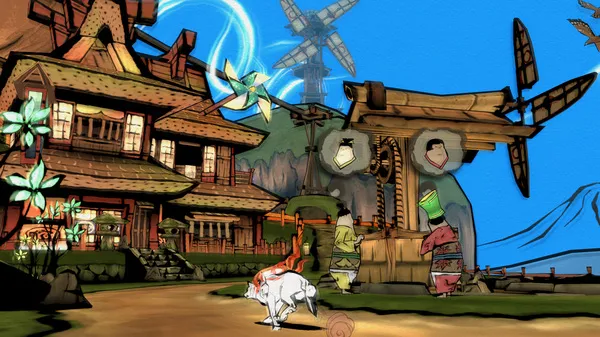
Amaterasu seems wonderfully inevitable now: a white wolf, divine powers, a world shaped by Japanese art, and a brush that lets us participate in its beauty. Clover Studio’s adventure first arrived on PlayStation 2 in 2006. Its identity feels so complete that it is tempting to imagine somebody pitching the whole thing in one inspired meeting. Capcom’s series history
Director Hideki Kamiya and producer Atsushi Inaba remember something considerably messier.
The route to Ōkami involved an unworkable ambition, experiments that failed to entertain, and other people providing the spark a celebrated director needed.
That is the story worth remembering. A finished game can make its own creation look obvious. Ōkami’s development was anything but.
First, the beautiful idea hit the machine
In their PlatinumGames interview, Inaba recalls a concept involving realistic drawings created through play. The technology available could not deliver it. Around two months into development, the team changed the visual approach. Kamiya’s original desire was to convey the pleasure of a vast natural landscape. The ink-painting direction provided another way forward. Inaba and Kamiya’s development recollections
Kamiya’s account to Satoru Iwata supplies the human detail: a colleague drew Amaterasu in an ink-wash style, and the image suggested a Japanese-art direction for the whole project. Kamiya’s Iwata Asks interview
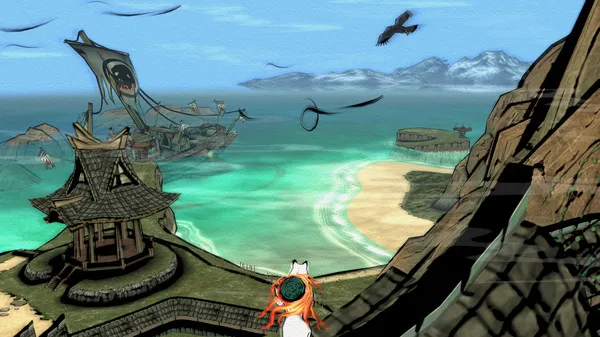
We love the practical intelligence in that turn. The goal of conveying nature survived. The first method of getting there did not. Changing the plan allowed the team to pursue the feeling that had made the project interesting in the first place.
🦊 Kiki: “This is where somebody in a meeting usually says we need more power, more budget, and a tree with individually simulated emotional problems. I would also like somebody to ask what we are actually trying to make people feel. Wonder? Peace? The urge to run through the grass? Good. Start there. A leaf does not become more meaningful because the console can calculate both sides of it.
“I love a beautiful realistic world. I also love an artist having the nerve to choose a different visual language instead of losing a technical arms race with the park outside. Give me a landscape with a personality. I can obtain extremely realistic grass by opening a window, although the side quests out there are mostly bills.”
🍪 Chip: Floats beside a painstakingly detailed leaf, turns over the enormous specification sheet beneath it, and paints a tiny flower on the blank back.
The trailer was lovely. The game was still missing.
Inaba remembers Ōkami being announced while the team had attractive promotional footage and an unresolved game system. Kamiya says cancellation was discussed; he would have preferred that to releasing something that disappointed players. PlatinumGames interview
Meanwhile, the experiments continued. Kamiya told Iwata that a simulation-like version included making fields and roads and building houses. He found it unenjoyable. The visual breakthrough had left the central design question unanswered. Iwata Asks
An appealing fantasy can support several possible games. Choosing between them requires more than describing the world. We need actions we want to repeat, problems those actions make interesting, and reasons to care about the result. A production can have a persuasive answer to “what does it look like?” while struggling with every one of those questions.
🦊 Kiki: “The trailer has music, flowers, a divine wolf, and excellent lighting. Wonderful. Now hand me the controller. That is the moment I care about. What happens when the camera stops following the carefully selected route and I start poking things like the nuisance I paid to be?
“A beautiful pitch makes me curious. It has not earned the next twenty hours of my life. I respect a team willing to look at its own gorgeous work and admit the fun is missing. That conversation is uncomfortable, expensive, and much kinder to the player than discovering the problem after checkout. Nobody wants to buy a screensaver with a quest log. Except perhaps the screensaver, which has been trying to get promoted for years.”
🍪 Chip: Flies through an ornate picture frame, reaches for a floating controller, and discovers that its cable ends at a painted wall.
The breakthrough gave the painting something to do
After Inaba confronted the stalled project, roughly ten core staff gathered over a three-day break. Kamiya recalls a miserable first day. On the second, a colleague’s observation that a goddess could do anything unlocked a new approach. Kamiya connected drawing with divine effects, including wind. A short plan followed; the third day developed content around it. Kamiya describes the breakthrough
The finished Celestial Brush makes the world into a place we can act upon through marks. Capcom’s Wii booklet explains drawing into the brush screen, using ink, and learning techniques. Its examples include restoring missing objects and bringing life back to withered trees. The artwork becomes part of the player’s vocabulary. Capcom’s Ōkami instruction booklet, Celestial Brush section
That connection gives the aesthetic a job. Restoration belongs to the premise, the appearance and the interaction. We understand the fantasy through what our input accomplishes. The player receives a small, tangible share of the power the story promises.
🦊 Kiki: “This is the delicious part. Let me interfere with the beautiful thing. Let the art direction reach into the controls and change how I solve a problem. If I am a goddess, I would like the job to include something more exciting than wearing a premium outfit while completing the local errands.
“Drawing a change into the world makes the fantasy feel personal. I did that. My ridiculous little mark mattered. That is a much stronger invitation than a narrator telling me, for the seventeenth time, that my character possesses unimaginable power. Imagine some of it, darling. Then put it on a button. Preferably before the next cutscene explains how impressive I am.”
🍪 Chip: Hovers over a cracked miniature bridge, carefully fills its missing section with ink, and ushers a procession of toy animals across.
A famous name does not hold the whole brush
These recollections keep returning to contributions from other people: the image that redirected the look, the conversation that loosened the design problem, the group that worked out a usable plan.
In the PlatinumGames interview, Kamiya praises colleagues who respond to an impossible request with an alternative, and says his games contain ideas he could not have supplied himself. Inaba describes the producer’s pleasure when someone returns with something better than expected. Inaba and Kamiya on collaboration
A director still makes decisions. The revealing part is how much good direction depends on recognizing a useful contribution and allowing it to change the project. Credit becomes more interesting when we follow the work instead of stopping at the most recognizable name.
🦊 Kiki: “I enjoy a good creative personality. I do not believe the credits are a decorative loading screen for one genius. Somebody draws the image that changes the direction. Somebody notices the idea that makes the system click. Somebody turns the exciting sentence into something that does not collapse when the player presses three buttons at once.
“The glamorous version is that a visionary dreamed it all. The version I find impressive is that talented people could influence what it became. If your great leader cannot recognize a better idea from somebody else, congratulations: you have given the bottleneck a fan club. Admire the director. Learn some other names. And when the team finds the answer, please let the team fit in the photograph.”
🍪 Chip: Floats beside a giant solo portrait, widens its frame, and pulls a row of smaller portraits into the picture.
The beauty earns attention. The playing still has to earn our time.
Ōkami’s later releases carried that identity forward. Capcom’s 2017 HD announcement brought the adventure to PS4, Xbox One and PC with higher-resolution presentation, including 4K support on compatible hardware. The central pitch remained Amaterasu’s divine brush powers and a world rooted in Japanese folklore. Capcom’s 2017 announcement
Players still disagree about the journey around those ideas. In a patientgamers discussion, some praise the art while objecting to slow dialogue and pacing. Others enjoy the long adventure: APeacefulWarrior says they loved its duration, while TheLumbergentleman enjoyed discovering each new area but disliked the handholding. Players discuss Ōkami’s pacing
That disagreement makes the development story more useful. Finding a powerful central idea does not settle every choice about length, guidance or rhythm. We can admire a work’s identity and still want it to trust us sooner. Its strongest accomplishment remains available to study without pretending every minute pleases everyone.
🦊 Kiki: “I can admire a painting and still ask the tour guide to stop blocking the doorway. Those feelings fit inside the same person. Art direction earns my attention; pacing decides what happens to it. Loving a game should make us better at describing the things it does brilliantly, and more specific about the things that make us reach for our phones.
“What I want other studios to borrow from Ōkami is the courage to find a personality and give us something interesting to do with it. Please do not copy the wolf, attach a crafting menu, and announce that the magic has been recreated. The difficult part is giving the player a reason to care about the brush. The ink is available in shops.”
🍪 Chip: Floats between a painting and a long queue of speech bubbles, gently moves the bubbles aside, and offers the brush to the reader.
Ōkami’s journey leaves us with a satisfying standard for ambition: a strong feeling, a willingness to revise the approach, and an interaction that makes the feeling playable. The final identity emerged through choices people made together. That is a richer creative achievement than the myth of a perfect first idea.
⚙️ Stay curious like a wolf wondering what else a brush can fix.
⚙️ Keep testing the fun like Chip looking for the controller behind the beautiful trailer.
⚙️ And remember: a masterpiece still needs something to do after we finish admiring the screenshot.
🦊 Kiki · 🍪 Chip · ⭐ Byte · 🦁 Leo
Tips, leaks, and suspiciously divine doodles: contact us here!