


Hello there, cookie munchers, cutscene skippers, controller grippers, and everyone who has watched a game trailer reveal the cast before explaining what the player actually does.
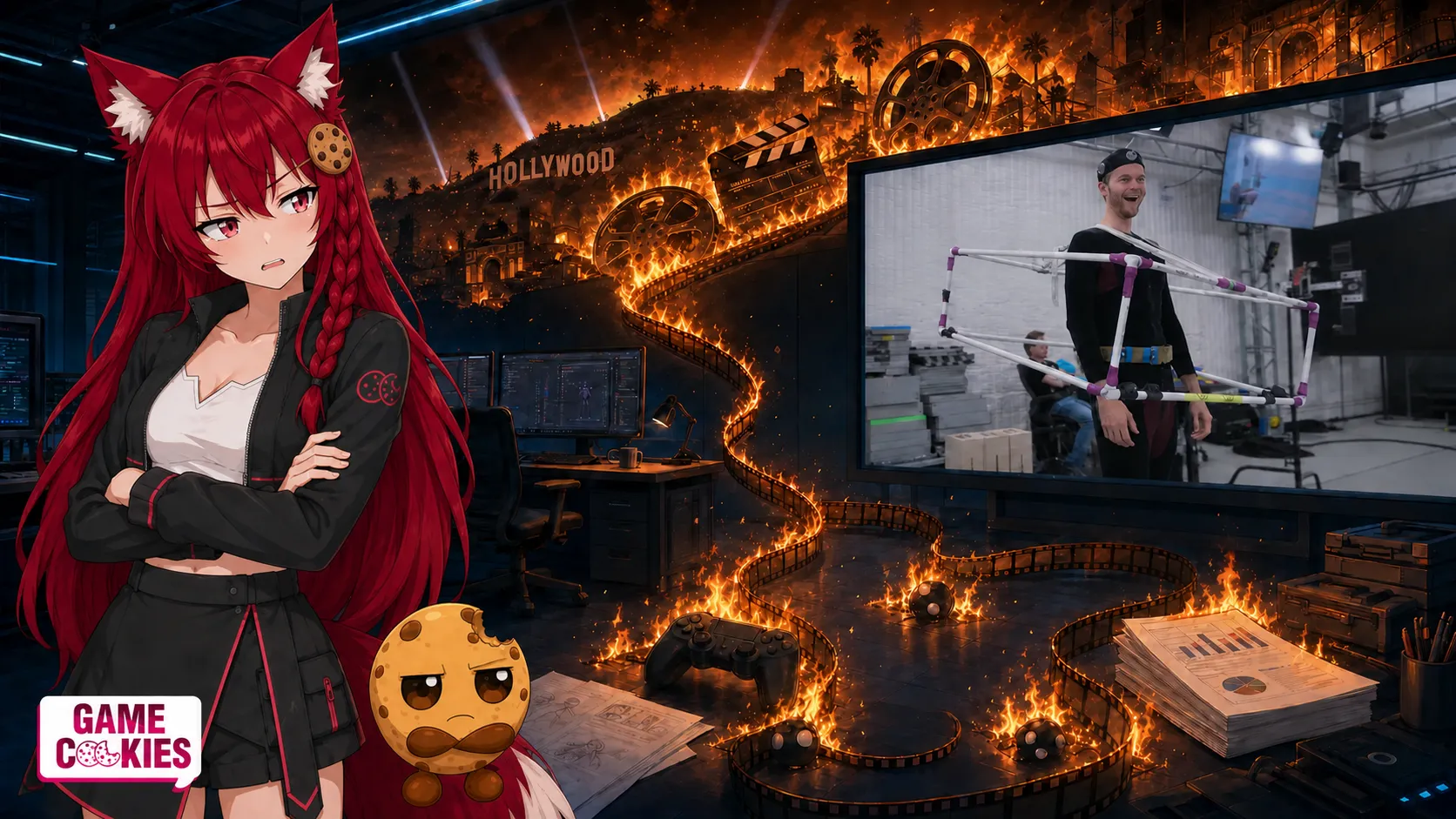
The latest symbol of AAA ambition is a man inside a cube. Santa Monica Studio’s first look at God of War Laufey introduced Phranque, a cosmic cube played by Jack Quaid. A behind-the-scenes clip then showed Quaid wearing a lightweight cube frame during performance capture so the cast could stage scenes around the character’s unusual shape.
Game director Ariel Lawrence later explained that the rig was not strictly required. It helped the actors understand direction, blocking, and the space around Phranque, while also making the session more playful. Lawrence’s explanation keeps the joke honest. The cube was a practical collaboration tool, not evidence that a studio burned the combat budget to measure six PVC pipes.
🦊 Kiki: I do not care who is inside the cube. Jack Quaid is fine. He may be beloved in somebody else’s algorithm. Wonderful. My wallet did not stand up and applaud. His name has the purchasing power of a patch note about improved menu transitions.
The performance might surprise me after launch. Before launch, announcing the celebrity inside a six-sided prop feels like marketing trying to invoice me for recognition. Sell me the character. The geometry already has enough faces.
🍪 Chip removes the actor’s name from the trailer and discovers the cube is still a cube.
The cube is funny. The production logic is serious
Performance capture can solve real creative problems. It lets actors share physical space, helps directors preserve timing and chemistry, and gives animators a coherent performance to build from. The same official Laufey reveal that announced its cast also led with combat goals: fluid movement between ground and air, greater responsiveness, and a distinct fighting style for Faye. Those claims still need to survive contact with a controller, but the studio is at least presenting performance and play as parts of the same design.
The larger AAA habit is harder to defend. Celebrity casting, photoreal faces, long cinematic sequences, prestige composers, virtual cameras, exhaustive capture stages, and carefully managed franchise continuity can become a complete production identity. Every piece may be excellent. Together, they can create a game that knows how it wants to be watched before it knows how it wants to be played.
Hollywood offers games a powerful toolkit. Blockbuster logic arrives with that toolkit: familiar intellectual property, expensive spectacle, marketable faces, rigid milestones, and layers of approval designed to protect a very large investment. The techniques expand what a game can express. The business model can quietly narrow what a team is allowed to attempt.
Actors can help. The evidence says so
A serious argument cannot blame performers for every oversized budget or timid design decision. A 2025 study in the Journal of Interactive Marketing analyzed 300 games released on Steam between 2008 and 2022. It found that recognizable actors were associated with stronger professional reviews, which in turn supported game success. The effect varied by genre and game traits, and the researchers also found a direct familiarity benefit.
That result tracks with common sense. Acting is a craft. A skilled performer can deepen a character, clarify emotional stakes, and make a strange world easier to enter. A recognizable name can also help a new project earn attention in a brutal market. Treating every famous actor as a symptom would discard a useful creative and commercial tool.
⭐ Byte: The study’s model estimated an 8.3% success lift for adding a star to its baseline action-game scenario, rising to 15.6% for a first-person horror example. Those are regression-based forecasts, not guaranteed sales returns. The sample contained 300 Steam games, including 72 with stars, and the authors note that incomplete budget data limits their ability to separate star power from the advantages of a better-funded production.
🦊 Kiki: The model can keep its 8.3%. I still do not care. Celebrity casting is a nice-to-have, like photo-mode filters and a steelbook nobody opens.
James Bond or Indiana Jones? Fine. Those properties dragged decades of movie identity into the room, so casting belongs to the fantasy. A brand-new magic cube has no such excuse. Sell me the writing, mechanics, and personality. I do not need an IMDb page stapled to six polygons.
🍪 Chip checks the deluxe edition and confirms the other five sides are sold separately.
The budget changes the creative question
The pressure around AAA design becomes clearer when the numbers enter the room. In its 2023 final report on Microsoft’s proposed acquisition of Activision Blizzard, the United Kingdom’s Competition and Markets Authority cited an IDG report using 2021 evidence. Five years earlier, most AAA console and PC releases were reported at development budgets between $50 million and $150 million. Projects being greenlit for potential release in 2024 and 2025 were reaching $200 million or more.
The same CMA record included third-party ranges from more than $80 million to almost $350 million in development cost per title, with marketing reaching as high as $310 million for some franchises. Elsewhere in the report, the authority said public and third-party evidence placed large AAA development cycles at roughly three to five years.
Those figures do not describe every publisher, every release, or any specific game announced in 2026. They show the scale of the decision environment. When a project absorbs hundreds of millions of dollars and years of labor, an unusual mechanic has to survive executives, greenlight committees, platform strategy, market forecasts, franchise expectations, focus tests, production reality, and the terror of explaining a miss to investors.
The resulting creative gravity pulls toward the recognizable. A sequel already has an audience. A film actor already has awareness. A cinematic trailer already communicates production value. A familiar combat loop can be benchmarked against something that sold. Nobody needs a conspiracy to produce safe games. A sufficiently expensive approval chain can do it politely in a conference room.
🦊 Kiki: Here is the scam: the budget becomes enormous, so marketing demands a famous face. The famous face makes the project look prestigious. The prestige helps justify the enormous budget. Congratulations, the snake is eating its own production schedule.
Meanwhile, the mechanic that might make the game memorable is presenting a prototype to twelve people who need it to resemble last quarter’s safest forecast. Hollywood glamour enters through the front door. The weird idea leaves carrying its little cardboard box.
🍪 Chip pastes a headshot onto the prototype and the greenlight spreadsheet begins to purr.
Prestige becomes camouflage when interaction disappears
Games can tell intimate stories, stage cinematic performances, and use the full language of film. Their defining advantage remains participation. The player moves, chooses, fails, experiments, notices, and creates timing that no editor can lock in advance. A production earns its spectacle when that spectacle sharpens those actions or changes how the player understands them.
Trouble starts when cinematic ambition repeatedly interrupts the medium it was hired to elevate. Long stretches of guided walking, forced camera control, conversations that forbid exploration, and transitions built to conceal loading can make a gorgeous world feel less interactive than its photo mode. Each technique can work. Repetition turns technique into house style, then house style into camouflage for limited agency.
Players do not reject story by reaching for the skip button. They may be rejecting a delivery method that keeps confiscating the controller. The best narrative games understand that a player’s attention becomes stronger when action and meaning arrive together. Let the route, tool, enemy, resource, or consequence carry part of the scene.
🦊 Kiki: I do not care how many pores the actor has if the game keeps confiscating my controller. Every time the camera locks me into another prestige shuffle down a corridor, I can feel the budget performing for itself.
Let me play. Let me fail. Let me turn left during the expensive emotional moment and knock over a bucket. If your masterpiece survives only when I behave like an audience member, you made a movie with an unusually needy remote.
🍪 Chip touches the left stick during a dramatic close-up and security removes him from the prestige experience.
A cinematic game can still be unmistakably a game
Death Stranding 2 offers a useful counterexample because it embraces film talent, elaborate performance technology, and lengthy storytelling without hiding its interactive identity. In a PlayStation interview about the sequel’s design, Hideo Kojima described expanding player freedom around combat, vehicles, and infrastructure while keeping the series’ delivery systems and Social Strand System at the center.
A separate launch interview with the development team explained that key characters used 4D scanning to preserve subtle facial movement. The same discussion tied weapons back to cargo decisions, climbing routes to difficulty, and online connections to experiences that emerge differently for each player. The cinematic layer has a job. It supports a game whose verbs, systems, and social structure remain specific enough to describe without naming the cast.
That coherence is the standard. Expensive technology should amplify a playable idea. Famous performers should inhabit a role the design needs. A cutscene should deliver something interaction cannot, then return control before the player forgets where the buttons are. Prestige works when the game underneath it remains impossible to confuse with a film waiting for occasional input.
The next AAA flex should be playable
Gameplay first. A reveal should communicate the central action with the same confidence it announces the cast, world, and visual fidelity. Players need a reason to hold the controller.
Technique with a job. Performance capture, virtual cameras, and photoreal rendering should solve a defined creative problem. Production complexity earns its place by improving the experience, not the making-of video.
A budget with oxygen. Milestones need room for prototypes, iteration, and ideas that do not arrive with a perfect comparable. Risk management that removes every creative risk leaves the market with an expensive familiar object.
Marketing that shows interaction. A trailer can celebrate actors and story while still proving how movement, choice, combat, exploration, or cooperation creates the player’s version of the experience.
🦊 Kiki: Yes, show me the actor in the cube. I will laugh for eight seconds. The celebrity has now completed his entire marketing contribution to my life.
Show me the game. Show me why Phranque is fun, useful, annoying, dangerous, or impossible to replace with a floating dialogue box. Famous is garnish. If the mechanic underneath tastes like cardboard, stop waving the parsley at me.
🍪 Chip presses Start and waits for the parsley to become a mechanic.
In the end…
AAA games have earned access to extraordinary performers, tools, and technical craft. Those resources can create richer characters and more expressive worlds. The industry loses its nerve when those tools become proof of quality before anyone can explain the interaction they serve.
The business pressure is real. Longer cycles and larger budgets reward familiarity because familiarity is easier to forecast. The same logic also increases the damage when every blockbuster begins to resemble the previous one. Safety becomes a portfolio risk when an entire tier of the industry makes the same safe choice.
A performer inside a cube gives us a perfect little image of the crossroads. Games can borrow Hollywood’s craft while protecting the participation, weirdness, and mechanical authorship that make the medium worth the investment. The next prestige game should leave players remembering what they did, not only who delivered the lines.
⚙️ Stay curious about the playable idea underneath every expensive reveal.
⚙️ Keep asking whether cinematic technology is serving interaction or replacing it.
⚙️ And remember: a famous face can open the trailer, but only a great game can keep the controller warm.
🦊 Kiki · 🍪 Chip · ⭐ Byte · 🦁 Leo
Tips, corrections, and actors currently inside geometric props: contact us here!