🍪 Roblox Cloned a Steam Hit in Weeks – Now Every Tiny Indie Idea Has a Target on Its Back

Hello there, paint-covered hiders, exhausted indie devs, and every platform lawyer suddenly pretending the copy machine is “community creativity.” Today we are talking about Meccha Chameleon, the Roblox clone panic, AI-powered fast-follow games, and whether the industry needs to stop treating indie ideas like free buffet samples.
Meccha Chameleon is exactly the kind of game the modern internet eats alive in the best and worst ways. It is simple, cheap, instantly understandable, and ridiculously streamable: players hide by painting their blank bodies to match the environment while seekers try to spot them. PC Gamer reported that the game sold one million copies in four days after launching on Steam, and later coverage said it had exploded to 15 million sales in under a month, with reports of a 340,000-player peak.
That kind of success used to create imitators over months or years. Now the window feels closer to weeks, sometimes days. A viral RoWatcher graphic circulating on X claims that multiple Roblox clones of Meccha Chameleon appeared quickly and, combined, began pulling serious player attention while the Steam original cooled from its peak. We should treat the exact clone count in that image as a live social-media snapshot, not a court filing, but the pattern is not imaginary. Similar reporting around PEAK found Roblox clones like CLIFF and CLIMB reaching millions of visits within weeks, with the original developers publicly furious about monetized ripoffs.
The argument is bigger than one painted lizard game. The question now is whether platforms should protect small developers from blatant, monetized knock-offs, or whether every simple idea that goes viral is basically a free design document for the fastest clone farm in the room.
What actually happened
Meccha Chameleon became the perfect clone target because its hook is easy to understand in one clip. You do not need a lore wiki, a 60-hour campaign, or a licensed car manufacturer. You need one strange visual rule: paint yourself into the wall and pray nobody notices your suspicious little knees. That makes it brilliant for players, streamers, and unfortunately, copycats.
The social reaction is split into three camps. On X and Reddit, the dominant emotional take is anger: people see Roblox clones as attention theft, especially when they copy the look, UI, name structure, or monetization opportunity of a fresh indie hit. On LinkedIn, the takes you saw map the business debate perfectly. Chris Heatherly’s point is the practical fear: AI will make this worse, and copyright alone will not save gameplay ideas. Serdar Copur’s point is the legal counterweight: rules, mechanics, and basic concepts are usually not copyrightable, and games have always evolved by borrowing. Aaron Casillas lands on the platform angle: Apple and Android had to police clone chaos in the early mobile era, and Roblox may be forced into the same role.
All three are partly right, which is annoying because clean villains are easier to write and much better for snacks.
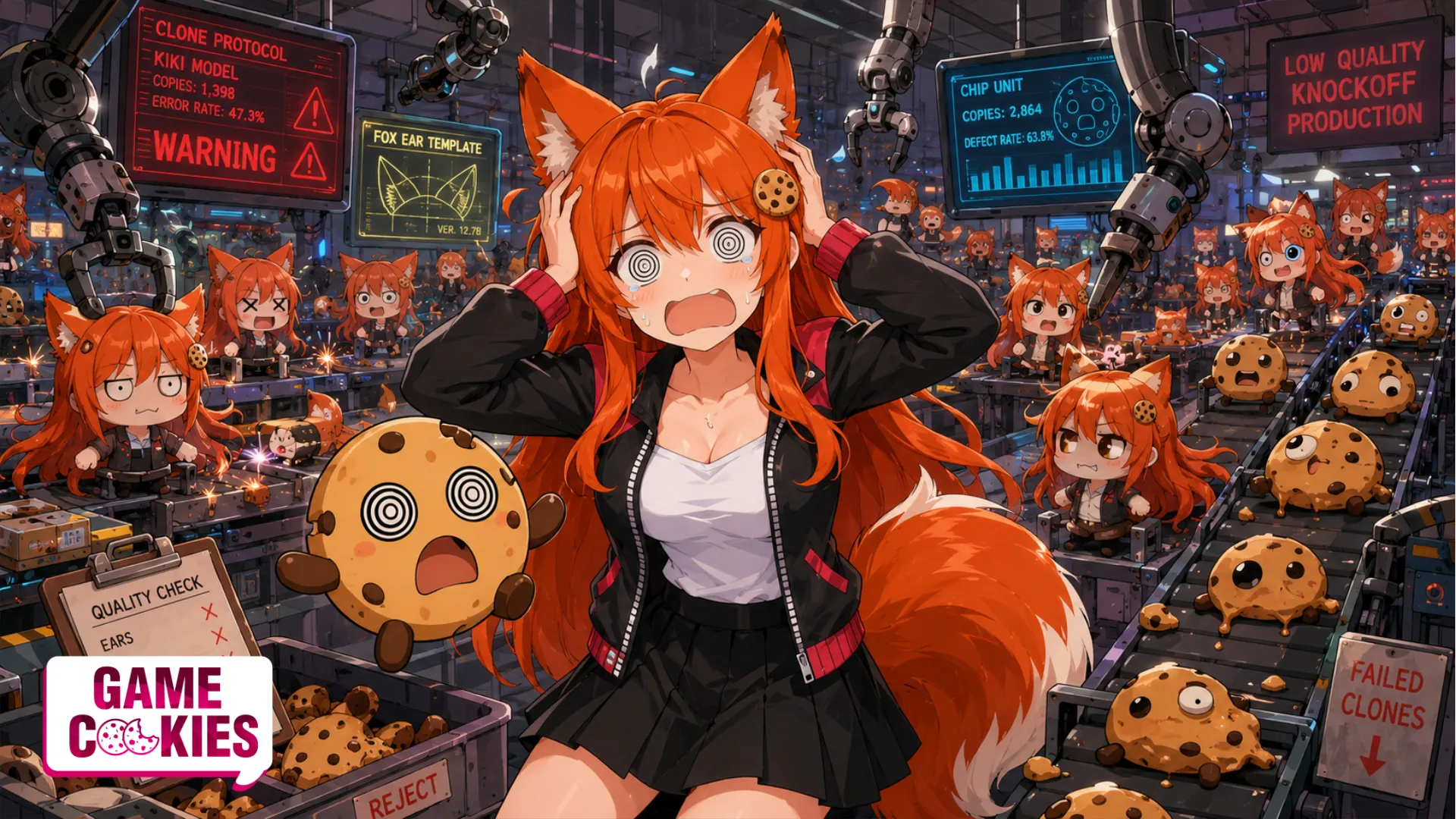
🦊 Kiki: Of course the copy machine found Meccha Chameleon. It is a $5 miracle with a mechanic so readable that a golden retriever could understand the pitch between chewing the controller and committing tax fraud. That is the beauty of the game. Also, that is exactly why the vultures show up wearing “inspired by” sunglasses.
The part that makes people mad is not that someone made another hide-and-seek game. We survived Prop Hunt. We survived Among Us-likes. We survived every “survivor” after Vampire Survivors like the industry had discovered garlic and math. The problem starts when the clone tries to intercept the original’s moment, dress close enough for confusion, and then stuff the pockets with Robux.
🍪 Chip floats behind Kiki wearing a tiny painted cardboard wall. Somehow the wall has microtransactions.
Why Roblox is such a powerful clone machine
Roblox is not just another storefront. It is a gigantic user-generated platform with creation tools, built-in social discovery, a young audience, and a virtual economy that can turn attention into money. Roblox reported 132 million daily active users in Q1 2026, while revenue grew to about $1.4 billion, even as new safety and age-verification systems slowed user growth.
That scale changes the copycat math. A Roblox clone does not need to beat the original on Steam quality. It only needs to be free, visible, fast, and familiar enough to catch players who saw clips but do not understand where the idea came from. For younger players especially, the Roblox version may be the first version they see.
Roblox also clearly understands that IP can be managed at platform level. In 2025, it launched a licensing feature with partners including Netflix, Lionsgate, Sega, and Kodansha, designed to let rights holders make licensed properties available to Roblox creators much faster. Roblox’s own product leadership said the company wants 10% of gaming content revenue flowing through its ecosystem.
⭐ Byte: The pattern is simple: low-cost viral indie plus high-visibility mechanic plus platform-native remake tools equals copy pressure. The original sells the idea to culture. The clone sells access to a different audience. The danger is not only lost purchases; it is loss of authorship, search visibility, and player understanding.
The legal answer is messy, slow, and very annoying
Serdar Copur’s LinkedIn take is broadly aligned with copyright law. In the U.S., copyright protects original expression, but it does not protect ideas, systems, methods of operation, or concepts. The U.S. Copyright Office says copyright does not protect ideas, concepts, systems, or methods of doing something, though it can protect the specific expression of those ideas.
Translated into games: you usually cannot own “hide and seek,” “paint yourself to camouflage,” “battle royale,” “jumping plumber,” or “co-op horror with proximity voice.” You can protect assets, code, music, characters, text, branding, and sufficiently specific audiovisual expression. That is why clone cases get ugly. The fight is rarely “did they use the same broad idea?” The fight is “did they copy enough protectable expression that this becomes a ripoff instead of another game in the genre?”
There is precedent for pushing back. In Tetris Holding v. Xio, the court found that a Tetris clone could infringe when it copied too much of the game’s expressive look and feel, even though basic gameplay rules were not protectable. Spry Fox v. Lolapps around Triple Town and Yeti Town also became an important clone case because the dispute focused on similarities beyond abstract mechanics.
Roblox’s own Terms of Use already say user-generated content must not infringe intellectual property rights, and the platform provides DMCA and trademark complaint processes. Roblox also says it may remove infringing content and suspend or terminate repeat or egregious infringers.
🦊 Kiki: The legal system basically looks at an indie developer and says, “Good news, you may have rights. Bad news, please spend terrifying amounts of money proving it while the clone already farmed the algorithm, the kids moved on, and your original game is now fighting a free version called Painty Lizard Hide Fun Obby 2.”
That is why “just DMCA it” sounds nice until you imagine a two-person team doing legal paperwork instead of patching servers, fixing bugs, answering community posts, and sleeping like mammals. The law might help if the clone is stupidly close. The platform has to help when the clone is fast.
🍪 Chip opens a legal folder, sees “10 to 14 business days,” and quietly climbs into a filing cabinet.
AI makes the clone cycle nastier
AI did not invent game cloning. The industry has been copying hits since Pong put on shoes and walked into every arcade. What AI changes is the speed and volume of the surrounding material: icons, thumbnails, store descriptions, UI mockups, concept art, fake ads, localization, code assistance, scripts, and quick asset variation.
GamesRadar recently covered Scale the Depths, whose developers said AI-powered ripoffs copied the browser version, ran it through filters, and even used real gameplay footage in ads. Weirdly, the clones may have helped advertise the original, but only because the copies were bad, ad-stuffed, and obvious enough to backfire.
Meccha Chameleon also has a second AI-adjacent problem: cheating. PC Gamer reported that players were using auto-paint cheats that scan environments and replicate them onto player models, attacking the core creativity of the game itself. When the same broader automation logic can help clone the game, market the clone, and cheat inside the original, the industry has a bigger mess than one Roblox knockoff.
🦊 Kiki: AI did not create the raccoons. It gave the raccoons a forklift, a fake mustache, and a Canva subscription. Before, copying a viral game still required some effort. Now the lazy version can arrive with a logo, store art, translated descriptions, fake screenshots, and monetization buttons before the original dev finishes reading the first “congrats on the success” email.
The scary part is not that all AI use is evil. The scary part is that the cheapest use case is often the grossest one: take someone else’s heat, wrap it fast, and point the traffic hose at yourself.
Should the industry fight to control this?
Yes, but the target matters. Fighting to control every mechanic would be terrible for games. Genres exist because people borrow, remix, improve, and respond. If one studio could own “players hide from seekers,” half of multiplayer history would need a lawyer before pressing Start.
The fight should be against deceptive, monetized, platform-amplified cloning. If a Roblox experience uses a confusingly similar title, thumbnail, UI, progression structure, or character presentation right after a breakout Steam hit, the platform should not shrug and wait for a tiny studio to become a legal department. Roblox already has IP tools and a licensing direction. The next step should be faster review, temporary monetization limits for obvious copycat disputes, clearer clone-reporting paths for small developers, and stronger repeat-infringer consequences.
A fair system would still allow inspiration. Make another camouflage game. Make it weirder. Add a social deduction layer. Make the seekers blindfolded accountants. Fine. But if the main pitch is “the thing you saw on Twitch, but free on Roblox and full of spending hooks,” platforms should treat that as a governance problem, not just community creativity with suspicious shoes.
App stores had to learn that totally open clone chaos hurts trust. Roblox is reaching the same stage. If it wants to be a serious ecosystem for brands, creators, and professional developers, it cannot ask IP owners to license properly on one side of the building while the other side lets clone farms sprint through the vents with a fake badge.
🦊 Kiki: “May the better game win” sounds fair until the worse game starts the race inside a mall with free candy, a Roblox search boost, and an audience that has never heard of Steam. Competition is healthy. Confusion is not. Inspiration is healthy. Speedrunning someone else’s launch window with a Robux basket is where the cookie starts tasting like cardboard.
🍪 Chip holds up a tiny sign that says: “INSPIRED BY ≠ COPY-PASTE WITH CONFETTI.”
What to watch next
Meccha Chameleon is probably not the last case like this. It may become the template. Cheap multiplayer games, streamer-first hooks, simple visual mechanics, and fast community content are now prime targets. Any indie game that can be explained in one viral clip can also be copied from that clip.
The smartest developers will start preparing earlier: register trademarks when possible, document original assets and UI, monitor Roblox and mobile stores after launch, keep official branding clear, watermark trailers carefully, and build community awareness around the real version. The smartest platforms will stop waiting for outrage before acting.
The answer is not to freeze creativity. The answer is to stop rewarding the laziest commercial version of it.
⚙️ Stay clone-aware like an indie dev checking Roblox search before breakfast.
⚙️ Keep protecting the original like Chip guarding a $5 Steam hit with one tiny crumb shield.
⚙️ And remember: if your “inspiration” needs the original’s launch window, visual hook, thumbnail energy, and monetization gap to survive, maybe the chameleon is not the only thing hiding.
🦊 Kiki · 🍪 Chip · ⭐ Byte · 🦁 Leo
Tips, leaks, and suspiciously familiar wall-painting games: contact us here!