🍪 Mixtape’s review war is about more than one nostalgic indie game

Hello there, review-score survivors.
Today we’re talking about Mixtape, the new narrative adventure from Beethoven & Dinosaur and Annapurna Interactive that has somehow become one of the loudest little games of 2026. On paper, it sounds easy to understand. Three friends. One last night of high school. A playlist that pulls them into dreamlike memories. Licensed music from DEVO, Roxy Music, The Smashing Pumpkins, Iggy Pop, Siouxsie and the Banshees, Joy Division, and more. Annapurna describes it almost like a playable coming-of-age album, full of mischief, music, adolescence, and that heavy feeling of moving on before you’re ready.
That sounds like a very specific kind of experience. Maybe even a good one, depending on what you want from games.
The problem is that Mixtape didn’t just arrive as a stylish narrative experiment. It arrived with huge critical praise, perfect scores from some outlets, and a review conversation that placed it uncomfortably close to the prestige zone of the medium. According to Metacritic, the PlayStation 5 version currently sits at an 85 Metascore based on 27 critic reviews, while the user score sits at 6.4 based on 486 user ratings. That gap is where the whole argument starts to rot.
And no, the interesting part is not whether one person liked the game and another person didn’t. That happens every week. The interesting part is what happens when critics treat a game like a major artistic statement while many players look at the same product and see a short, light, heavily curated nostalgia piece with minimal interactivity.
That’s not a small disagreement. That’s a fight over what review scores are supposed to mean.
The score became bigger than the game
The backlash around Mixtape isn’t only about the game’s content. It’s about the symbolic weight of the numbers attached to it.
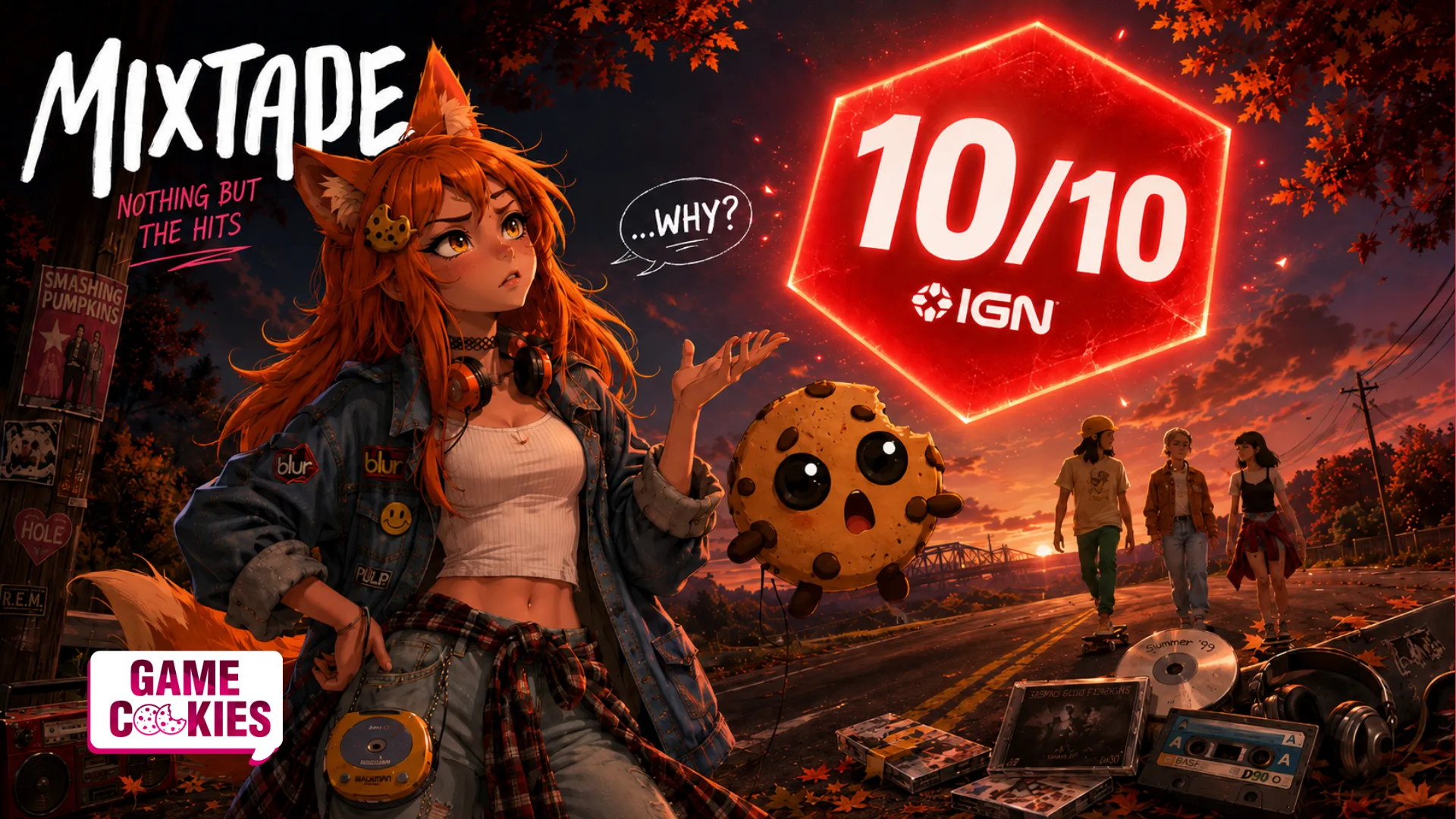
A 10/10 from a major outlet doesn’t land like a personal diary entry. It lands like a statement. It tells readers this game belongs in the highest tier of the medium. It tells publishers that this kind of work deserves attention. It tells awards conversations to keep the door open. It tells marketing teams they have a quote to plaster everywhere.
That’s why players react differently when a small, vibes-first narrative game gets a perfect score. They’re not only judging whether the soundtrack made someone cry. They’re asking what the industry is being told to reward.
PC Gamer’s review, interestingly, gets close to the core tension without turning the piece into culture-war noise. The reviewer praised Mixtape as lovely, beautiful, and heartwarming, but also said it struggled to justify why it needed player input at all. The review even describes it as a three-hour nostalgia trip and argues that the game only occasionally uses interactivity to strengthen the story.
That’s a fairer way into the debate. The question isn’t “can narrative games exist?” Of course they can. The question is whether the interactivity in Mixtape earns the critical elevation it received.
🦊 Kiki: Look, I like weird games. I like games where nothing explodes for twenty minutes and some sad girl stares at a vending machine while synth music plays. I’ve been there. I’ve defended that stuff. But when people start throwing perfect scores around, the vibe tax gets real. You can’t just hand me a licensed soundtrack, a few dreamy transitions, and a teenager looking meaningfully into the distance, then tell me I witnessed the future of the medium. Bro, sometimes I witnessed a very expensive playlist with buttons. And that’s okay, just don’t ask me to salute it like it stormed Normandy.
🍪 Chip clutches a tiny cassette tape with both hands and slowly lowers it like he’s no longer sure it’s safe.
Nostalgia can carry emotion, but it can also fake depth
The strongest defense of Mixtape is obvious: music is powerful. Songs do trap memories. A track can pull you back into a year, a room, a person, a version of yourself you don’t know how to explain anymore. Games have used that feeling beautifully before.
But nostalgia is dangerous because it can make recognition feel like writing.
If a game plays the right song at the right moment, the player may bring their own emotional archive into the scene. That doesn’t automatically mean the game built that emotion. Sometimes it borrowed it. Sometimes it leaned on a cultural memory bank and let the soundtrack do work the characters and mechanics didn’t fully earn.
That’s where Mixtape becomes more interesting as a controversy than as a game. The official pitch is very open about the structure: a curated playlist pulls the characters into reenactments of formative memories, with narrative vignettes covering friendship, first kisses, parties, mischief, and growing up. That can be charming. It can also become a shortcut if the game confuses “remember this?” with “feel this because the story made it land.”
Some critics clearly felt the emotion worked. Metacritic’s listing includes perfect-score praise that highlights writing, performances, art direction, creative gameplay beats, and the soundtrack as the backbone of the experience. Other reviews were more cautious. The Guardian’s excerpt on Metacritic called it a beautiful and silly series of musical vignettes, but said it lacked real conflict and might leave players wishing they had spent their time more wisely.
That range matters. It suggests the game is not impossible to defend. It also suggests that the backlash didn’t appear from nowhere.
🦊 Kiki: The thing with nostalgia is that it cheats. I say that as someone who has absolutely been emotionally destroyed by one old opening theme from a show I barely remember. Your brain fills in the missing writing. It goes, “Oh no, I was young once,” and suddenly the scene looks deeper than it is. That doesn’t mean the art did nothing. It means the art found the big red button in your chest and pressed it. Cool trick. Still a trick if there’s not much behind it.
🍪 Chip stares at an old Walkman, presses play, and immediately gets overwhelmed by feelings he does not have the vocabulary to process.
Players are reacting to review authority, not only to taste
A lot of the defense around Mixtape has gone straight to the safest possible place: people like different things. True. Boring, but true.
Xbox even stepped into the noise with the line, “Reminder: just because you’re not personally into a game, doesn’t mean it’s a bad game.” The post didn’t name Mixtape, but multiple outlets connected it to the current debate, especially after Annapurna interacted with the post.
That message is technically correct and still incomplete.
Players are not only saying, “I don’t personally enjoy this.” Many are saying, “Why is this being scored like an essential work when the gameplay looks thin, the runtime is short, and the emotional payload depends so heavily on nostalgia and licensed music?”
Some media summarized several recurring criticisms from players: some argue the game barely qualifies as a video game because so much of the action is walking, others criticize era authenticity, and others question how an “indie” can carry such a loaded licensed soundtrack. Some of those arguments are stronger than others. The “is it really a game?” line can get lazy fast, especially because games have had walking simulators, interactive dramas, visual novels, and experimental narrative works for decades. But the review-score argument is harder to dismiss.
Review scores still shape perception. They influence storefront blurbs, awards buzz, publisher confidence, social media discourse, and the weird moral authority certain outlets still carry even after years of players saying they don’t trust them anymore.
So when players see perfect scores attached to something they consider thin as a game, the frustration isn’t random. They read it as another sign that parts of games media value filmic presentation, themes, and cultural positioning more than player agency, systems, challenge, replayability, mechanical creativity, or even basic interaction.
That’s the nerve Mixtape hit.
🦊 Kiki: People keep pretending scores don’t matter, which is adorable in the same way a raccoon pretending it didn’t open your trash is adorable. Scores matter. Publishers quote them. Platforms promote them. Fans weaponize them. Award shows sniff around them. So when a critic drops a 10, then turns around and acts like everyone is weird for treating that 10 like a statement, come on. Don’t do the little innocent face now. You put the number there. Players know what the number does.
🍪 Chip holds up a tiny scorecard, hesitates, then quietly flips it face down.
The “culture war” label is becoming a convenient escape hatch
Some criticism around Mixtape absolutely has drifted into the usual internet sludge. That happens with every visible game now. You can find bad-faith posts about almost anything if you dig long enough.
But flattening the entire backlash into “culture war anger” is too easy. It avoids the more uncomfortable question: why do so many players feel that games media no longer represents their priorities?
Certain media noted that some complaints around Mixtape do invoke “woke” framing. That part exists. Pretending otherwise would be dishonest. But the broader argument online has also included gameplay depth, authenticity, pricing, review inflation, and whether critics are overvaluing cinematic presentation in games.
Those are legitimate topics.
The problem is that modern games discourse has become very good at finding the dumbest version of an argument and pretending it speaks for everyone. Once that happens, nobody has to answer the stronger version. Critics can point at the worst posts and say the backlash is unserious. Players can point at the most indulgent reviews and say the media is useless. The actual conversation gets buried under screenshots, dunking, and the kind of smugness that makes everyone worse.
Mixtape is a perfect flashpoint because it sits at the intersection of several old wounds: review inflation, narrative-game defensiveness, distrust of games journalism, resentment toward prestige indies, and the industry’s long-running embarrassment around games being games.
The backlash got loud because players saw Mixtape as a symbol. Maybe that’s unfair to the developers. It probably is, at least partly. But symbols are rarely chosen politely.
🦊 Kiki: I hate when every argument gets shoved into the same culture-war blender because then nobody has to think. Some guy with fourteen anime avatars says something stupid, and suddenly every normal criticism gets dragged into the same dumpster. No. I can dislike weak gameplay without secretly running a basement conspiracy board. I can also think some players are being dramatic gremlins. Both things can be true because reality is annoying and refuses to make clean teams for Twitter (who calls it X?).
🍪 Chip nervously pushes two angry comment threads away from each other with a tiny broom.
Narrative games deserve better defenses than “you just don’t get it”
There is a real defense of games like Mixtape. Games do not need combat systems, loot, skill trees, fail states, or sprawling mechanics to justify themselves. A game can be quiet. It can be short. It can be guided. It can be about mood, memory, and emotional texture.
The better argument is not that Mixtape is above gameplay criticism. The better argument is that interactivity can be subtle, and some games are designed around inhabiting a mood rather than mastering a system.
But then the burden gets heavier, not lighter.
If a game is light on mechanics, every interaction needs purpose. Walking needs rhythm. Button presses need emotional intent. Mini-games need to reveal something about the characters or the player’s relationship to the scene. Player input cannot feel like the developers added it because the project needed to qualify for the “video game” shelf.
That is where even sympathetic critics found tension. PC Gamer’s review specifically argued that Mixtape had standout moments where interactivity worked, but not enough of them, and that several mechanical interludes interrupted the story instead of deepening it. That’s a much more useful critique than yelling “walking simulator” and calling it a day.
If Mixtape wants to be judged as a narrative game, fine. Judge it as one. Ask whether its interactions express character, memory, discomfort, joy, regret, fear, or change. Ask whether the player’s hands matter. Ask whether the game uses the medium or decorates a movie with input prompts.
That conversation could help narrative games evolve. The score war probably won’t.
🦊 Kiki: I don’t need every game to let me parry a god with a frying pan. I’m fine with slow. I’m fine with sad. I’m fine with “press X to remember your childhood trauma” if the moment actually hits. But if the interactivity is just there like parsley on a restaurant plate, I’m going to notice. And then someone online will tell me I don’t understand art, which is very funny because half the time the “art” is just a licensed song doing emotional unpaid labor.
🍪 Chip places a tiny parsley leaf on a controller and looks deeply concerned by the metaphor.
What the industry should actually learn from Mixtape
If critics want more games like Mixtape, they should be specific about what “more” means.
More short narrative games with strong art direction? Sure.
More music-driven storytelling? Absolutely, if the licensing budget doesn’t become the whole personality.
More experimental indies that don’t chase live-service sludge? Please.
More games where interactivity feels optional, player input feels ornamental, and critics reward the mood while players feel ignored? That’s where the fight starts.
The industry lesson from Mixtape should not be “players hate art games.” That’s lazy. Players supported Disco Elysium, What Remains of Edith Finch, Outer Wilds, Journey, Kentucky Route Zero, Before Your Eyes, Pentiment, and plenty of other works that are strange, quiet, literary, emotional, or mechanically unusual. The issue is not art. The issue is whether the game earns its chosen form.
And if a game is going to be praised as one of the year’s best, players are allowed to ask what standard is being celebrated.
Right now, Mixtape has a strong critic score, positive Steam reception, and a loud backlash existing at the same time. SteamDB shows the game with strong Steam review percentages and hundreds of players active, while also listing tags like Adventure, Music, Narrative, Soundtrack, and Walking Simulator. So the reality is not clean. It is not “critics love it, players hate it.” It is more fractured than that.
Some players clearly love it. Some critics were cautious. Some criticism is lazy. Some praise feels inflated. That messy middle is where the article lives.
The better takeaway is that review culture is under stress because players no longer accept authority without alignment. They want critics who can explain why a game works as a game, not only why it matches a personal aesthetic preference. They want outlets to stop acting surprised when perfect scores create expectations. They want experimental games to be defended with craft arguments, not moral superiority.
Mixtape may survive the noise just fine. Annapurna has weathered louder storms. Narrative-game fans will keep defending it. Critics who loved it will keep loving it. Players who bounced off it will move on to the next argument by the end of the week.
But the wound underneath won’t move on that fast.
Because this was never only about a mixtape.
It was about who gets to press play on the future of games, and whether the people scoring that future are still listening to the audience holding the controller.
⚙️ Stay skeptical like players watching a perfect score land where the gameplay barely did.
⚙️ Keep asking what the medium actually gains when a game borrows from film, music, and memory.
⚙️ And remember: nostalgia can start the song, but the game still has to earn the chorus.
🦊 Kiki · 🍪 Chip · ⭐ Byte · 🦁 Leo