🍪 Dialogz: Kate Edwards on Why Games Are Never Culturally Neutral

Hello there, global players and cultural chaos survivors. Today’s Dialogz goes into the part of game development that usually stays invisible until something breaks: culturalization.
Games travel with baggage. They carry maps, symbols, languages, religions, political assumptions, historical references, jokes, architecture, costumes, and all the tiny creative choices that may look harmless inside a production meeting. Then the game ships globally, players read those choices through their own histories, and suddenly a background detail is no longer background.
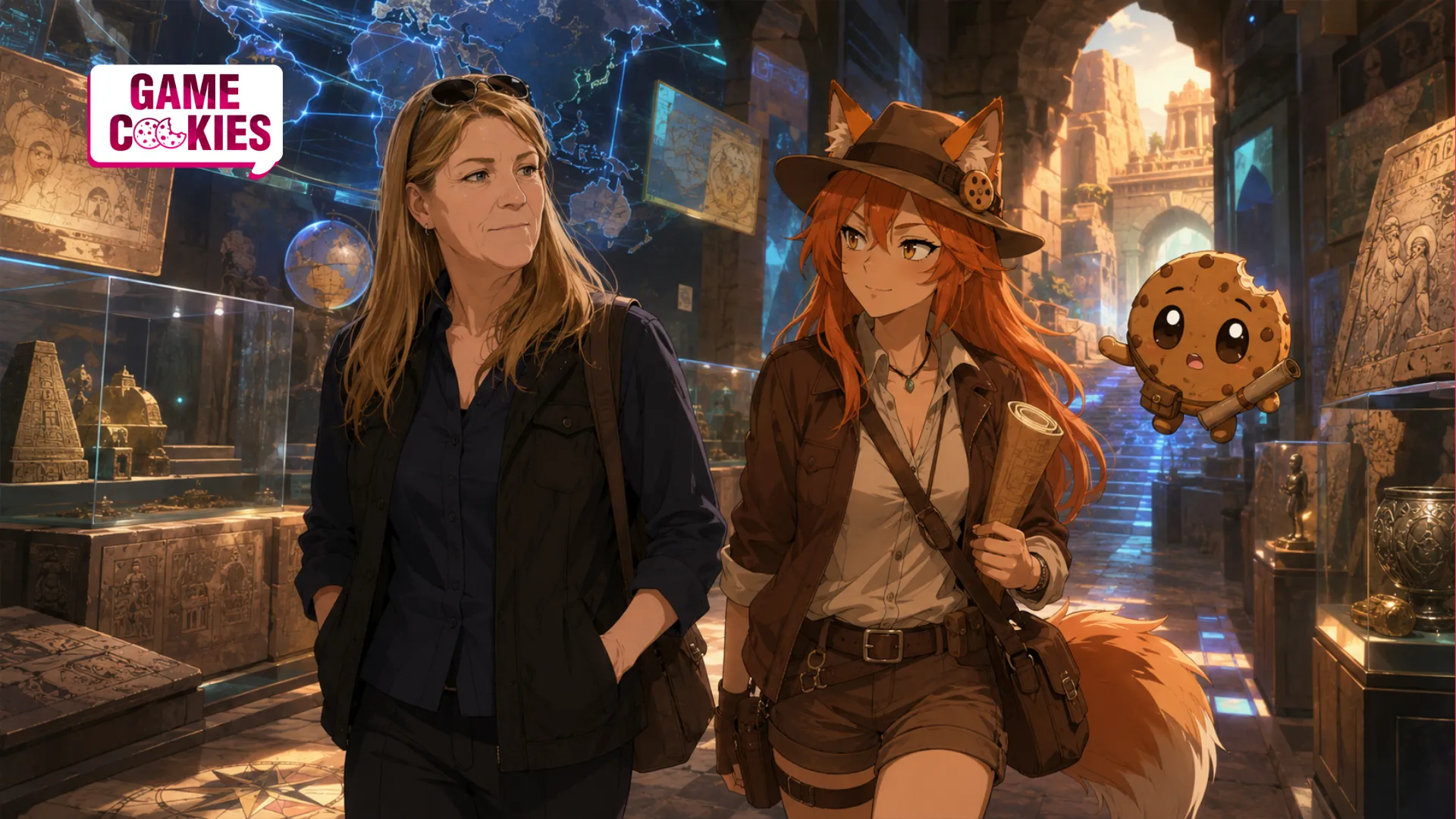
Kate Edwards has spent decades working in that space. Her career runs through cartography, Microsoft, Age of Empires, Kakuto Chojin, the International Game Developers Association (IGDA®), SetJetters, Indiana Jones and the Great Circle, and more than 300 games. She has also been one of the industry’s public voices on harassment, crunch, inclusion, ageism, and the long-term consequences of how studios treat both players and workers.
For this Dialogz interview, Kate spoke with Game Cookies about culturalization, AI risk, global audiences, creative resistance, and why games are cultural artifacts whether studios plan for that or not.
This interview was conducted in writing and edited for structure and readability. Kate Edwards’ quoted answers are preserved from her written responses.
A map line can become a political statement
Before Kate became one of the best-known voices in game culturalization, she worked in cartography and digital mapping. That background taught her to see maps as systems of representation: technical, data-driven, and supposedly objective.
That changed during her time at Microsoft in the late 1990s, while working on early titles like Age of Empires.
A relatively small geographic detail, specifically the depiction of an international boundary, triggered concern from the South Korean government. The team had not intended to make a political statement. They were trying to be accurate. The problem was that “accuracy” itself can be contested.
“That was the moment I fully realized that maps are never neutral. Every line, every label, every omission carries meaning, and that meaning can be interpreted politically, culturally, or historically depending on the audience.”
For Kate, that moment reframed games as global artifacts. Once a game ships internationally, it enters a network of interpretation that the development team cannot fully control. A border, a label, or an omission can say something even when nobody meant to say anything at all.
“What struck me most was that the development team had no intention of making a political statement. They were simply trying to be accurate. But ‘accuracy’ itself is often contested.”
That idea became central to her work: games are received by audiences with different histories, sensitivities, politics, and expectations. The asset may be digital. The reaction is very real.
🦊 Kiki: I still think this is the part a lot of studios underestimate because maps feel so boring inside production. Like, it’s a line. It’s a label. It’s a tiny thing someone probably reviewed at 1 a.m. while also fixing UI bugs and eating cold noodles. But players and governments do not evaluate your intent. They evaluate what appears on screen. That is the scary part. A team can be completely sincere and still walk into a mess because nobody in the room knew the line carried history. And honestly, that is why culturalization should be closer to design than PR. If PR is touching it first, everyone is already sweating.
🍪 Chip stares at a map, gently nudges one border line, then immediately hides behind a globe.
The “oh sh*t” moment that changed everything
The most dramatic example from Kate’s career is still Kakuto Chojin: Back Alley Brutal, the Xbox fighting game Microsoft recalled after religious content appeared in the game’s soundtrack.
Kate describes it as the biggest “oh sh*t” moment of her career.
“It remains one of the clearest examples of how a single content asset can escalate into a major geopolitical and cultural crisis if teams don’t fully understand the context of what they’re shipping.”
The issue came from a background audio track used for a fighter character. Someone had added Arabic chanting because it sounded atmospheric and authentic. When Kate asked an Arabic linguist at Microsoft to review the audio, they found that the chant contained verses from the Quran.
That changed the situation completely.
“In many Islamic cultures, particularly in places like Saudi Arabia, Quranic verses are treated with profound reverence and are not supposed to be mixed into entertainment media, especially violent entertainment like a fighting game.”
The team had not acted maliciously. That is part of what makes the example so useful. The mistake came from context failure. A sacred religious text had been treated as aesthetic texture. Then it was placed inside a violent fighting game.
Kate pushed internally to stop distribution, but the game had already entered manufacturing and release pipelines. Formal objections followed from the Saudi government. Microsoft recalled the game globally and issued apologies. Kate later traveled to Riyadh to meet with Saudi officials and media representatives on Microsoft’s behalf.
By then, the problem had expanded beyond the game itself. It touched Microsoft’s reputation and business relationships across the Middle East.
“Ironically, that crisis became one of the foundational moments for what later evolved into formal game culturalization processes.”
Internally, the incident helped executives understand that culturalization could not remain reactive. The review needed to happen before the asset became expensive, public, and politically charged.
🦊 Kiki: And the wild thing is, Kakuto Chojin wasn’t even some impossible-to-predict lightning strike. Gaming had already brushed against this exact kind of mess with Ocarina of Time. The early Fire Temple theme had Islamic recitations in it, and Nintendo later changed the track. The Gerudo symbol also got changed because, yeah, maybe borrowing real religious-looking imagery for your desert fantasy tribe gets complicated fast.
Like… bro. This is Nintendo. Zelda. One of the most carefully protected franchises in gaming history. And even there, you had sacred-sounding material used as dungeon atmosphere because someone probably heard it as “mysterious chant texture” instead of asking what it actually was. That is the whole problem in miniature.
So when Kate talks about Kakuto Chojin, I don’t read it as some bizarre one-off Microsoft disaster. I read it as the industry learning the same lesson harder, louder, and with way more executives sweating in conference rooms. If your production pipeline treats culture like a sample pack, eventually the sample pack punches back.
🍪 Chip slowly deletes a folder named “cool mysterious chants” and replaces it with “ask someone first.”
Culturalization is part of creative execution
Culturalization still faces resistance inside development. Kate says that resistance usually comes from a misunderstanding of what the work is trying to achieve.
Some teams hear culturalization and assume it means creative restriction, market-safe blandness, or a global standard that flattens the work. Kate frames it differently. For her, culturalization is about making the creative vision land more effectively across audiences.
The conversation changes when teams understand consequence.
“Instead of saying ‘this is problematic,’ I say, ‘this will be interpreted this way in this market, which could lead to X consequence.’”
That consequence might be a ratings issue, a market ban, a delayed release, a public backlash, or a business relationship problem. Once the conversation becomes specific, teams tend to engage more constructively.
“Once teams see that culturalization is about informed decision-making, not restrictions, they tend to engage more constructively.”
That distinction matters. Culturalization does not have to mean removing bold ideas. It can mean understanding how those ideas will be read once they leave the studio.
🦊 Kiki: Developers already accept this logic in other parts of design. If players misunderstand a mechanic, you tune it. If the UI sends people the wrong way, you fix it. If a tutorial teaches the wrong behavior, everyone agrees the game has a communication problem. But when culture is the thing being misunderstood, suddenly people act like someone is trying to take the soul out of the project. Come on. Meaning is part of the player experience too. I hate how clean this sounds, but culturalization is basically UX for interpretation. Terrible phrase. Annoyingly accurate.
🍪 Chip stamps “context needed” on a suspicious prop and nods with tiny bureaucratic seriousness.
Fictional worlds still borrow from real ones
One of Kate’s key ideas is “allegorical distance,” which refers to how closely a fictional game world maps onto real cultures, places, conflicts, or histories.
Teams often misjudge that distance. If a game borrows too directly from real cultures or conflicts, it inherits the sensitivities attached to them. If it drifts too far away, the world can feel generic or hollow.
“The mistake I see most often is inconsistency. A game might use real-world geography but fictionalize cultural elements, or vice versa. That creates a kind of cognitive dissonance for players.”
That inconsistency can produce two different problems. Some players feel misrepresented or offended. Others simply disengage because the world does not feel authentic.
“Getting it right requires intentionality: understanding exactly how much you’re borrowing and why.”
This is where culturalization becomes part of world-building. A fictional empire, tribe, religion, costume, ritual, city, or naming convention may still carry visible real-world echoes. Players notice when those echoes feel researched. They also notice when they feel like decoration.
Culturalization is also a business conversation
For Kate, culturalization eventually becomes a business issue. When budgets are tight and priorities shift, studios need to understand the measurable impact.
She points to two main levers: risk mitigation and market expansion.
“On the risk side, a single cultural misstep can result in a game being banned, delayed, or pulled from a market, which is a clear financial impact.”
That side is easy to understand once something goes wrong. Delays, recalls, public apologies, market restrictions, legal attention, and executive damage control are expensive.
The opportunity side matters too. A game that is culturally aware can feel more accessible and meaningful to players who might otherwise feel ignored, flattened, or misread.
“The key is to position culturalization not as a separate process, but as part of good global design.”
That timing is crucial. Culturalization loses power when it becomes a late-stage cleanup pass. By then, the expensive choices are already locked into narrative, art, audio, geography, UI, marketing, and localization.
Indiana Jones and the line between accuracy and playability
Kate also worked on Indiana Jones and the Great Circle, where authenticity carried unusual weight. Indiana Jones depends on cultural, historical, and geographic texture. If the artifacts, locations, and environments feel careless, the fantasy starts to weaken.
At the same time, a modern action-adventure game has pacing needs. Real-world travel distances, artifact contexts, and environmental details do not always fit cleanly into gameplay.
“There were moments where historical accuracy or geographic realism could have slowed down the experience.”
The solution was prioritization. The team preserved authenticity where it directly supported immersion, especially in cultural representation, environmental design, and artifact credibility. Other areas, such as scale and traversal, could be abstracted to serve the game’s rhythm.
“It’s always a balancing act, but when done well, authenticity really enhances the experience rather than constraining it.”
That answer shows a useful production truth: authenticity is not a single switch. Some details protect the fantasy. Other details may need compression so the game can move.
Progress after Gamergate has been uneven
Kate was one of the people willing to speak publicly during Gamergate, especially around harassment, diversity, and industry responsibility. Looking back a decade later, she sees progress, but she does not describe it as clean or complete.
“Since Gamergate, I would say there has definitely been progress, but it’s been uneven and sometimes superficial.”
The industry has more inclusive policies, more awareness, and more willingness to discuss harassment and inclusion. Those changes matter. Yet Kate says many underlying tensions remain.
“In some cases, the industry has simply become better at managing optics, knowing what to say publicly, without fully addressing systemic issues.”
She also points to the current polarized social and political climate, where companies that publicly emphasize diversity and inclusion can become targets. That has complicated progress and made some companies more cautious.
Still, Kate sees long-term reasons for optimism. New developers are entering the industry with different expectations around inclusion, accountability, and workplace culture.
Crunch is still a leadership problem
Crunch has improved in some ways, according to Kate, but it has not disappeared. In some cases, it has become less visible.
The familiar drivers remain: tight deadlines, financial pressure, competitive markets, and production plans that rely on workers absorbing the impact of bad decisions.
The missing piece is consistent leadership accountability.
“Crunch is often framed as a team-level issue, but it’s fundamentally a management issue.”
For Kate, the problem comes down to planning, prioritization, and resource allocation. During her time running the IGDA, she often made the point bluntly.
“In most other industries, ‘crunch’ is simply called ‘poor project management.’”
That line cuts through years of industry mythology. Crunch is often framed as passion, sacrifice, or team spirit. Kate’s framing puts responsibility back where it belongs: with the people who build the plan, set the deadlines, and allocate the resources.
The industry loves fictional mentors more than real ones
Kate created the 50 Over 50 list to push back against the industry’s fixation on youth and novelty. She sees one misconception repeated often: the idea that innovation is tied mainly to youth.
“Innovation benefits from a combination of fresh perspectives and experienced insight.”
Experienced developers bring more than technical memory. They mentor, contextualize, and recognize patterns. They have seen technology cycles repeat, market trends return under new names, and production mistakes come back with better branding.
Kate points out the irony in an industry obsessed with wise mentors in fiction.
“For such a geeky industry that openly thrives on so many iterations of the hero’s journey, and how explicitly we admire older, wiser veteran mentors in cherished narratives, think Obi-Wan Kenobi, Gandalf, Dumbledore, etc., why doesn’t that perception of value transfer to our real workplaces?”
The industry loves the image of wisdom. It does not always protect the people who carry institutional knowledge.
AI scales cultural risk
AI is now moving through content creation, localization, world-building, and production workflows faster than many studios can define clear standards. Kate is not opposed to experimentation, but she sees major cultural risks.
“AI introduces a new layer of complexity because it scales both creation and risk simultaneously.”
Many AI systems are trained on large datasets that reflect dominant cultural narratives. Those datasets are often Western-centric, which means the tools may default to those perspectives unless carefully guided.
The deeper issue is trust.
“The risk isn’t just bias. It’s the illusion of neutrality.”
AI output can feel objective because it is machine-generated. In practice, it reflects the data, assumptions, exclusions, and dominant patterns it learned from. That can become especially dangerous in cultural work, where missing context is often the whole problem.
Kate also warns about homogenization. If many teams rely on similar tools trained on similar data, content may become less culturally diverse over time.
“Culturalization in an AI-driven world becomes even more critical, not less.”
For Kate, AI may support the process, but it cannot replace cultural expertise.
🦊 Kiki: This is the AI problem that makes me itchy. The output arrives looking confident, clean, and weirdly finished, so someone in a hurry assumes it is safe. Then the team ships a polished mistake because nobody in the room knew what the tool missed. And cultural context is exactly where that gets dangerous. AI can generate a symbol, a name, a ritual, a costume, a faction, a fake language, whatever. It may look plausible enough to pass a rushed review. That does not mean it understands what it is echoing. Use the tool if it helps. Fine. But leaving it unsupervised on cultural meaning is like letting a raccoon organize your legal department because it has tiny hands and appears committed.
🍪 Chip watches an AI label sacred imagery as “cool fantasy decoration” and silently drags the file into an emergency review folder.
Serious games still have to work as games
Kate has long argued that games can do more than entertain. They can educate, build empathy, and help players understand the world differently.
But she says games often fall short when meaningful content is treated as something separate from entertainment.
“When educational or cultural elements feel bolted on, players disengage.”
For Kate, the stronger opportunity is to embed meaning into core mechanics. The gameplay itself should carry the idea, perspective, or experience.
She points to franchises like Assassin’s Creed and Age of Empires as examples where history and geography have been woven into the player experience effectively, though she still sees plenty of untapped potential.
🦊 Kiki and 🍪 Chip silently hold up a sign with Kingdom Come: Deliverance 2 on it and nod like, yeah, exactly.
The mistake that keeps repeating after more than 300 games
After working across more than 300 games, Kate says one mistake appears again and again, regardless of studio size or experience.
“The assumption that a single perspective will resonate globally.”
Teams often design from their own cultural viewpoint and assume it will translate. Sometimes it does. Often it does not.
What surprises Kate is that this happens at every level, from small indie teams to large AAA studios. She does not see it purely as a resource issue. She sees it as a mindset issue.
“The teams that succeed are the ones that proactively seek out diverse perspectives and incorporate them into their design process right from the start.”
The fix is not mysterious. It requires humility, timing, and bringing the right perspectives into the process before the expensive choices harden.
The global audience is fragmenting
While much of the industry is focused on AI, layoffs, and market disruption, Kate thinks one major shift is still being underestimated: the fragmentation of global audiences.
“We’re moving away from broad regional categories like ‘Western’ and ‘Eastern’ markets.”
Expectations are becoming more diverse and localized within regions. Emerging markets are becoming more influential as creators as well as consumers. That means old labels are getting weaker.
Studios that continue to think in simplified global categories will struggle.
“The future belongs to those who can navigate complexity and design for a truly global and highly differentiated audience.”
That may be the clearest warning in the interview. The global market is not becoming easier to read. It is becoming more specific.
🦊 Kiki: This is where that magical phrase “the modern audience” starts looking goofy as hell. Every time I hear it, I imagine some executive deck with one fake person on it who somehow represents teenagers, parents, RPG sickos, mobile whales, cozy gamers, anime fans, horror freaks, Latin America, Europe, Japan, Southeast Asia, and one guy on Reddit who only buys games with fishing mechanics.
Like… bro, that person does not exist. The “modern audience” is usually just whatever a studio, publisher, platform, or consultant needs to justify the decision they already wanted to make. Sometimes it gets used to chase trends nobody asked for. Sometimes it gets used as a shield when the writing is mid. Sometimes angry fans use it as a punching bag for every change they dislike. Both sides make it dumb.
Kate’s point lands because global players are getting more specific, not easier to compress. You cannot design for “the modern audience” like it is one big blob with a controller. You have to know who you are talking to, what they care about, what they ignore, what they forgive, and what makes them instantly go, “Yeah, this was not made with us in mind.”
🍪 Chip holds up a chart labeled “THE MODERN AUDIENCE,” realizes it is just one confused stick figure, and quietly shreds it.
Last Bite
Kate Edwards’ work points to an uncomfortable truth for game development: shipping globally means being interpreted globally.
That does not require games to become cautious or sterile. It requires studios to understand what they are borrowing, what they are inventing, and how those choices may land once they leave the room where they were made.
A line on a map can carry history. A sound can carry religion. A fictional culture can carry real-world echoes. AI can produce clean-looking content while hiding the assumptions underneath. None of that waits politely for a post-launch patch.
Stay intentional, like Kate’s approach to culturalization and global design.
Keep questioning the choices that feel neutral, especially when nobody in the room has the context to test them.
And remember: global players do not just play games. They read them.
🦊 Kiki · 🍪 Chip · ⭐ Byte · 🦁 Leo