

Hello there… industry watchers, budget skeptics, and anyone still trying to justify how AAA math keeps getting this out of control.
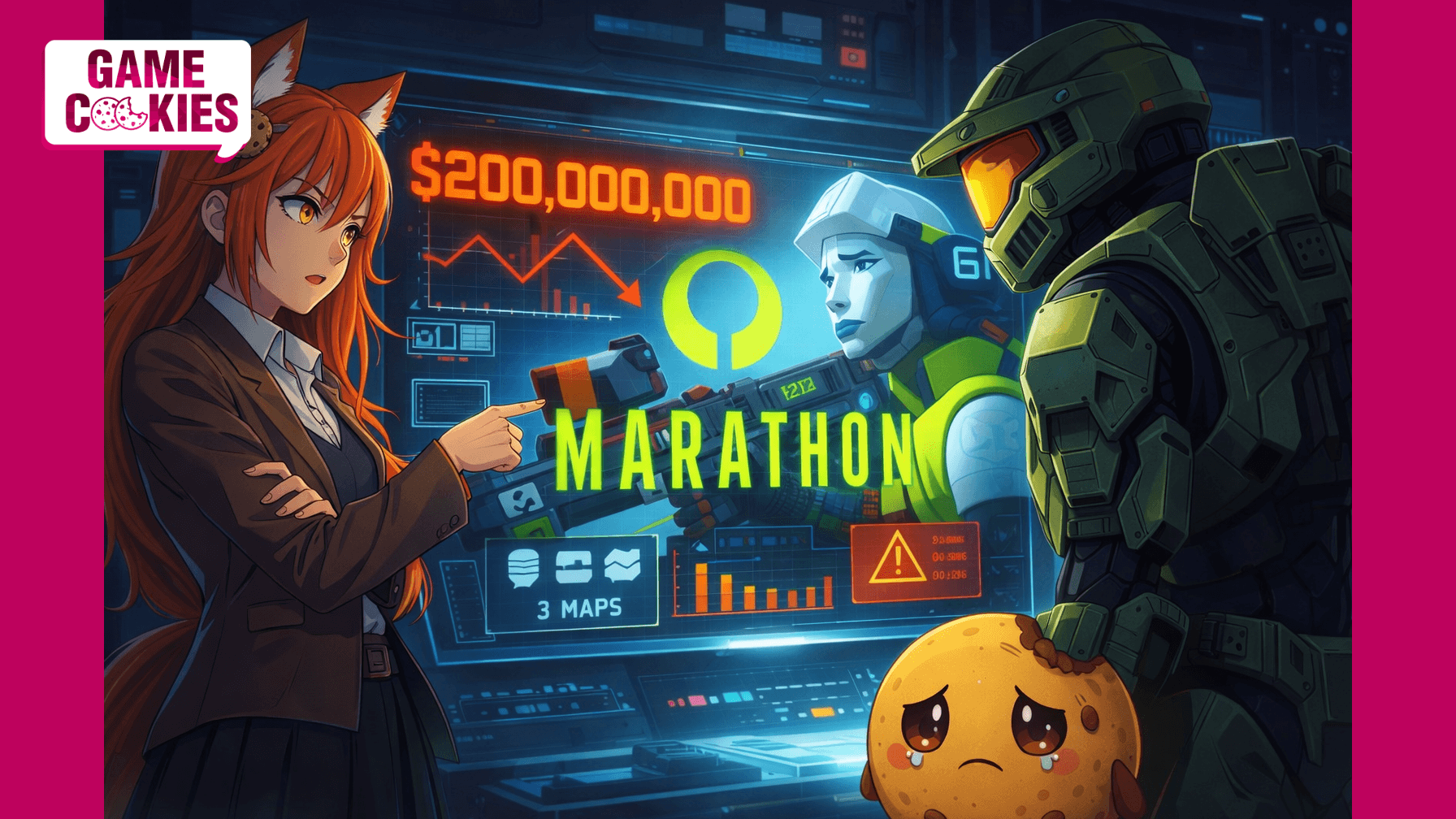
Bungie Marathon reportedly crossed the $200 million mark, with some estimates pushing it closer to $250 million. That places it in the same financial territory as Grand Theft Auto V, one of the most content-dense and commercially successful games ever made.
That comparison is not a fun fact.
That’s the problem.
The budget is blockbuster. The output doesn’t feel like it
When a game enters the $200M+ bracket, expectations change. Not marketing expectations. Player expectations.
You expect:
scale
content density
breadth of systems
a clear sense of where the money went
Marathon doesn’t clearly communicate that.
This is not about calling the game “bad.” The issue is perception versus investment. Players are looking at a premium live-service extraction shooter with a relatively narrow content offering and asking a very simple question:
How did this cost that much?
And that question is dangerous, because once it starts circulating, it doesn’t go away.
The retention curve is not what a $200M game needs
Early data paints a very specific picture.
Around 1.2 million units sold
Strong concentration on PC (~70%)
Average playtime ~28 hours
Only ~7% of players crossing the 100-hour mark
That’s not failure.
But it’s also not the shape of a breakout live-service hit.
It suggests a split audience:
a highly engaged core
a much larger group that doesn’t fully convert
For a game at this cost, that’s a structural issue. These games are built around scale, retention, and long-term monetization. If the funnel narrows too aggressively, the economics start to break.
The design leans toward the elite, not the mass
One of the more subtle problems is how progression and endgame are structured.
High-end content appears to be gated behind extreme investment. That creates a strong loop for the most dedicated players, but it also risks alienating everyone else.
This kind of design tends to produce:
highly loyal top players
steep drop-off below that layer
limited mid-tier engagement
That’s fine for a niche title.
It’s not fine for a $200M live-service bet.
Bungie didn’t have room to miss
This is where the context matters.
Bungie has already gone through:
layoffs across 2023–2024
leadership transition in 2025
declining performance in Destiny 2
a ~$200M impairment tied to underperformance
Marathon wasn’t just another project.
It was part of a broader recovery and positioning strategy under Sony.
At that point, the margin for error is gone.
You don’t need perfection. But you do need momentum.
The development signals were already there
Before launch, Marathon was:
delayed indefinitely
reworked after community feedback
impacted by an art controversy that required internal review and corrections
Those are not minor events. They usually indicate deeper production friction:
iteration cycles expanding
direction shifting
assets being replaced or rebuilt
timelines slipping
All of that translates directly into cost.
And eventually, into pressure.
🦊 Kiki:
Yeah, okay… let’s just say it properly because everyone in the industry is thinking it, but nobody wants to write it down with their real name attached.
This doesn’t look like a clean $200 million game.
It looks like a game that got expensive because it didn’t know what it was early enough.
That’s the part people dance around. They’ll say “rising costs,” “modern pipelines,” “AAA complexity.” Sure. All of that is real. But there’s a difference between expensive execution and expensive confusion.
And this feels like confusion.
Because if everything is going right, you don’t end up with players questioning where the budget went. You don’t get that disconnect. You don’t get that weird moment where someone compares your game to GTA V and it doesn’t feel like a compliment.
It feels like a mismatch.
And let’s be honest for a second, because this is where people start getting nervous about saying the quiet part out loud.
A lot of teams in big studios know exactly how this happens.
You get early prototypes that don’t land. You pivot. Then you pivot again. Then leadership changes something mid-stream. Then you rebuild systems. Then you cut content. Then you rebuild again.
And suddenly the budget isn’t high because the game is massive. It’s high because you paid for multiple versions of the same game.
Nobody wants to admit that publicly. Especially not if you work in the industry. You don’t call that out on LinkedIn. You don’t post that on X. You don’t say that in interviews.
But when you see a $200M+ tag on a game that players describe as “not enough content”… people connect those dots privately.
And the other uncomfortable part?
This wasn’t supposed to be a side experiment.
This was supposed to be one of Sony ’s pillars for live service. The “next big thing” after Destiny. The proof that Bungie still had that muscle.
So when the player curve drops fast, and the content conversation is already happening, and the hardcore players are basically the only ones fully engaged… yeah, people inside companies start asking very real questions.
Not publicly.
But internally? Those conversations get sharp.
Because at that scale, it’s not about whether the game is fun.
It’s about whether the business case still holds.
And right now… it’s not obvious that it does.
🍪 Chip quietly sits next to a giant budget number… then slowly lowers his head like he just understood everything at once
This is a broader industry problem
Marathon is not an isolated case.
AAA budgets are now regularly pushing $300M+ for major productions. The assumption has been that bigger investment increases the probability of success.
What’s happening instead is risk concentration.
Fewer bets. Larger stakes. Less tolerance for underperformance.
And in live-service specifically, that model becomes even more fragile because success depends on:
sustained player engagement
consistent content delivery
strong community retention
You don’t “ship and recover.” You either hook players early, or you spend months trying to climb back.
The real question Sony has to answer
This is where it stops being a game discussion and becomes a strategy discussion.
Marathon doesn’t need to be the biggest game in the world.
But it does need to justify its cost.
And right now, the signals are mixed at best.
solid core engagement
weak broader retention
high development cost
ongoing pressure on Bungie
That combination forces a hard question:
Can this realistically scale into a long-term return… or is it going to stabilize below the level it was built for?
That answer is what Sony should be watching very closely.
⚙️ Stay skeptical
⚙️ Keep auditing
⚙️ And remember — expensive games don’t fail loudly, they fade quietly until someone cuts the budget
🦊 Kiki · 🍪 Chip · ⭐ Byte · 🦁 Leo