


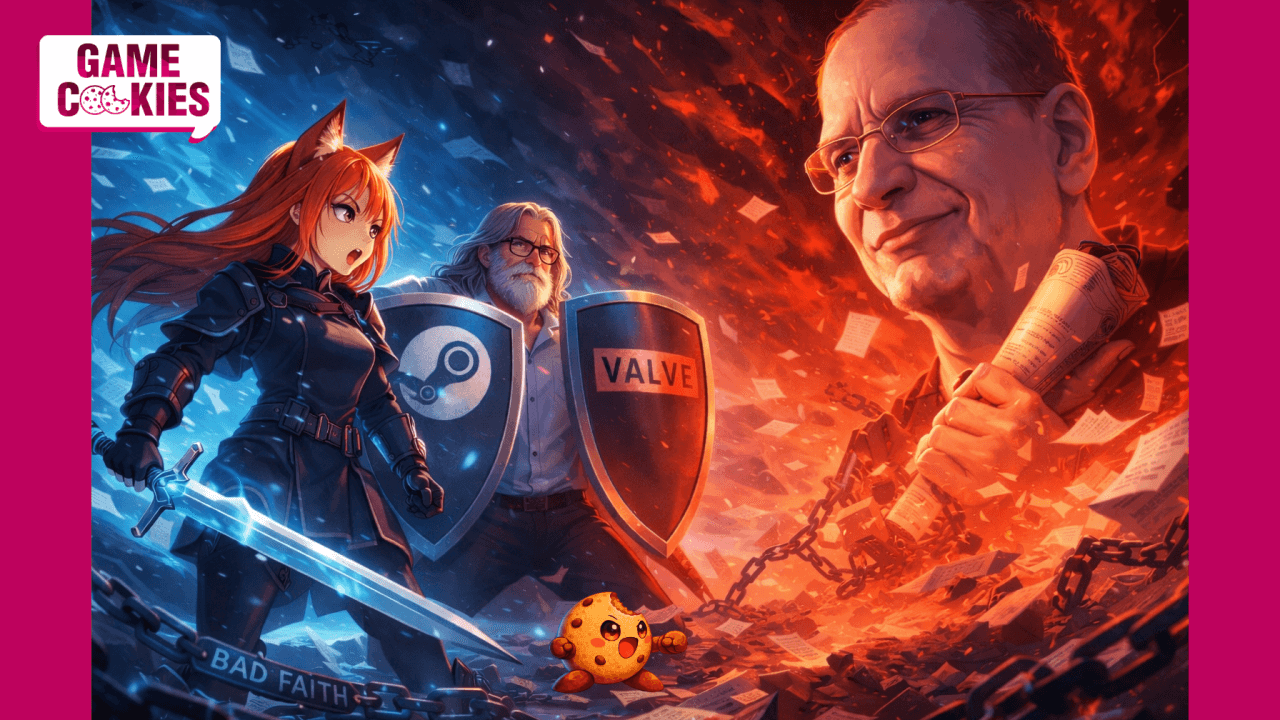
Hello there, developers who’ve paid a legal invoice just to make a problem disappear.
Because that’s how this normally ends.
A patent claim shows up. It’s vague. It’s broad. It smells wrong. But fighting it costs millions. So you pay. You move on. You call it operational friction.
Valve corporation didn’t.
And that’s why this one matters.
The “peace treaty” that was supposed to end it
In 2016, Valve signed a Global Settlement and License Agreement with patent litigator Leigh Rothschild.
Valve paid a lump sum for a perpetual, irrevocable, royalty-free, fully paid-up worldwide license to the patent portfolio.
Perpetual means forever. Irrevocable means you don’t get to change your mind.
Six years later, one of Rothschild’s entities sued Valve anyway over a patent Valve says was already covered under that agreement.
Valve sent them the contract.
Instead of backing off immediately, the lawsuit ran until it was dismissed.
A federal judge ruled that filing the lawsuit itself constituted a breach of contract. And dismissing it later did not fix it.
That’s already decided.
Now it’s about damages.
The patent itself
One of the disputed patents describes:
“A method for storing media content and delivering requested media content to a consumer device.”
Read that slowly.
Storing content. Delivering content. To a device.
That’s not a niche invention. That’s the internet.
Streaming video fits. Downloading a game fits. Running a storefront fits.
This is where people get irritated.
Because when a patent sounds less like innovation and more like a description of infrastructure, it doesn’t feel like protection. It feels like leverage.
This case isn’t about whether the patent is valid. It’s about whether Valve already licensed it. But the scope explains why this doesn’t feel like a normal business dispute.
🦊 Kiki: Let’s call it what it is. When you patent something that abstract and then try to enforce it after taking a perpetual payout, you’re not defending innovation. You’re running a slot machine. Pull the lever, hope someone folds. That model works until someone with real money decides they’re done being the casino customer.
🍪 Chip pulls a tiny slot handle. Nothing comes out.
The “genuine mistake” defense
In 2023, another patent threat was sent. This time the explanation was that it was a mistake. The patent had allegedly been overlooked.
The judge declined to settle that part on summary judgment. A jury may decide whether it was a genuine oversight or something more deliberate.
This is where pattern matters.
One lawsuit might be sloppy.
Two starts to look comfortable.
🦊 Kiki: If you forget once, that’s negligence. If you forget twice, that’s habit. And if the only company that fights back happens to be the one with the deepest pockets, that’s not coincidence. That’s selective pressure. Funny how “mistakes” survive until they hit someone who can afford to expose them.
🍪 Chip holds up a sticky note that says “Oops?” and slowly crumples it.
This stopped being a contract dispute
Valve didn’t just argue breach of contract.
They invoked Washington’s Patent Troll Protection Act.
That law targets bad-faith patent assertions. Rothschild’s side argued that only the Attorney General could bring those claims.
The judge disagreed.
Valve can pursue them directly.
That means this case isn’t just about breaking a license agreement. It’s about whether the business behavior itself crosses into unfair or deceptive trade practice territory.
And if statutory damages come into play, that changes incentives fast.
🦊 Kiki: This is the part I love. Most companies treat trolls like a cost center. Valve treated it like a hostile act. That’s the shift. When you move from “let’s make this go away” to “let’s make this expensive,” you flip the table. And suddenly the model that relied on low-risk intimidation doesn’t look so safe.
🍪 Chip flips a tiny table and dusts off his crumbs.
Piercing the insulation
Patent trolling thrives on insulation.
LLCs. Asset-light entities. If one loses, it collapses. The individual walks away untouched.
Valve is trying to pierce that insulation and pursue personal liability.
That’s not symbolic. That’s existential for this kind of model.
Because once personal exposure is real, high-volume litigation strategies start looking like high-stakes gambling.
🦊 Kiki: You can’t build an empire on shell games forever. If the veil cracks even once, everyone running that playbook starts sweating. Not because they’re guilty. Because the risk profile just changed overnight.
🍪 Chip gently taps a tiny cardboard “LLC” wall. It wobbles.
Why this feels different
Patent abuse thrives on asymmetry.
Smaller studio gets a letter. They panic. They pay. Mid-sized company negotiates. Big company shrugs and writes a check.
Valve didn’t shrug.
They escalated.
Not because they had to survive. Because they could afford to fight.
🦊 Kiki: This isn’t about worshipping Valve. It’s about incentive math. Patent trolling survives because resistance is expensive. Valve absorbed the cost. If they win decisively, the message is simple: intimidation is no longer low-risk. And once intimidation gets expensive, volume drops. That’s how ecosystems stabilize. Not with speeches. With consequences.
🍪 Chip flips a sign from “Easy Target” to “Try Again.”
The uncomfortable question
Do you think this was the only time this “mistake” happened?
Or just the first time someone pushed hard enough to turn it into precedent?
If Valve lands this cleanly:
Perpetual licenses regain teeth
Bad-faith threats get riskier
Personal liability becomes realistic
High-volume trolling models get stress-tested
That won’t end patent abuse.
But it will make it less comfortable.
And discomfort is how abuse shrinks.
Stay relentless inspired by companies that refuse intimidation
Keep documentation tight inspired by contracts that survive scrutiny
And remember asymmetry only lasts until someone powerful decides to absorb the cost of breaking it
🦊 Kiki · 🍪 Chip · ⭐ Byte · 🦁 Leo