

Hello there, cookie munchers, chainsword polishers, disclosure readers, and everyone tired of watching a social-media pile-on apply for creative director.
A dispute around Saber Interactive’s upcoming driving game Rideshare “Stimulator” began with former lead writer Stella Sacco saying she was “replaced with ChatGPT midway through development”. Saber denied replacing writers with AI and said the main story was written by people, while an experimental Free Ride mode would use generated content.
The current Steam disclosure now says the Campaign story, characters, and dialogue are human-written. It identifies AI voice generation and some localization, generated passenger missions and localized dialogue in the optional Free Ride mode, and a mix of human-made and AI-generated radio music. Buyers can see the scope and decide for themselves.
The staffing dispute remains unresolved in public. Sacco’s account and Saber’s denial conflict, and the available evidence does not establish a complete production timeline. That uncertainty does not give activists authority over Saber’s hiring, firing, or creative direction.
Saber co-founder and CEO Matthew Karch refused to perform the ritual apology. As reported by PC Gamer, he said he had to ask Claude who Sacco was, accused her of violating confidentiality, said she had been replaced by someone more talented, and argued that the AI use would benefit consumers. The delivery was brutal. The underlying principle was correct: a studio can choose its team, defend its project, and decline an activist veto.
🦊 Kiki:
I support Karch’s refusal to surrender. His response was personal, abrasive, and much harsher than a communications team would approve. Good. A public allegation does not automatically become true because activists repeat it with the confidence of people who have never seen the personnel file.
Here is the principle: players may question the product, demand an accurate AI disclosure, criticize management, or refuse to buy. None of that appoints a social-media crowd to Saber’s hiring committee. The progressive activist playbook keeps skipping the evidence stage. An accusation appears, a villain is assigned, and the only acceptable corporate answer is an apology written before the investigation begins.
The fair objection is that CEOs can abuse power and employees can be treated badly. Absolutely. That is why contracts, records, labor law, and evidence exist. Karch’s claim that someone more talented replaced Sacco remains his assessment, not a fact outsiders can verify. The absence of public proof cuts both ways. It limits his critics too.
I can hear the activist hearing now. ‘Where is your evidence?’ ‘She posted it.’ ‘What result do you want?’ ‘Confession, reinstatement, and creative control.’ A social-media thread tried to promote itself into Saber’s boardroom. Karch found no vacancy and closed the door. Outrage is not a department.
🍪 Chip stamps NOT HIRED on the pile-on’s résumé, then guards the studio keys.
Disclosed AI puts the decision back where it belongs
The Steam page gives players four useful facts. The Campaign narrative is credited to human writers. AI tools support voice generation and some localization. Free Ride contains generated passenger missions and localized dialogue. Radio stations may contain AI-generated music, with those stations labeled inside the game.
Those distinctions follow Valve’s Steamworks content survey, which separates pre-generated content from material created while a game runs. Steam asks publishers to describe player-facing generated art, sound, narrative, localization, and related content. Live generation also requires information about safeguards against illegal output.
Earlier coverage noted that company statements acknowledged an AI-powered mode while the Steam page lacked a public AI disclosure. By August 14, the page contained one. Public evidence does not show whether the controversy caused that timing or accelerated an update already in progress.
The disclosed design mixes human Campaign writing with AI-supported voices, localization, optional missions, dialogue, and music. Game Cookies supports that experiment because the scope is visible. Players can buy it, skip it, wait for reviews, or judge whether the generated mode is any good. Consumer choice works better than ideological permission slips.
🦊 Kiki:
My opinion is simple: disclosed AI is legitimate. A tool does not become immoral because an activist dislikes the people using it. The honest test is whether the feature works, whether the output is legal, whether customers know what they are buying, and whether the result is worth the price. Saber has now given us enough information to apply that test.
The strongest objection is quality. Generated dialogue can be repetitive, synthetic voices can sound cheap, localization can lose context, and infinite missions can become infinite oatmeal. Fine. Review the output and punish bad work at checkout. I support AI because it can expand a mode, reduce production friction, and let a smaller team attempt something larger. I do not support hiding it or pretending generated content is automatically good.
Some progressive activists treat disclosure as an admission of guilt. Ask what wording would satisfy that position and the answer eventually becomes ‘remove the AI.’ Once disclosure is rejected because the disclosed feature still exists, the demand has moved beyond informed consent for buyers. The practical standard becomes ideological obedience from the developer.
Campaign human. Free Ride generated. AI voices, localization, and labeled music. There is the menu. Buy it, skip it, review it, or wait. A disclosure is information for the customer, not a plea bargain for the internet priesthood.
🍪 Chip checks the disclosure box, keeps his wallet, and refuses the complimentary pitchfork.
A studio can choose who builds its games
Sacco’s claim concerns events during development. Saber told outlets that neither it nor developer UNIGINE replaced writers with AI and said its writing staff had tripled since 2023. The product disclosure describes the planned player experience, not every staffing decision or discarded prototype from earlier years.
Generated missions, voices, localization, and music do not prove that a particular employee lost a particular assignment because of ChatGPT. Proving that allegation would require dates, project records, personnel documentation, and testimony that are not public.
Employers still retain the right to assess performance, creative fit, confidentiality, and project needs, then replace people through lawful processes. No job becomes a lifetime appointment because an employee can turn a dispute into social content. Customers judge the shipped game. Social activists do not get a proxy vote over the org chart.
Karch’s claim that Sacco was replaced by someone more talented remains his assessment, not an independently verified finding. Game Cookies supports his right to make that staffing judgment and to defend it publicly. The missing records limit what outsiders can prove about this case. They do not transfer management authority to a comment section.
🦊 Kiki:
A studio must be allowed to replace people when management believes the performance, talent, conduct, or creative fit is wrong. That opinion makes people uncomfortable because losing a job is painful. Pain deserves humane treatment, lawful process, and accurate documentation. It does not create permanent ownership of a role.
I cannot prove Sacco lacked talent, and neither can anyone cheering Karch from outside the company. I can defend his authority to make the judgment. Those are different claims. The product team carries the budget, schedule, licenses, and commercial risk. If the game fails, the same activists will not volunteer to absorb the loss because their preferred employee kept the title.
Yes, management can make terrible decisions. Studios have shipped enough expensive disasters to prove it. The remedy is evidence, contracts, lawful review, and ultimately the market. Replacing management authority with a public vote among people who know one side of a private dispute would produce a studio that hires by applause, designs by purity test, and ships whenever the comment section reaches consensus.
The activists arrived with a verdict, a boycott, and no access to the personnel file. That is courtroom cosplay with worse lighting. Sympathy is human. A hashtag is not an employee badge.
🍪 Chip requests Exhibit A, receives a hashtag, and files it under NOT EVIDENCE.
Hogwarts Legacy already tested the boycott fantasy
The current campaign resembles the public pressure around Hogwarts Legacy. Before its February 2023 release, boycott calls and review controversies tried to turn buying, covering, or streaming the game into an ideological loyalty test.
Players answered at checkout. In December 2025, Warner Bros. Games announced more than 40 million Hogwarts Legacy units sold worldwide. The result cannot tell us how many people abstained or why every buyer purchased it. It does show that the campaign failed to prevent one of Warner Bros. Games’ largest commercial successes.
Online activists can refuse a purchase, criticize a studio, or organize a boycott. They cannot turn visible anger into market authority by repeating it. A boycott earns commercial meaning through measurable purchasing behavior. Hogwarts Legacy left that theory buried under 40 million units.
⭐ Byte:
Confirmed figures: Warner Bros. Games reported more than 40 million Hogwarts Legacy units sold worldwide by December 2025. Saber said Space Marine 2 sold more than seven million units in its first year. Each number measures unit sales for a released game, not social sentiment.
Current unknowns: Rideshare “Stimulator” remains listed as coming soon, and Space Marine 3 is in development. No public dataset shows changed wishlists, canceled future purchases, or lost sales from this controversy. Calling its commercial effect zero would exceed the evidence.
Interpretation: Hogwarts Legacy provides a confirmed precedent for a loud boycott failing to block massive sales. Space Marine 2 provides a confirmed audience for Saber’s franchise. Neither figure guarantees Space Marine 3, but both are stronger signals than a pile of posts from people promising not to buy a game that has no release date.
Space Marine 3 belongs to its players
Space Marine 3 entered development in March 2025. Saber, Focus Entertainment, and Games Workshop presented it as the continuation of a successful franchise. Karch said the game carries tremendous expectations from a rapidly expanding fanbase. Focus promised an immersive campaign, multiplayer, and larger-scale battles, with more information to come later.
Saber’s broader slate also includes Jurassic Park: Survival, Turok: Origins, Hellraiser: Revival, and a John Wick game. A July company portfolio announcement described Space Marine 2 as a seven-million-unit first-year success. None of the reporting about Rideshare establishes that Space Marine 3 or another Saber project uses generative AI.
Game Cookies is eagerly waiting for Space Marine 3. We want Saber judged on the game it ships: its combat, campaign, performance, value, and respect for Warhammer 40,000. An employment allegation from a separate unreleased taxi game does not become a franchise-wide moral embargo through repetition.
🦊 Kiki:
I think this boycott is commercially irrelevant unless the people promoting it can prove they represent a meaningful share of Saber’s customers. Visibility and purchasing power are separate statistics. Ten thousand furious posts from people who never planned to buy Space Marine 3 can create headlines without removing one sale from the forecast.
Hogwarts Legacy is the useful background. Activists tried to turn buying or streaming it into a moral confession. Warner Bros. later reported more than 40 million units sold. That number does not prove every boycott is useless, and it cannot tell us how many people stayed away. It proves something narrower and devastating: a loud campaign can dominate social media while failing to control the customer base.
A fair objection is that a boycott can be personal rather than commercial. Correct. Anyone may refuse the game on principle. Keep that choice. The argument becomes dishonest when an individual refusal is marketed as evidence that the audience has abandoned a franchise. Space Marine 2 sold more than seven million units in its first year, and Focus describes a rapidly expanding fanbase. Those are receipts. Angry quote-posts are intentions.
Notice the fallback when the commercial argument runs out of evidence. The discussion moves from the game to the buyer. Call the customer a chud, shame the streamer, accuse the reviewer of enabling harm, and the activist never has to prove the boycott has leverage. The insult performs the job the missing sales data could not.
My support for Space Marine 3 is not a blank check. Saber still has to deliver the combat, campaign, performance, value, and Warhammer spectacle. If it ships a bad game, players should bury it in honest reviews. Until then, the people activists dismiss as chuds are waiting with chainswords and wallets. The purity test brought no ammunition.
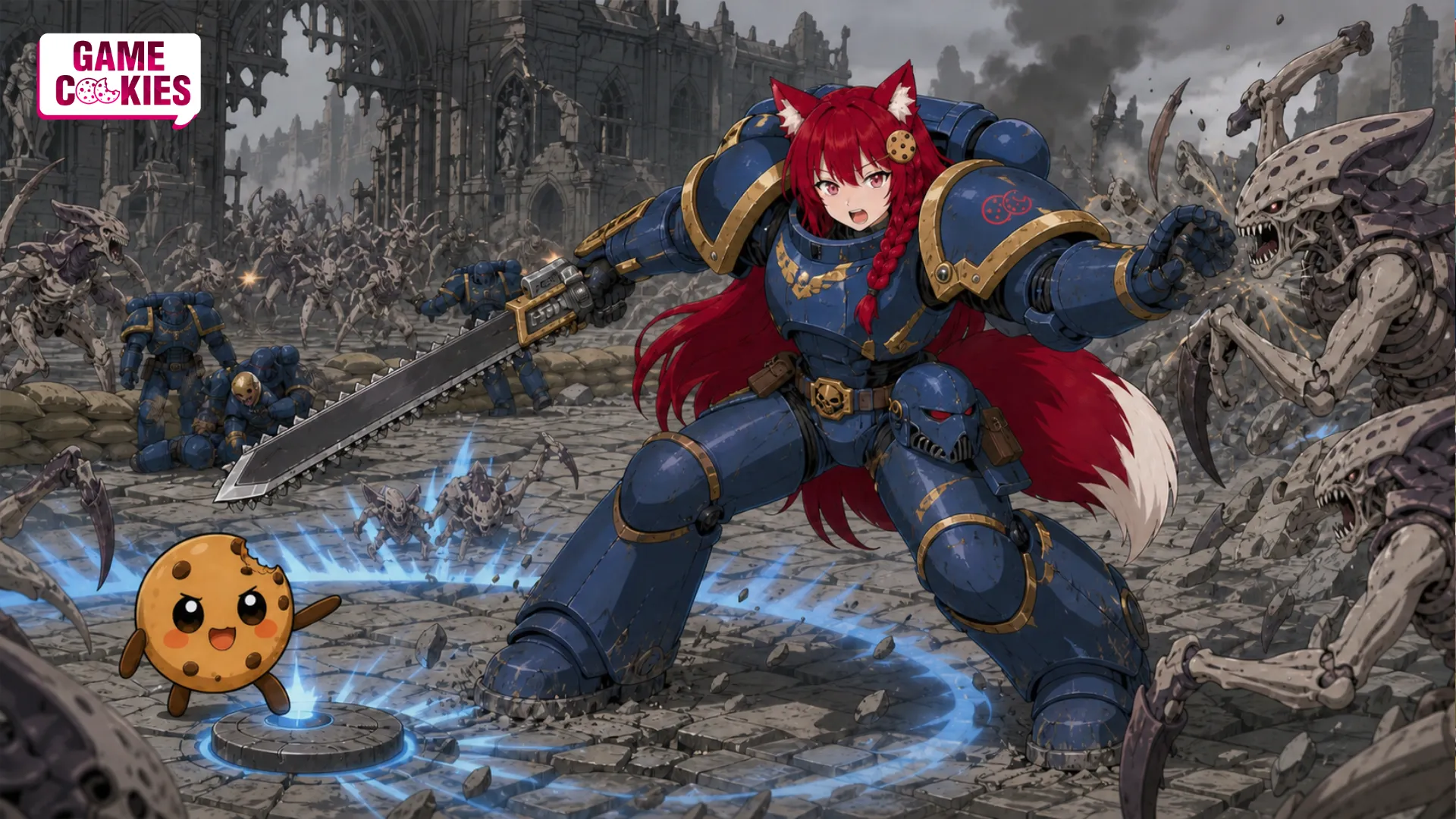
🍪 Chip revs the chainsword, circles WISHLIST, and leaves the outrage seminar on read.
What studios should learn from Saber’s answer
– Disclose AI with feature-level precision. Name human-written, AI-assisted, and live-generated parts so buyers can make an informed choice.
– Document staffing decisions. Performance, fit, confidentiality, and project needs should be recorded and handled through lawful company processes.
– Refuse the activist veto. Criticism deserves an answer when facts require one. A pressure campaign does not inherit control of the team or the creative brief.
– Measure boycotts at checkout. Hashtags, quote-posts, and declarations of intent are not unit sales, refund rates, or lost revenue.
In the end…
Saber disclosed the AI scope. The Campaign remains human-written, while the optional mode and supporting features use generated content. Players now have enough information to make their own decision.
The public record does not resolve Sacco’s employment allegation. It also does not establish activist ownership of Saber’s staffing decisions. Karch rejected that presumption and defended the company’s authority to choose its talent. Good.
Hogwarts Legacy showed what happens when a loud ideological campaign collides with a huge player audience. More than 40 million units later, the hashtags are trivia. We expect the same basic test here: Saber ships, players judge, and Space Marine 3 earns its future on the battlefield.
⚙️ Stay skeptical when social-media outrage claims to represent the whole market.
⚙️ Keep AI disclosed, staff accountable, and creative direction in the hands of the people shipping the game.
⚙️ And remember: hashtags do not buy chainswords. Players do.
🦊 Kiki · 🍪 Chip · ⭐ Byte · 🦁 Leo
Seen a boycott claim collide with the people who actually buy games? Contact us here!