🍪 Resident Evil Creator Says Watching Shouldn’t Be Enough

Hello there, survival horror veterans, YouTube walkthrough archivists, and everyone who says “I’ll just watch the ending” before somehow watching nine hours of gameplay. Today we are talking about Shinji Mikami, game streams, passive audiences, and one very sharp reminder that games are supposed to survive contact with the controller.
Resident Evil creator Shinji Mikami has gone viral for a comment that sounds simple, but lands directly in one of gaming’s messiest modern debates: if someone watches a full playthrough and feels satisfied without ever touching the game, was the stream the problem, or was the game not compelling enough to play?
The comment came through Japanese comedian and YouTuber Eiko Kano, who is known for chaotic Resident Evil playthroughs. Kano said he once worried that his streams might spoil too much of the experience: the puzzles, the story beats, the scares, and all the carefully placed moments that make survival horror work.
Mikami’s reported answer was not anti-streamer. It was harsher than that. He basically put the responsibility back on developers: if watching is enough, the game was only that good.
That is the real story. Not “Mikami attacks streamers.” Not “YouTube is killing games.” The sharper point is that the streaming era exposes which games are built around interaction, and which games are mostly content with buttons attached.
What actually happened
According to Automaton West, Kano brought up the story during a June 18 TV appearance, where he talked about meeting Mikami and asking him directly how he felt about Resident Evil playthroughs.
Kano’s concern was specific. Resident Evil is not just combat. It has puzzles, routes, jump scares, item decisions, story reveals, and boss encounters. A full stream can show a viewer almost everything in order, including the answers the player is supposed to discover under pressure.
Even though Kano reportedly had permission from Capcom, he still wondered whether the creators themselves were uncomfortable with that kind of exposure. He said he was prepared to stop streaming if Mikami answered negatively.
Instead, Mikami reportedly told him that if viewers watch a playthrough all the way to the end and feel satisfied with only that, then the game was only that good. He added that developers should make games that leave people wanting to clear them with their own hands, even after watching someone else beat them.
📢 “Our job is to make games that leave people wanting to clear them with their own hands, even if they’ve watched someone else do it.”
That line is doing most of the work. It turns streaming from a threat into a test. After the stream ends, did the viewer feel like they saw the whole thing, or did they feel like they missed the important part because they never played it?
🦊 Kiki: This is the kind of answer that sounds inspirational until you realize it is also a professional slap with excellent posture.
Because Mikami is not saying “streamers bad.” That would be the easy boomer boss fight. He is saying the developer’s job is to build something that cannot be fully digested by watching someone else press the buttons. And yes, that is annoying, because now nobody gets to hide behind the usual excuse pile.
If a viewer watches your game and immediately wants to play it, congratulations, the stream worked like marketing. If a viewer watches your game and feels done, maybe the streamer did not steal the experience. Maybe your “game” was mostly a guided museum tour with occasional crouching.
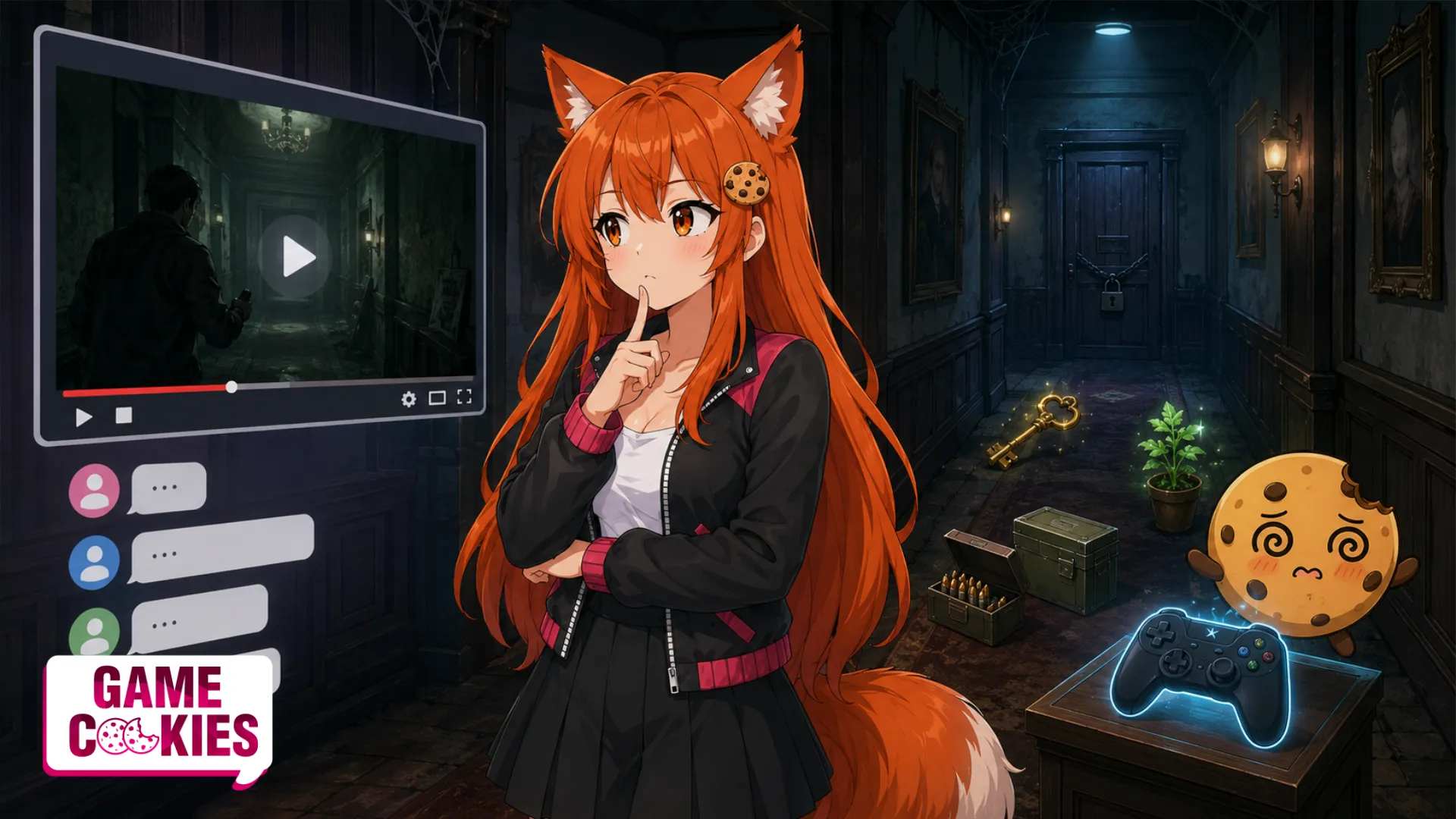
🍪 Chip floats beside a giant play button, holding a tiny controller like it just became evidence in court.
Why people reacted so strongly
The reaction split because Mikami’s comment hits several nerves at once.
Some players loved it because it defends the basic identity of games. Games are not just plot delivery systems with a pause menu. They are timing, pressure, decisions, execution, failure, improvisation, repetition, and all the tiny personal mistakes that make a playthrough feel like yours.
Watching someone solve a Resident Evil puzzle is not the same as solving it yourself while low on ammo, unsure if the next hallway contains a zombie, a locked door, or another little statue asking for a gemstone like it owns the building.
But the pushback also makes sense.
Some people watch games because they cannot afford every new release. Some do not have the hardware. Some want the story but dislike the genre. Some enjoy horror as a spectator sport because playing it directly turns their soul into soup. There is a real difference between “I watched this because the game failed to make me care about playing” and “I watched this because I cannot buy it, run it, or physically deal with it.”
That matters because the strongest version of Mikami’s point is not about every viewer. It applies to the person who could play the game, is interested in the game, watches the entire thing, and then feels no pull to experience it personally.
That is the warning sign. Not because every watcher is lazy. Not because every stream is lost revenue. Because the game’s interactive layer did not create enough curiosity after the spectacle was already exposed.
🦊 Kiki: The internet is very good at turning a useful point into two dumb armies.
Army one: “If you watched it, your opinion does not count.” Calm down, gatekeeper of the sacred loading screen.
Army two: “Watching and playing are basically the same.” No. Also calm down, Netflix-with-button-prompts enjoyer.
The reasonable middle is less dramatic and more useful: watching can give you story, mood, tone, characters, and even a rough sense of pacing. But it cannot give you responsibility. It cannot give you the panic of choosing wrong. It cannot give you the shame of missing five shots at point-blank range while the game quietly asks if you are okay.
That is the part games own. Or at least, the part they should own.
🍪 Chip tries to write “I am brave enough for horror” on a tiny sign, then hides behind it when a door creaks.
The part many headlines miss
The easiest headline is “Resident Evil creator criticizes people who watch playthroughs.” That is not the useful framing.
Mikami’s actual point is much more dangerous for developers because it is not aimed only at audiences. He is not just asking players to respect games. He is asking games to deserve being played.
That is a brutal standard in 2026, because a lot of modern games are fighting for attention against their own complete footage. A new title can be streamed, clipped, summarized, reacted to, explained, spoiled, memed, and archived before many players even finish downloading the day-one patch.
That reality changes the design problem.
If your game depends entirely on “what happens next,” then a full playthrough is a threat. If your game depends on “what would I do here,” then a stream can become bait. The viewer sees a situation and imagines their own route, their own build, their own mistake, their own victory. That is where the controller starts whispering.
This is why the conversation overlaps with what Final Fantasy VII Revelation director Naoki Hamaguchi recently said about modern RPGs. He argued that games need more player agency because viewers may otherwise feel satisfied simply watching someone else stream the story. His answer is not to reject streaming, but to design more moments that make the viewer wonder how their own version would play out.
That is the key. The more a game creates personal ownership, the harder it is to replace with a video.
🦊 Kiki: This is where some cinematic games should start sweating through the expensive leather jacket.
Because if the pitch is “look at our emotional cutscenes,” that is great, but YouTube can show me those. If the pitch is “look at our famous actor,” also great, but YouTube can show me that too. If the pitch is “look at our ending,” congratulations, the thumbnail already ruined it.
But if the pitch is “your decisions, your route, your build, your execution, your panic, your stupid little disaster,” now the stream is not the full product. It is the smell coming from the bakery. You still need to bite the cookie.
And yes, I am proud of that one.
🍪 Chip nods proudly while standing next to a cookie labeled “player agency,” then realizes he is technically also the cookie.
Why this matters for horror games
Resident Evil is a useful example because horror changes dramatically depending on who holds the controller.
Watching a horror game can still be entertaining. Sometimes it is more entertaining. You get the fear without the responsibility. You watch the streamer walk into the terrible hallway, you laugh, you scream, you judge their inventory management, and you get to pretend you would have handled it better.
You would not. But the fantasy is beautiful.
Playing horror is different because the pressure belongs to you. The silence becomes your problem. The ammo count becomes your problem. The decision to save now or risk another room becomes your problem. Even the camera angle becomes personal because your hands are the ones forcing the character forward.
That is why horror can survive streams better than people think, when it is designed around tension and player responsibility. A good horror stream may spoil the location of a scare, but it cannot fully reproduce what it feels like to move toward it yourself.
However, if a horror game leans too hard on scripted moments and not enough on player pressure, then the stream gets much closer to the full experience. The scare becomes content. The puzzle becomes an answer. The monster becomes a clip.
Mikami’s point is especially sharp in horror because the genre is not just about seeing something scary. It is about choosing to continue when the game gives you several excellent reasons to close the application and go water a plant.
🦊 Kiki: Horror is the genre where “watching is enough” is both understandable and a little suspicious.
Understandable because not everyone wants to personally babysit their blood pressure for twelve hours. Suspicious because if the best part of the game is only watching other people scream, maybe the game is closer to a haunted house livestream than a great playable horror experience.
The real magic is when a horror stream makes you say, “I hate this. I need to try it.” That is the toxic little miracle of good survival horror. The game abuses you just enough that you want custody of the trauma.
🍪 Chip puts on a tiny “professional coward” badge and refuses to enter the next hallway without a strategy guide and emotional support crumbs.
The streaming problem is different for every genre
The streaming debate gets messy because people talk about “games” as if every genre works the same way.
A visual novel is not affected like a fighting game. A fighting game is not affected like a survival horror title. A survival horror title is not affected like a sandbox RPG. A roguelike, a strategy game, a party game, a Soulslike, a mystery game, and a cinematic action game all have different relationships with being watched.
For a visual novel or mystery-heavy game, spoilers can seriously weaken the product. Watching the ending can almost replace the purchase because the reveal is the main attraction. That is why some Japanese publishers still use strict streaming rules, and why Steins;Gate Re:Boot recently drew attention for announcing a full streaming and upload ban for gameplay footage.
For competitive games, streams often increase desire. Watching someone perform at a high level can create aspiration. You do not watch a Street Fighter tournament and think, “I have consumed all punching.” You think, “Maybe I too can lose online with style.”
For sandbox and systemic games, streams can become proof of possibility. Someone builds a weird base, breaks a quest, creates chaos, survives with a ridiculous strategy, and the viewer wants their own version.
For linear story games, the risk is higher. If the player’s main job is to move between scenes, then watching someone else move between those scenes may be enough for a large chunk of the audience.
That does not make linear games bad. It means they need to be honest about what their playable value is.
🦊 Kiki: Genre matters. Please tattoo that on every comment section before people start throwing chairs.
A fighting game being fun to watch is not proof it failed. A visual novel being vulnerable to spoilers is not proof it has no value. A horror game being popular with streamers is not automatically lost revenue. And a cinematic game being watchable does not mean it is doomed.
The question is simpler: what does the player get from touching the game that the viewer does not get from watching it?
If the answer is strong, good. If the answer is “uh, trophies?” maybe sit down. We need to talk.
🍪 Chip opens a spreadsheet titled “Reasons to play,” sees only “achievement unlock sound,” and slowly closes the laptop.
The business problem behind the design problem
There is also a money problem under all of this.
Streamers can generate attention from a game without always converting that attention into sales. Sometimes they help a game explode. Sometimes they create a giant viewing event that benefits the channel more than the developer. Sometimes they introduce players to a game they would never have seen. Sometimes they accidentally give the audience everything the audience wanted.
That is why some developers want better attribution, better purchase links, better revenue-sharing systems, or clearer guidelines. Exposure is useful, but exposure is not the same as revenue. A developer cannot pay artists with “the stream had good vibes.”
At the same time, blocking streams can also backfire. If a publisher becomes too restrictive, players may read it as fear, greed, or insecurity. For smaller games, the right streamer at the right time can create awareness that traditional marketing could never afford.
So the business answer is not simple. Streamer access, spoiler rules, creator partnerships, demo strategy, embargo windows, and revenue-sharing experiments all matter. But Mikami’s answer cuts beneath the business layer. Before the industry asks how to control streams, it should ask what the stream reveals about the game.
Does the footage make people want to play, or does it make them feel finished?
That one question is uncomfortable because it cannot be solved with a stricter guideline document.
🦊 Kiki: This is the part publishers hate because it is not a policy problem you can bury in a PDF.
You can write “please do not stream past chapter five” in very official language. You can embargo endings. You can ask creators nicely. You can chase uploads. You can build a streaming guideline page with more conditions than a JRPG side quest.
But if people only want the plot and the plot is fully online, your problem started earlier. The stream did not create the fragility. It revealed it.
And if the game is genuinely great to play, a good stream becomes dangerous in the opposite direction. Suddenly people are not saying “thanks, I saved $70.” They are saying “annoying, now I want this.”
That is the energy you want.
🍪 Chip throws fake money labeled “exposure” into a cash register. The register coughs once and dies.
What the industry should learn from Mikami’s comment
The best takeaway is not that developers should stop caring about spoilers. Spoilers matter. Guidelines matter. Genre matters. Streamers should credit games properly, link to store pages when possible, and understand when a full playthrough can affect a creator’s work.
But the deeper takeaway is about design.
Modern games are not competing only with other games. They are competing with videos of themselves. The full experience may be online immediately. The ending may be clipped. The boss fight may be uploaded. The twist may become a thumbnail. The funniest bug may reach more people than the trailer.
That means games need to make a stronger case for interaction.
Not every game needs branching narratives. Not every game needs endless replayability. Not every title needs to become a sandbox where players can accidentally invent crimes against physics. But every game should know what it offers that cannot be captured by watching.
Maybe it is mastery. Maybe it is pressure. Maybe it is choice. Maybe it is exploration. Maybe it is emotional responsibility. Maybe it is the satisfaction of solving something personally. Maybe it is simply the feel of movement, combat, rhythm, and control.
Whatever it is, that part has to matter.
Because if the best parts of a game are all transferable to passive viewing, then the controller becomes optional. Once the controller becomes optional, the game has a problem.
🦊 Kiki: The controller is not a decoration. It is not a ceremonial object you hold while the movie politely waits for you to press forward.
A good game should make your hands part of the memory. You should remember the mistake you made, the route you chose, the boss you barely beat, the puzzle that made you feel stupid, the build that worked by accident, the hallway you refused to enter for ten minutes because the vibes were rancid.
That is the stuff a stream cannot fully steal.
If a game can create that, let people stream it. Let them clip it. Let them scream over it. Let them make thumbnails with their mouth open like they just saw the tax bill. The footage becomes invitation, not replacement.
But if the stream gives away everything that matters, then yes, Mikami’s line starts looking less like shade and more like a diagnosis.
🍪 Chip places a tiny stethoscope on a game case and whispers, emotionally, “the gameplay pulse is weak.”
The real lesson
Mikami’s comment landed because it refuses to flatter anyone.
It does not flatter streamers by pretending every playthrough helps. It does not flatter developers by blaming every lost sale on YouTube. It does not flatter players by pretending watching and playing are always the same experience.
The cleanest read is this: a great game should become more tempting when watched, not less necessary.
That is a high bar, but it is also the medium’s strongest defense. Games do not win by hiding forever from spectators. They win when spectators become curious enough to participate.
Watching can show the monster. Playing makes you open the door.
⚙️ Stay controller-curious like the man who made doors scary before loading screens had therapy.
⚙️ Keep checking what the game actually asks you to do like every puzzle that looks obvious until you are the one holding the green herb and one bullet.
⚙️ And remember: if the full playthrough feels like the full meal, maybe the gameplay was just the plate.
🦊 Kiki · 🍪 Chip · ⭐ Byte · 🦁 Leo
Tips, leaks, and suspiciously complete walkthroughs: contact us here!