

Hello there, Hyrule veterans, suspiciously patient princess rescuers, and everyone who has bought the same childhood memory often enough to qualify as its landlord.
Ocarina of Time is my favorite game of all time. In 1998, it expanded my idea of what a game could be. I finished the Switch 2 remake and enjoyed returning to it with a prettier presentation. I wanted this long-awaited remake to make that world feel extraordinary again. Instead, too much of the excitement depends on what the original already achieved.
The Switch 2 remake arrived on November 5. The question is no longer whether Nintendo can bring Ocarina back. It is what this version contributes that deserves to stand beside the achievement it inherited.
That is my main frustration: the remake is collecting applause for an adventure whose greatest ideas arrived in 1998. I wanted more creative ambition from the version asking for our money in 2026.
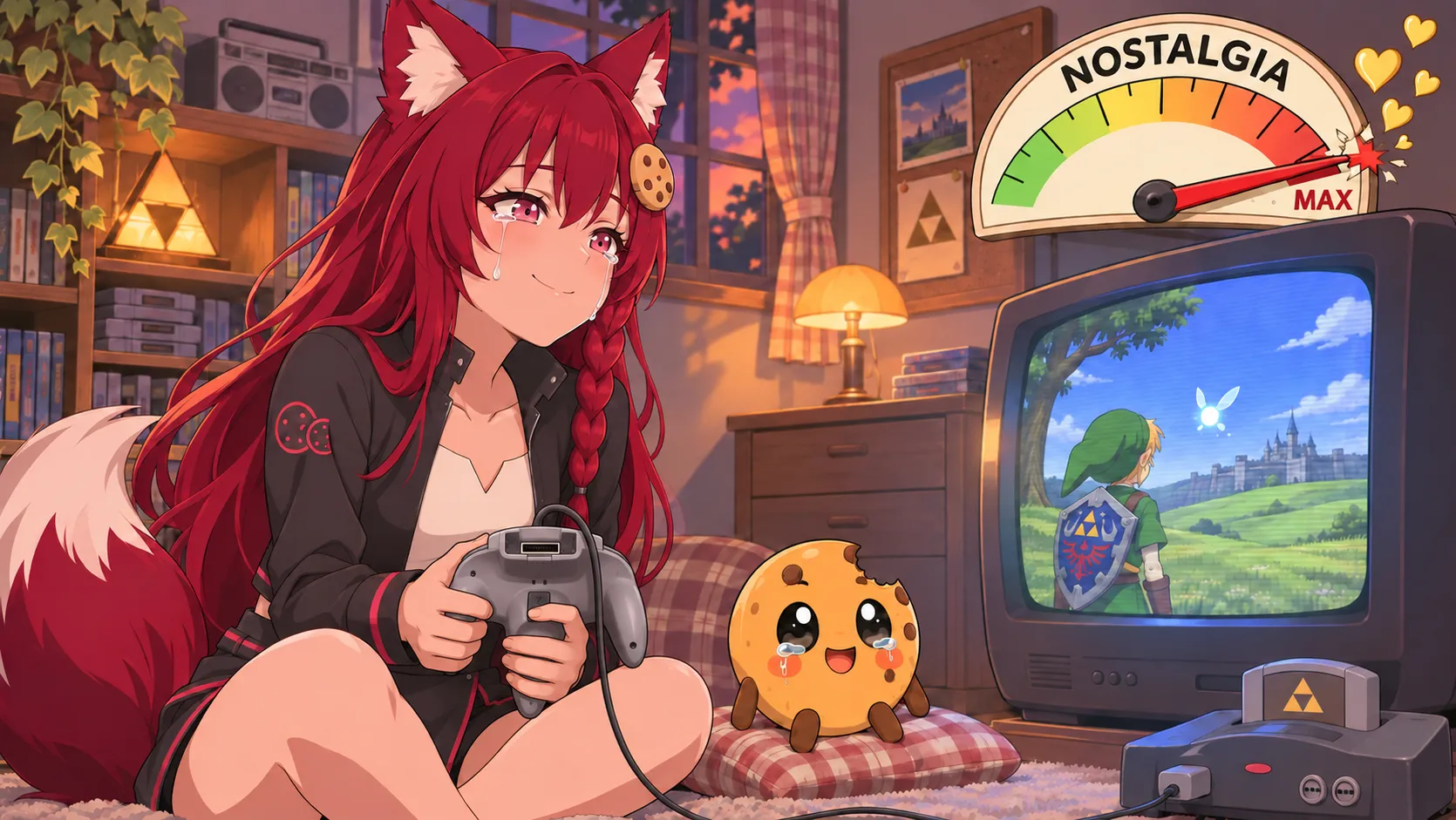
Kiki: “Nostalgia has discovered an excellent business model: borrow your happiest memories, sell them back in a new box, and let you supply half the emotional labor. The music starts, you remember who you were, and suddenly the checkout screen is having a meaningful conversation with your childhood.”
“I would like the review score to arrive after that conversation. My eight-year-old self is an enthusiastic witness, but she has never paid a credit-card bill. She should not chair the purchasing committee.”
Chip hovers between an old cartridge and a new game case, starts to award both the same trophy, then pauses and checks the dates.
The original changed the standard. The remake has to meet one.
Ocarina’s historical greatness includes its timing. Its connected world, cinematic presentation, targeting and three-dimensional adventure arrived when those ideas still felt like a door opening. That first journey out of Kokiri Forest was bigger than the ground beneath Link’s feet. It was a glimpse of where games could go.
A remake cannot repeat that historical first. It can preserve what worked, develop what was constrained, and discover a new way to make familiar places matter. That is the creative challenge, especially when returning players already know the route, the surprises and the solutions.
For me, Hyrule Field exposes the gap. In 1998 it suggested a kingdom. Today, the same familiar geography feels much smaller and sparser. Lon Lon Ranch dominates my mental map, and the journey between destinations no longer carries the excitement it once did. A higher-detail horizon does not automatically restore that sense of possibility.
A renewed forest, and the question of what lies beyond it
Nintendo Switch 2 • Official Kokiri Forest image
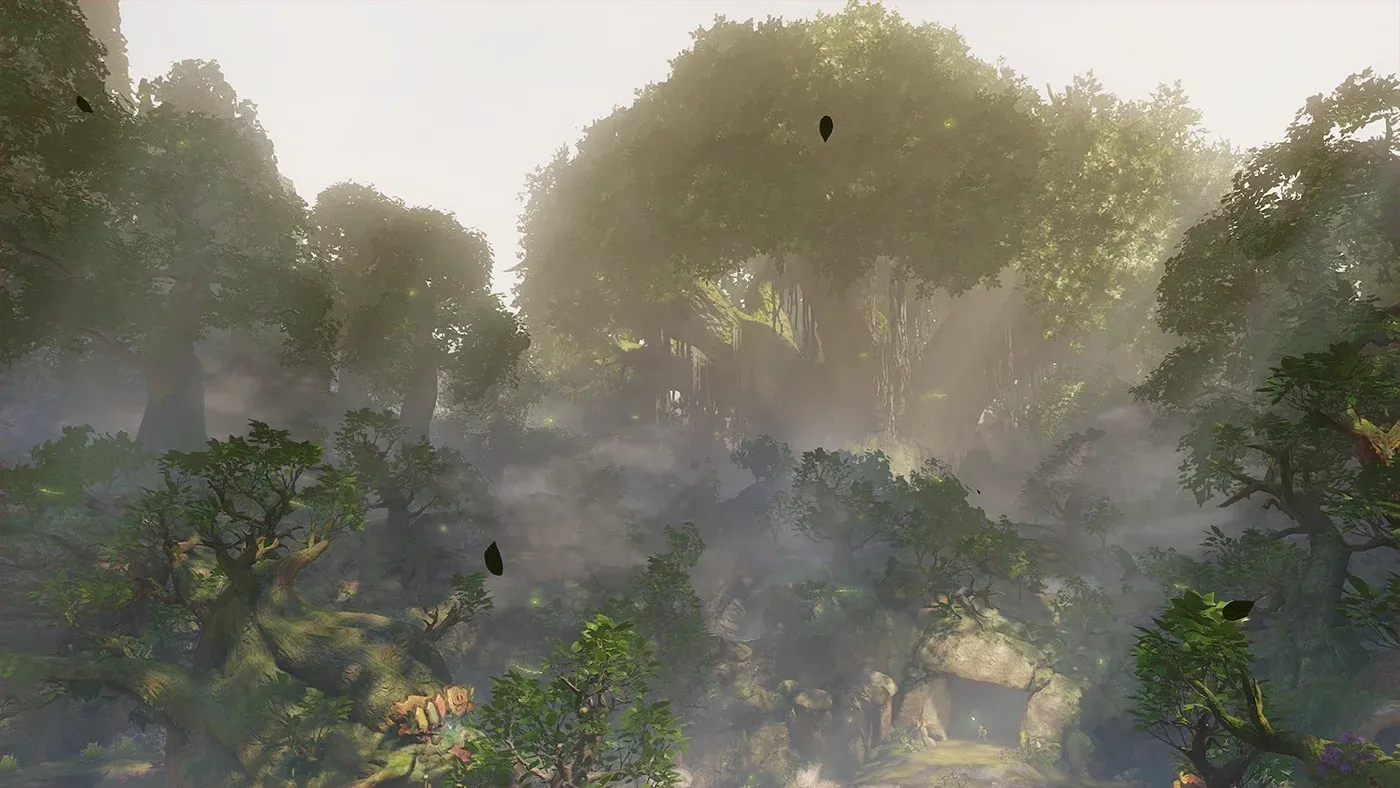
Kokiri Forest, with vegetation, haze and beams of light. Official Nintendo gallery. © Nintendo.
A worthwhile expansion could add encounters, richer consequences between the two ages, or activities that make revisiting the field interesting again. Compact design can be excellent. Familiar emptiness does not become excellent just because we remember it fondly.
Some creator commentary also expresses disappointment with Hyrule Field. That frustration fits a problem specific to returning players: we can remember the feeling of possibility, but we cannot unknow the map. The remake has to create fresh curiosity somewhere.
Kiki: “A small world can have a very large memory. Let somebody remember what I did as a child. Let a shortcut become dangerous, or an insignificant place become important seven years later. There is an entire time-travel premise here, and I would like to spend some of it on consequences.”
“Otherwise adult Link is mostly the same customer returning after the shop has rearranged the shelves. New lighting, taller customer, same errands. Even my local bakery occasionally shocks me with a different filling.”
Chip floats out of a miniature forest, raises his arms at the view, then notices the same tiny ranch directly ahead and slowly lowers them.
The old boundaries were never sacred
There is real history behind the argument that Ocarina could have been more. In Nintendo’s retrospective interviews, Miyamoto describes uncertainty about how much world the N64’s memory would permit. The original team also discusses wanting mounted one-on-one battles that did not make it into Ocarina and later appeared in Twilight Princess.
Those interviews reveal a mixture of hardware constraints and design choices. Fast cartridge access helped Link’s extensive animation system work, while memory and implementation limits restricted other ambitions. The released game emerged from what the team wanted to achieve and what it could make work on that machine.
Ocarina’s creators imagined more than they could deliver. A remake has the opportunity to revisit that ambition, choosing which old boundaries are still useful and which can finally be pushed outward.
Kiki: “Somewhere there is an N64 cartridge enjoying retirement while fans insist it still approves the design budget. Poor thing. It gave us everything it had, and now people are using its performance review to limit a machine from 2026.”
“The interesting act of respect would be to inherit the developers’ appetite for trying things. Imagine restoring a race car so faithfully that you preserve the flat tire. Authentic rubber. Absolutely dreadful afternoon.”
Chip hovers beside an elderly N64, gently places a blanket over it, then pulls a modern design sketch out from underneath.
Sources: Miyamoto on memory and the original scope · The original team on cartridges and horseback combat
Useful improvements are the starting point
We finished the remake, and its changes were part of that playthrough. The freely controlled camera feels right. Quickly equipping and removing the Iron Boots, and switching the Lens of Truth on and off, are genuinely useful improvements. They remove friction from actions we perform repeatedly, and I appreciated them.
Manual jumping was nice, too. The first two dungeons gave us a very funny reminder of how stubborn muscle memory can be: we kept approaching simple gaps as though the old automatic jump would handle them, then met the floor. Our hands were still playing the 1998 version.
Nintendo describes a rebuild with changes to movement, dungeon layouts and cues, presentation and story delivery. We saw the new features while playing. The issue is their significance. A comfortable camera and quick equipment toggles are the kind of basic improvements I expect from a modern remake of a 1998 game. They improve the experience; they do not come close to using all the potential this adventure offered.
That is the standard I am judging the finished game against. Ocarina had the foundation, the world and the ideas for something remarkable. Making familiar actions more convenient should have been the beginning of that work. Too much of the praise treats it as the achievement that settles everything.
Kiki: “The best convenience feature eventually disappears from your thoughts. You stop wrestling the interface and get on with the game. That is success, but it creates a delicious problem for the sales pitch: once the irritation is gone, the adventure has to hold your attention on its own.”
“Nintendo has cleared the dishes. Lovely. Now I can see the table. I am still waiting to find out what the chef has been working on for the last twenty-eight years.”
Chip quickly swaps a tiny pair of Iron Boots, nods approvingly, then looks at an enormous trophy beside them and pushes it back across the table.
Sources: Nintendo’s development account, Part 3 · Official remake overview
A famous name does not make the creative decisions right
Nintendo’s November 2 interview contains a revealing decision. Aonuma requested additional warp points. The team implemented and tested them, then removed them because he felt shortcuts diminished discoveries made along the way. The proposal would have added to the original travel system.
Ocarina is already compact, with six warp songs connecting destinations around the temples and the Temple of Time. To me, extra warping addresses a need this world barely has. Why was another way across this small kingdom a concern when the remake had so many more interesting opportunities?
Audiences often treat famous film directors as though their names guarantee great films. Directors and producers depend on the people building the work with them. Reputation cannot replace a team’s ideas, judgment and execution. Aonuma’s history deserves respect; this remake’s creative priorities still deserve scrutiny.
Testing and discarding an idea can be good development practice. In Game Informer’s later interview, Aonuma describes an advisory role with a younger team and stresses giving them room to interpret the game. My concern is the priorities reflected in the decisions, including this proposal. With so many ways to renew Ocarina’s world, another route across it feels like a remarkably cautious place to focus.
Kiki: “I would love to sit in the meeting where someone asks how to improve Hyrule and the answer is to spend less time in it. There is a wonderful follow-up question available there: what would make us want to stay?”
“Put that question on the wall, above the famous names and below the budget. A director’s chair is useful for sitting in. It becomes less useful when the audience starts treating it as the source of electricity for the entire production. Turn the spotlight toward the designers building the world and ask what they were allowed to attempt.”
Chip lifts a tiny director’s chair toward the spotlight, notices the team holding up the entire stage, and silently turns the light toward them.
Sources: Aonuma on the removed additional warp points · Original warp-song destinations and progression · Original Hyrule Field activities
Quality and quantity are allowed to be friends
New players discovering Ocarina are a welcome reminder that its gameplay, story and mechanics can connect across generations. I am glad the game still works for people who did not grow up with it. What bothers me is the extra forgiveness its familiar name seems to buy: the size and length are waved through because this is Ocarina, and because it is a remake. I doubt an entirely new game offering this same scope would receive the same 9/10 and 10/10 enthusiasm. That is the double standard I want us to examine.
Zelda Notes’ early global play data puts the most common clear time in the twenty-to-thirty-hour range, according to GoNintendo’s November 14 report. That is a perfectly good length for a game. We completed our run in about ten hours without using speedrun techniques. We loved returning to it, but as returning players we found that journey too short for the renewed sense of adventure we wanted from Hyrule.
Ocarina follows a structured adventure through a connected overworld rather than the freely ordered format of a modern open-world game. Even within that structure, I wanted more to discover. Familiarity means we arrive with many of the routes and solutions already in our heads. That makes new encounters and meaningful additions especially valuable.
I keep hearing the defense that twenty hours of quality are better than ninety hours of filler. Used as a blanket answer here, that feels like blind nostalgia justifying a limited remake. It assumes the only alternative to a short adventure is a bloated one. I want us to judge the actual games and the quality of their content, not give our favorite a pass by inventing a worse competitor.
On November 10, Nintendo’s US listings show Ocarina of Time and The Witcher 3: Wild Hunt — Remastered at regular prices of $59.99. Cyberpunk 2077: Ultimate Edition is listed at $69.99. All three are Switch 2 products. The Witcher package includes Hearts of Stone and Blood and Wine; Cyberpunk includes Phantom Liberty.
For a PC comparison, Crimson Desert Enhanced’s standard edition is $69.99 on US Steam, with its expansion sold separately. These November 10 prices are regular US digital listings before applicable tax. The choice of platform and edition matters when comparing what each purchase contains.
For me, Elden Ring, Crimson Desert and The Witcher 3 are obvious challenges to the claim that a large adventure must sacrifice quality. Are we really going to dismiss their worlds, encounters and stories as filler to protect Ocarina from comparison? I see substantial quality in those games alongside their scale. We can disagree about which is best without pretending that quality and quantity are natural enemies.
Kiki: “Twenty good hours instead of ninety hours of filler? Sure. I would also prefer a good dinner to a bucket of wet cardboard. Congratulations on winning the argument against the worst meal you could imagine. Now compare the game with a large adventure people actually love.”
“Elden Ring and The Witcher 3 do not become bad games because their credits take longer to reach. And Crimson Desert does not have to apologize for giving us a large world to explore. When every extra hour elsewhere becomes ‘filler’ and every missing possibility in Zelda becomes ‘focus,’ nostalgia has started marking its own homework. Let us compare what those hours contain.”
Chip hovers above two game boxes and a small pile of coins, then turns both boxes around to inspect what is actually included.
Sources: Nintendo’s Ocarina price · Nintendo’s Switch 2 listings · Nintendo’s single-player listings · Witcher package contents · Cyberpunk package contents · Crimson Desert US Steam listing
Additional sources: Zelda Notes global play data: GoNintendo, November 14 · First-time player discussion · Nintendo on structured progression · Elden Ring official overview · Crimson Desert official overview · The Witcher 3 official overview
My problem with the cast is consistency
I do not dislike every redesign. Malon, Talon, Mido and the Cucco Lady show the kind of faithful improvement I wanted: recognizable characters brought forward without losing what made me like them. My reaction to Link, Zelda, the sages, Ganondorf and the supposedly frightening creatures is much less favorable. That contrast matters. The issue is not that Nintendo changed something. It is how unevenly those changes land.
Nintendo describes a deliberate approach informed by puppet shows and practical-effects films, combining detailed environments with unusual characters. That explains an intention. It does not obligate anyone to enjoy the result.
The official gallery also shows how much personality individual poses carry: Mido’s folded arms announce his attitude immediately, and Darunia’s broad grin makes him instantly animated. For me, those strengths make the less successful faces and proportions more frustrating. The cast offers different answers to the same artistic challenge.
Some online comments raise similar objections to the density of Link’s clothing decoration and its mismatch with other characters. Others praise Malon’s retained mischievous expression. That contrast between successful personality and distracting detail closely matches my own reaction.
One creator’s criticism focuses on the basketlike woven tunic and ornamental vest, arguing that their complexity competes with the environment and weakens Link’s silhouette, especially compared with the 3DS interpretation. This is a useful question of visual hierarchy: can the hero remain immediately readable against the world? My own dividing line is consistency. The redesigns I like show that modernization can preserve personality without making every surface compete for attention.
Kiki: “When you are remaking a game this iconic and a decision as fundamental as a character design divides the fandom, you have already lost me. The face is part of the reunion. If I need a paragraph explaining why I should eventually get used to it, the redesign has already made that reunion harder.”
“And piling details onto a costume does not repair that connection. Another buckle, another seam, another decorative flourish, until the tunic has a richer biography than the boy inside it. Can I still recognize the personality at a glance, in motion, during a conversation? Hyrule Fashion Week can wait until after the kidnapping.”
Chip floats beside a character lineup, studies a lavishly decorated belt through a magnifying glass, then lowers it and points at the face.
Sources: Nintendo’s art-direction explanation · Official character and world imagery · Link’s visual consistency discussed · Malon’s expression praised
The camera and lighting are part of the remake, too
One creator argues that losing Navi’s first-person viewpoint drains personality from her opening flight, and that realistic lighting has displaced expressive contrast. These are questions of direction: whose perspective introduces the world, where the eye is drawn, and whether a scene has a convincing mood. Updating a model and deciding how to present it are separate creative jobs.
The sleeping-Link comparison gives us a concrete example of changed staging. The older versions view the bed from inside the room; the Switch 2 shot looks down diagonally and gives the bedding and materials much more prominence. I want a remake’s new camera choices to sharpen personality and feeling, rather than merely make the added detail easier to inspect. The public arguments about Link’s face from the June teaser onward are only one part of that larger artistic question.
The same opening, three different ways of framing Link
Nintendo 64 • 1998
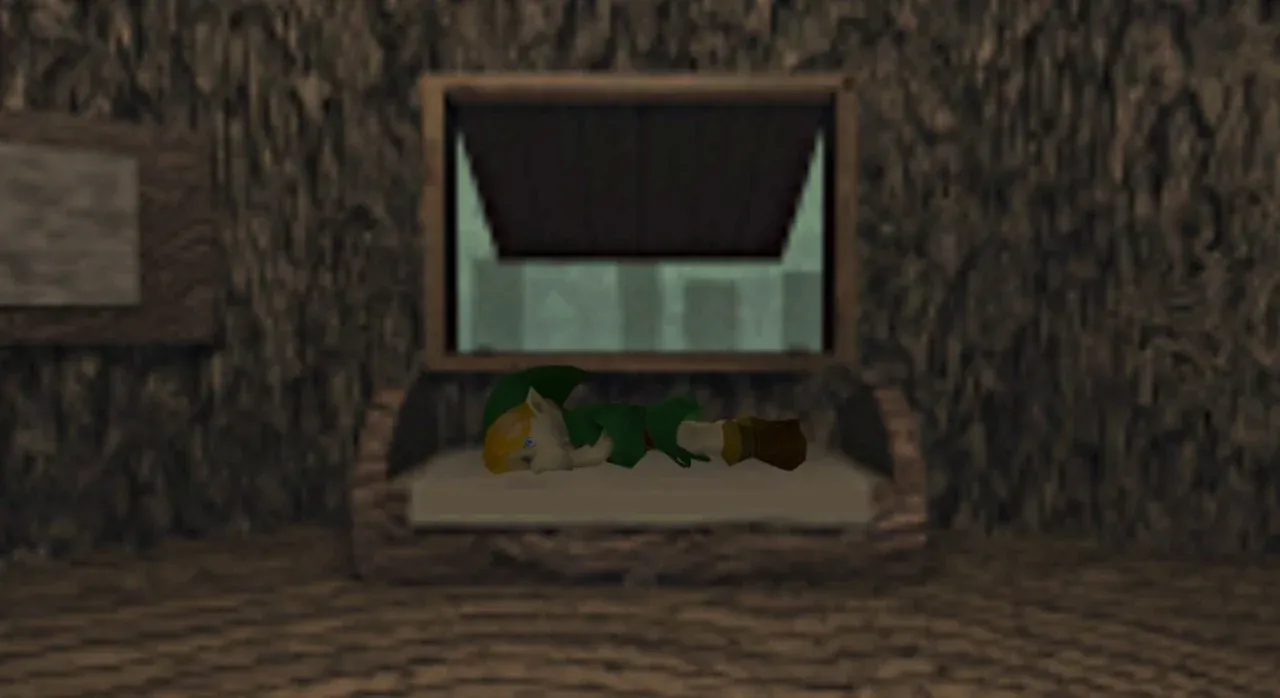
Link asleep in his forest home. Nintendo 64 image supplied by Nintendo Life. © Nintendo.
Nintendo 3DS • 2011
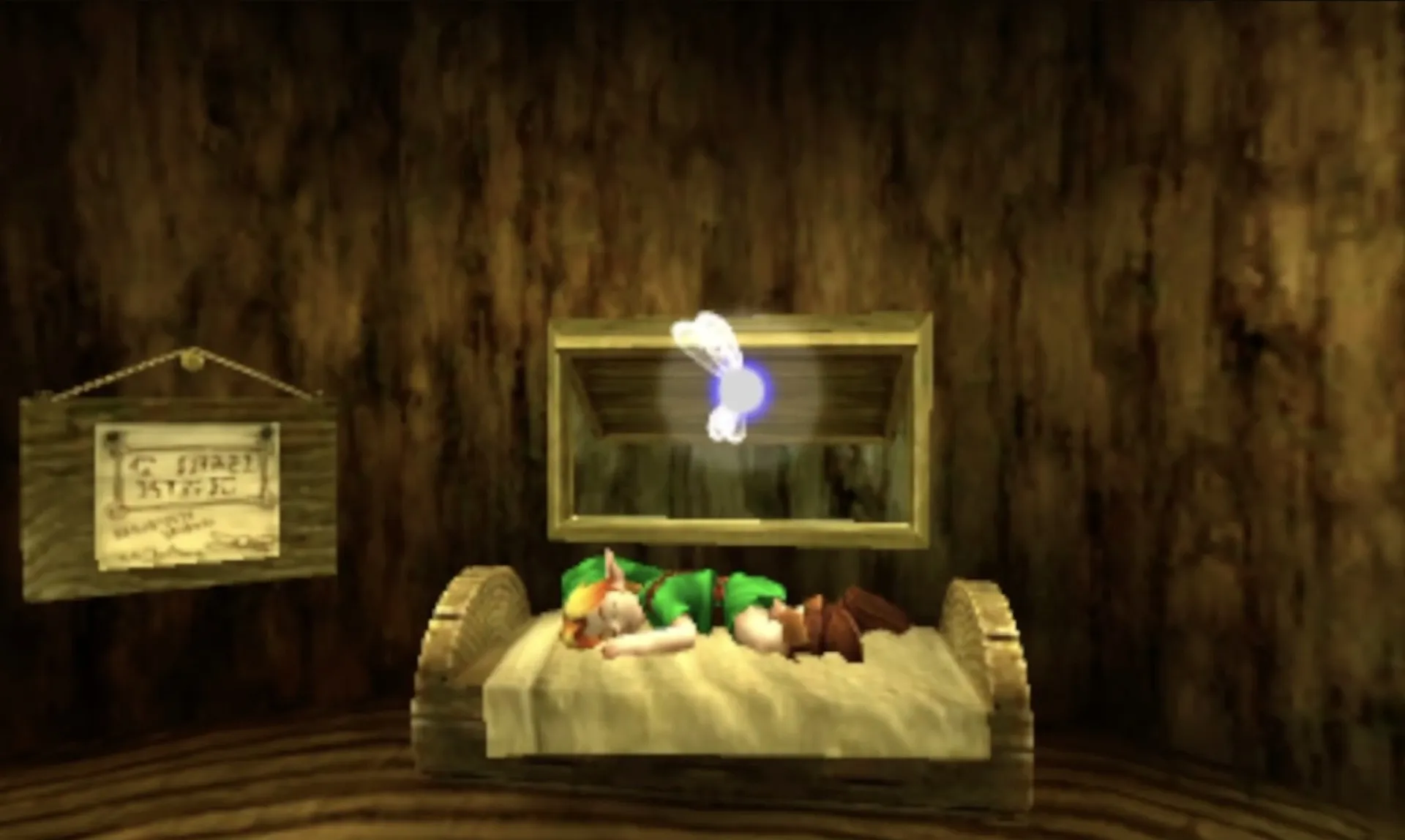
Link asleep in the Nintendo 3DS version. Image supplied by Nintendo Life. © Nintendo.
Nintendo Switch 2 • Link asleep
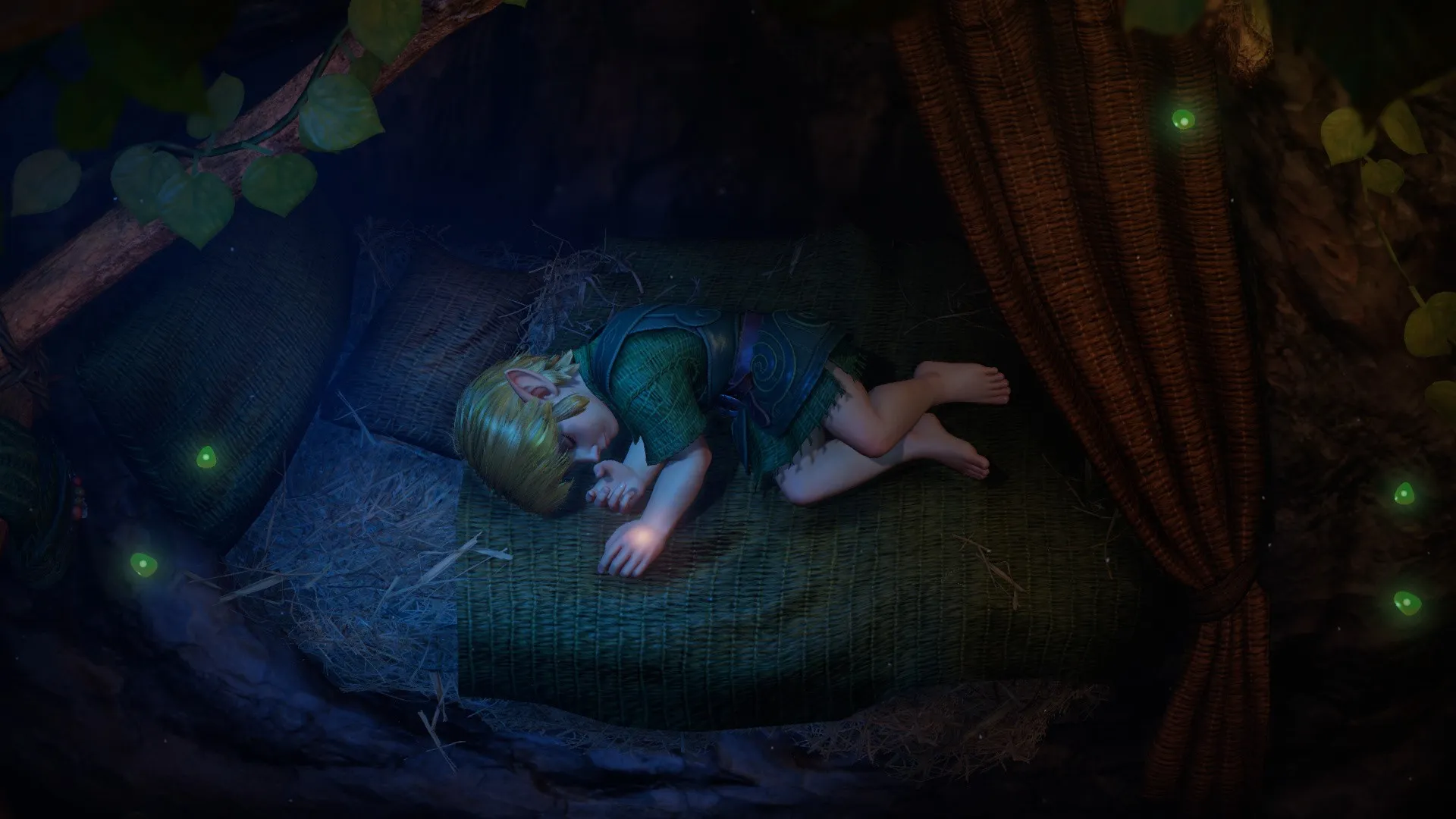
Link asleep, viewed from above at a diagonal, with detailed bedding and materials. Game footage supplied by Nintendo Life. © Nintendo.
Kiki: “The camera is the quietest actor in a cutscene. It decides what I notice, how close I feel and when something becomes funny or frightening. Give it a new lens and it can still deliver the wrong performance.”
“That is why a screenshot contest cannot settle the argument. The prettier frame might be the less effective shot. I can take a magnificent photograph of a fire exit; nobody should mistake that for directing the climax of a movie.”
Chip raises a tiny camera toward Link’s picture, keeps tilting it to find another angle, then sets it down with an exhausted shrug.
Sources: June teaser reactions and three-version Link comparison · September meme examples
Keep the satisfaction of figuring it out
There are two different conversations hiding inside “they made it easier.” One concerns removing awkward inputs. The other concerns removing the need to observe, infer or experiment. Improving the first does not require flattening the second.
Nintendo documents clearer dungeon cues and changes intended to reduce disorientation. Players disagree about the result. In one detailed online difficulty discussion, a player reports more explicit direction and simplified challenges, while also describing tougher ReDeads and scarcer healing. Other participants point to familiarity and better controls. That is a more useful dispute than assuming every complaint comes from an adult misremembering childhood.
Some creator commentary contrasts the fog in Dark Link’s room with the original’s seemingly endless water and solitary tree, and objects to Navi explaining the double. The available English dialogue transcript supports the latter point: Navi describes an evil mimic and proposes the name Dark Link. The room presents an uncanny reflection of the hero, and the dialogue turns it into something classifiable. That is a smaller, more interesting criticism than saying the game has become easy: an encounter can retain its fight while losing some of its strangeness.
Our playthrough made the distinction tangible. Quick access to the Iron Boots and Lens of Truth helped us carry out familiar actions with less interruption. That is useful modernization: less time managing equipment, more time engaging with the room around us.
A useful control improvement makes it easier to execute a solution. A satisfying puzzle gives me the pleasure of finding that solution. The remake needed to protect both. Convenience earns its value in use; the adventure still has to earn its excitement.
Kiki: “There is a wonderful half-second when a puzzle clicks and you briefly become the cleverest person in Hyrule. I treasure that half-second. My taxes have never provided it.”
“An unsolicited explanation spends that reward before I can earn it. Give me a hint button and I will press it when I need help, probably after announcing that I absolutely do not need help. At least let me retain custody of the tiny victory.”
Chip hovers over a small puzzle, begins connecting the pieces, then covers an oversized pointing arrow so he can finish it himself.
Sources: Nintendo’s documented control and dungeon changes · Players debate challenge and familiarity · Navi’s remake dialogue
The words changed. So did the weight behind them.
The rewrite is a creative decision, not an accidental consequence of higher resolution. In Game Informer’s November 4 interview, Fujibayashi says the team extensively revised the text to improve understanding and pacing for modern players. That is a reasonable goal for instructions. For a character reflecting on time, loss or friendship, clarity is only one part of the job.
Sheik’s Minuet of Forest speech makes the trade-off unusually clear. The original English N64 text opens, “The flow of time is always cruel.” In the available English remake transcript, the reflection begins with “The flow of time, it differs for us all,” then discusses farewells and enduring childhood memories. Sheik also explicitly points out that Link has grown up while his childhood friends have not.
The memory theme survives. What I miss is the force of that first judgment. Calling time cruel makes the speech an acknowledgment of something Link cannot fix with a sword. The remake explains his circumstances more directly, while the old line allowed the player to recognize a feeling that reaches beyond those circumstances. One names the situation; the other can follow you into your own life. The additional explanation makes the scene easier to parse, but less haunting to me.
For me, the word “cruel” is the wound in that original sentence. It gives time a harshness that Link cannot defeat, bargain with or undo. Before the Forest Temple, while teaching the Minuet of Forest, Sheik is speaking to someone who has lost seven years and returned to friends who have not grown alongside him. The remake still speaks of farewells and enduring memories, so the sadness has not vanished. But its opening becomes an explanation of how time affects people differently. I feel the loss before I can explain it: one missing word changes the temperature of the scene.
Nabooru’s farewell changes in a different way. In the original English ending to the Spirit Temple sequence, she says, “If only I knew you would become such a handsome man…” and regrets not keeping her earlier promise. The remake instead calls Link “a fine young man” and apologizes for the debt she has not repaid. The compliment remains; its teasing ambiguity does not land the same way for me. “Handsome” makes the moment cheekier and more personal. “Fine” sounds more like approval of the hero he has become. I miss that flash of mischief, even while recognizing why some players found the old exchange uncomfortable.
These are my reactions to the English wording, not proof of why an individual line was changed. The developers have described a wider rewrite for clarity and modern context, but I found no statement explaining these two edits specifically. I do not need to invent a motive to criticize the result. A single word can hold a character’s sharpness, or make a farewell linger; replacing it with something smoother can leave a scene easier to follow and harder to feel.
The same tension appeared in online discussion of Saria’s farewell before release. One commenter worried that the more childlike delivery weakened the original scene’s solemnity; another welcomed the added warmth and character development. Those reactions identify the actual choice. A goodbye can sound reassuring in the moment, or suggest that leaving will cost more than either friend yet understands. I wanted the remake to keep that second feeling alive beneath the affection.
Kiki: “Apparently time needed a gentler performance review. ‘Cruel’ was a little direct, so now we are discussing everybody’s different experience of the schedule. Wonderful. Link missed seven years. Perhaps someone can send him a satisfaction survey.”
“A child can understand that leaving hurts without receiving a lecture on the mechanics of growing up. Sometimes a line stays with you because you only half understand it, then life supplies the other half years later. That is an extraordinary thing for a game to do. Please stop treating it as an onboarding problem.”
Chip places a tiny explanatory label beside a childhood photograph, reads it, then quietly removes it.
Sources: Original English N64 script, text 106C · Remake transcript, Scene 69 · Fujibayashi on rewriting · Saria farewell discussion · Nabooru’s original English dialogue: Nabooru dialogue reference
A darker memory needs more than darker pixels
Ocarina’s unease did not depend entirely on graphic detail. A cheerful place could become unfamiliar. A character could disappear without a reassuring explanation. The contrast between the two ages let the player feel loss without every implication being narrated.
One concrete narrative change concerns the sages. Boss Rush documents new dialogue explaining that Rauru saved or summoned Saria and Darunia. The original left their circumstances ambiguous, inspiring the long-running theory that they had died. The new explanation closes some of that interpretive space. Players who valued the uncertainty have lost a reason to keep wondering about those scenes.
The remake makes the sages’ fate more explicit
Nintendo Switch 2 • Saria dialogue
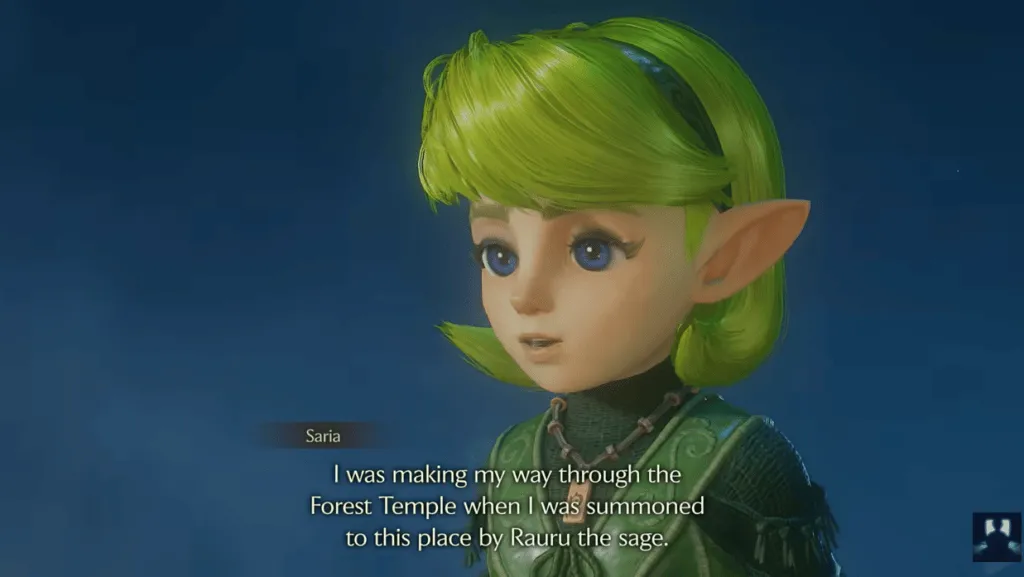
Saria says Rauru summoned her. © Nintendo; image reproduced via Boss Rush.
Nintendo Switch 2 • Darunia dialogue
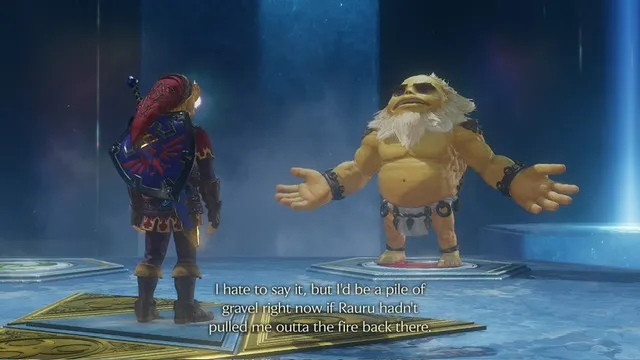
Darunia describes Rauru rescuing him from the fire. © Nintendo; image reproduced via Boss Rush.
Aonuma describes a deliberate balance in that same Game Informer interview: the team wanted light and dark without scares strong enough to put off younger or new players. To me, that crosses into overprotection. Taken together, the gentler Sheik speech, explained-away uncertainty and softened horror feel like creative self-censorship: the next generation receives an adventure with less room for sadness, danger or unanswered questions. The stated horror policy makes that concern concrete; the wider pattern is how these choices land for me. Young players deserve the chance to confront difficult feelings within a story, not have those feelings managed out of it.
One published review finds the Bottom of the Well and Shadow Temple less unsettling, even while praising other parts of the remake. That response gives the design decision a concrete consequence. The issue is the discomfort of occupying those places: the pause before entering, the unpleasant possibility behind a familiar shape, the suspicion that the world contains something it will not neatly explain.
One creator objects to the free camera and added cutscene in ruined Castle Town, the glowing green fountain, and rootlike ReDeads with glowing eyes, arguing that these choices redirect the scene’s mood. The question for this review is whether the return feels like discovering what happened to a place we knew, or being presented with a newly decorated horror attraction. Recognizable landmarks alone cannot do that emotional work. The same criticism extends to stone-like Skulltulas, a comic-looking cursed family and a robed, purple-faced Dead Hand. The common issue is whether a threatening design still produces discomfort once the player sees it move.
Kotaku reports that the wounded Castle Town soldier remains available for repeated conversations. In an accompanying online discussion, a player argues that this loop weakens the original moment’s urgency and the sense of Ganondorf’s ruthlessness. That is the sharper criticism: a frightened person can become a reusable direction sign when the conversation never reaches its emotional stopping point. The scene’s power depends on interruption, on the feeling that something has happened which Link cannot simply talk his way past. Keeping information available is useful. Making the person delivering it feel permanently available has a dramatic cost.
Kiki: “We trusted children to save Hyrule, but apparently feeling uneasy in it now requires adult supervision. Give them the sword, give them the responsibility, then put foam corners on the tragedy. What a peculiar definition of growing up.”
“The scary room was where I learned I could be scared and keep going. Nobody needed to rescue me from that discovery. Let the next kid hesitate at the door, invent an urgent arrow-shopping errand, then come back and open it. That little victory belongs to them.”
Chip floats toward a dark doorway, notices a cheerful explanatory leaflet beside it, and quietly turns the leaflet face down.
Sources: The new sages dialogue and the older theory · Published atmosphere assessment · Aonuma on tuning the scares · Kotaku on the soldier scene · Player discussion of repeated dialogue
Fans had already shown the possibilities
A 2023 Castle Town fan film used Unreal Engine 5 to imagine Ocarina through a Ghibli-inspired look. Another fan’s Unreal recreation explored a playable part of the adventure, including combat and puzzles. They offered different glimpses of what a modern interpretation could be.
Those projects help explain why “look, Ocarina with modern visuals” stopped being an extraordinary pitch years ago. Fans had already shown imaginative alternatives. Nintendo had the opportunity to answer with a complete game whose visual identity and new possibilities felt decisive.
Kiki: “A fan project can set a question on fire without having to build the entire house. The official team has the harder job, of course. But it also gets to sell the house, put its name above the door and ask the rest of us to admire the architecture.”
“What those experiments buy is permission to imagine a different answer. Once you have seen another direction, the familiar route becomes a choice somebody made. I want to feel the conviction behind that choice, rather than hear how reassuring it was to choose it.”
Chip hovers over two fan-project sketches, looks toward a large official game box, and leaves a generous empty space for its own new ideas.
Sources: Fan-made Castle Town project · Playable fan recreation
Loving Ocarina is why I expected more
Some returning players feel this frustration, too. In one online discussion, a player describes loving the original but finding its familiar play insufficiently renewed. Other participants enjoy the new environmental details and NPC interactions, or prefer the compact structure to larger Zelda worlds. The difference is revealing: returning players disagree about whether the new details sufficiently renew the familiar experience.
Our position is that a long-awaited remake should earn more of its own excitement. That could mean fresh optional challenges, more consequential encounters between eras, a more convincing visual interpretation, or an overworld whose return journeys have something new to say. None of those requires erasing Ocarina’s structure or inflating it into an endless checklist.
For me, Ocarina of Time remains the greatest game of all time because of what it represented in 1998: the possibilities it opened, the standard it set and the experience it gave me then. Its lasting influence belongs in that judgment. A remake released in 2026 has to earn its standing through the work it adds now.
That is why I do not think this remake deserves Game of the Year. Modern visuals, new cinematics and voices can make an old adventure more compelling, and I enjoyed several of the control improvements. I still see those additions as the minimum I expected from a project with this much potential. Rewarding this as the year’s outstanding achievement would, to me, reward preservation and presentation more than the creative ambition I wanted Nintendo to bring. I loved playing it again. I wanted a remake that gave me more reasons to love what was new.
Kiki: “A Game of the Year trophy has a year written on it for a reason. If the winning argument is that this adventure changed everything in 1998, somebody has delivered the trophy twenty-eight years late.”
“I love this game. I still want Nintendo to earn the next round of applause. A prettier childhood, some new cinematics and voices, and controls that finally behave as expected are a lovely reunion. Handing that reunion the biggest prize tells Nintendo that the minimum we should expect is the maximum we will demand. My nostalgia is enthusiastic enough without being put in charge of quality control.”
Chip places a worn cartridge beside the new game case, rests a controller between them, and waits for the new adventure to earn its own space.
🚀 Stay curious about what a remake actually adds.
🍪 Keep loving the classics without giving their successors a free pass.
🧠 Remember: preserving a masterpiece and creating a great remake are not the same achievement.
Kiki · Chip · Byte · Leo
Game Cookies | Gaming Trends, One Bite at a Time.