
Hello there, players, creators, and everyone who has ever been told a new tool will make their job easier.
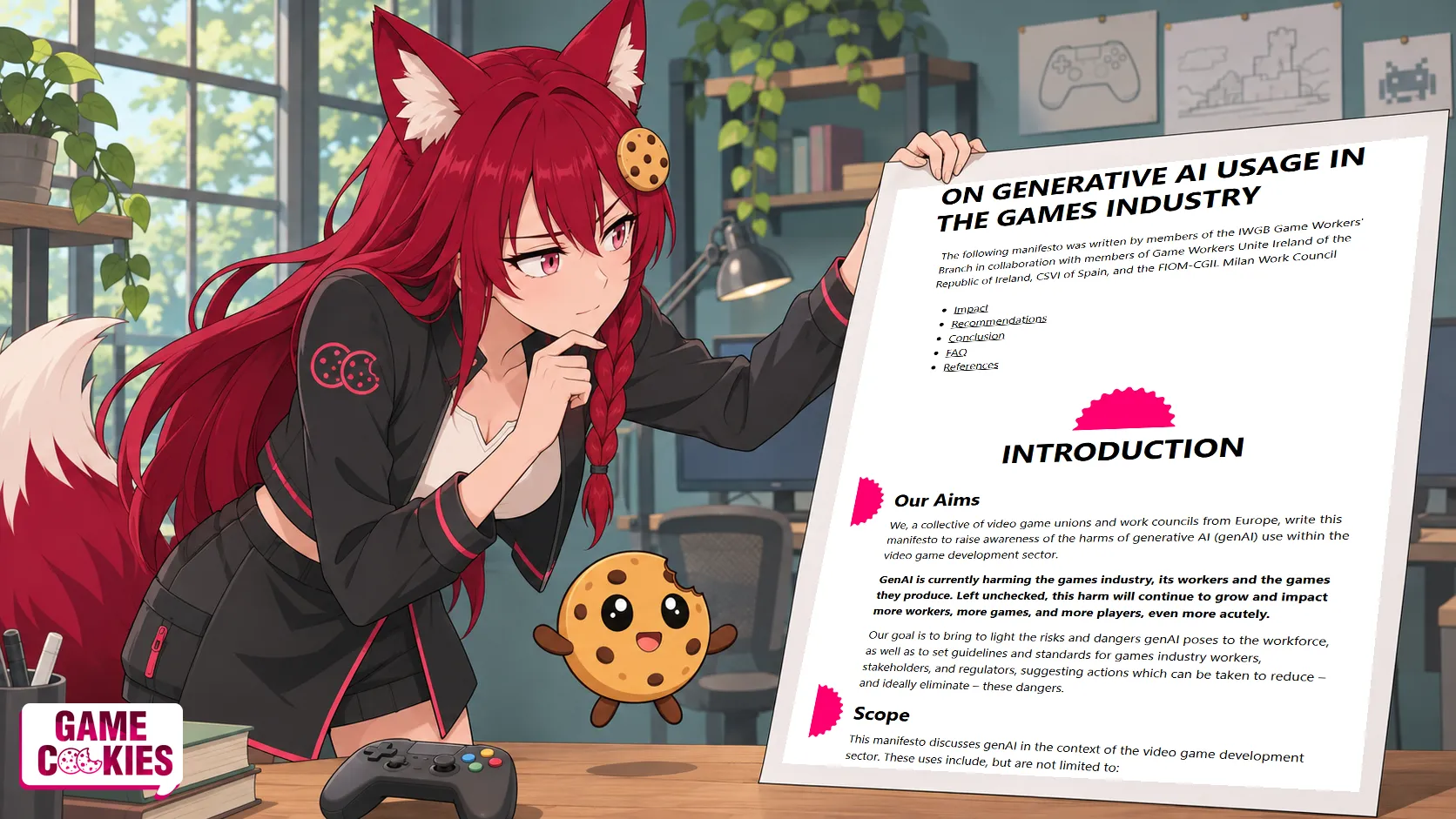
European game worker representatives are asking studios to avoid generative AI and urging players to support games made without it. The manifesto published by IWGB Game Workers on November 16 covers both finished assets and internal work, including prototypes and pre-translations. Its credited collaborators include Game Workers Unite Ireland, Spain’s CSVI and the FIOM-CGIL Milan Work Council.
The demands reach into the decisions that shape a game long before we see a trailer: who chooses the tools, whose work goes into them, and who deals with the consequences.
Game Cookies uses AI assistance in its writing and illustrations. We support its creative possibilities. We also think workers have good reasons to question how their employers are using it.
An optional tool needs a genuine alternative
The manifesto calls for employers to prohibit generative AI, protect workers who refuse it, involve staff in policy decisions and retain managerial accountability. It warns about job displacement, inflated workloads, weaker entry-level opportunities and the loss of creative ownership. Where use cannot be avoided, it asks for precise disclosure.
A meaningful choice depends on what happens after someone says no. If a studio allows a traditional workflow but assigns a deadline built around an untested promise of AI speed, the employee still carries the pressure. A policy written with the people using the tools has a better chance of catching that contradiction before it becomes another late night.
The same applies to quality control. An artist may be able to produce a rough composition quickly and then spend hours correcting anatomy, matching the established design and preparing a usable asset. A programmer may receive a plausible solution that takes longer to understand and test than expected. Those stages belong in the schedule.
There is also a question of professional development. Small assignments give junior staff practice making decisions and receiving feedback. If a studio automates those assignments, it should explain how newcomers will gain that experience. Expecting a constant supply of senior talent while removing the work through which people develop is a poor hiring strategy.
Chip hovers beside her with a tiny timesheet that unfolds all the way to the floor.
Creative work needs terms people can understand
For training data, the manifesto demands explicit consent, fair compensation, transparency about data handling and a way for workers to withdraw their material. It applies those expectations to employees’ work as well as outside creators’ contributions.
That raises practical questions a studio should answer before building a dataset. Which assets will be included? Will an outside provider receive them? Who can use the resulting system? What happens if an artist leaves, a project is canceled or the company changes vendors?
Our view is that permission should describe the actual use. A creator agreeing to deliver an illustration for one project deserves to understand any proposed reuse of that work in a training process. The relevant terms should be discussed clearly, rather than hidden behind a vague assurance that the company is merely improving its workflow.
Game performers have already negotiated protections addressing some of these concerns. SAG-AFTRA members ratified their 2025 Interactive Media Agreement with provisions covering consent and disclosure for AI digital replicas, including the ability to suspend consent for generating new material during a strike.
That agreement offers an example of workers negotiating how a technology may be used. Different disciplines need their own terms. A voice replica, a training library of concept art and an assistant with access to a private codebase create different risks.
Kiki: “If a company wants to build something valuable from your work, it can survive a conversation about permission and payment. Somehow these conversations become terribly complicated the moment the person asking to be paid is the artist.
“I would want the boring details in writing. Which work? Which uses? For how long? Who else gets access? ‘Trust us, it’s internal’ does not tell me much if the internal plan changes next quarter.
“And when a worker asks those questions, answering with a speech about the future is just wasting everyone’s time. They asked about their work. Bring the terms.”
Chip floats over a stack of paperwork and taps an empty signature line with a pencil.
Adoption does not settle the argument
GDC’s November 2026 State of the Game Industry preview reports that 40% of surveyed industry professionals use generative AI at work. On its impact across the industry, 55% of respondents were negative, 35% mixed and 8% positive.
GDC found interest in repetitive tasks, research, brainstorming and early prototyping, alongside strong opposition to creative and player-facing applications. The useful discussion is already more specific than whether someone has ever opened an AI tool.
A team may welcome help searching documentation and reject generated dialogue. An artist may find an experimental workflow useful while objecting to how its training material was obtained. A player may accept internal assistance and still prefer human performances in the finished game.
The manifesto’s FAQ acknowledges teams that collectively choose to use generative AI after considering its risks, while maintaining the authors’ opposition to adoption.
That leaves a difficult question for workplace policy: how does a collective decision protect an individual who objects? We would expect a serious agreement to address available alternatives, the work assigned to each employee and how disagreements will be resolved. Calling a meeting is a start. The resulting policy needs to hold up during production.
For players, precise disclosure helps. A description of what was generated gives buyers something they can assess. A broad label tells them much less about the actual contribution, whether the people involved agreed to it, or how carefully the output was reviewed.
Kiki: “Someone using AI to sort through a pile of notes has not automatically signed up for a game full of generated performances. People are allowed to draw a line between tasks.
“And players are allowed to have preferences. If somebody wants to support games made without generative AI, tell them enough to make that choice. Trying to sneak it past them and then complaining that they do not understand the technology is a terrible way to build trust.
“The same courtesy goes in the other direction. A small creator experimenting with a tool deserves criticism of what they actually made and how they made it. We can have standards without pretending every project has the same budget, process or intent.”
Chip floats between two argument-filled speech bubbles and holds up the game itself.
Our support for AI comes with responsibilities
We want people to have more ways to make things. AI assistance can be part of a creator’s chosen process, and we are keeping it as part of ours.
That choice gives us work to do. We need to check facts, make deliberate editorial decisions, inspect our illustrations and take responsibility for errors. An appealing result does not answer every question about the service behind it. Neither does enthusiasm excuse vague sourcing or careless publication.
We also support workers who want stronger protections or who choose to avoid generative AI altogether. A creator experimenting independently can stop, discard the output or change direction. An employee working under somebody else’s targets may have much less freedom. Employers need to account for that difference.
The manifesto pushes for much broader avoidance than we would choose for Game Cookies. Its concerns about consent, responsibility and working conditions still deserve direct answers from the companies adopting these systems.
Kiki: “We use AI here. I’m hardly going to hide behind the cookie jar and pretend otherwise. That also means our positive experience does not cancel out somebody else’s bad one.
“I want the tiny team with an idea nobody would fund to get a chance. I want more strange games, more personal projects and more people able to bring their worlds to life. I also want the artists, writers, performers and developers already doing this work to have a decent living and a say in what happens to it.
“So yes, show me the ambitious thing you made. Tell me what you used and take responsibility for the result. And if your grand plan depends on dismissing the people who have to live with it, expect a few uncomfortable questions before I get excited.”
Chip hovers beside her, balancing a sketchbook in one hand and a controller in the other.
🍪 Stay curious about how your games are made.
🎮 Keep asking who benefits from the tools behind them.
🦊 Remember: the people doing the work deserve a voice in how it changes.
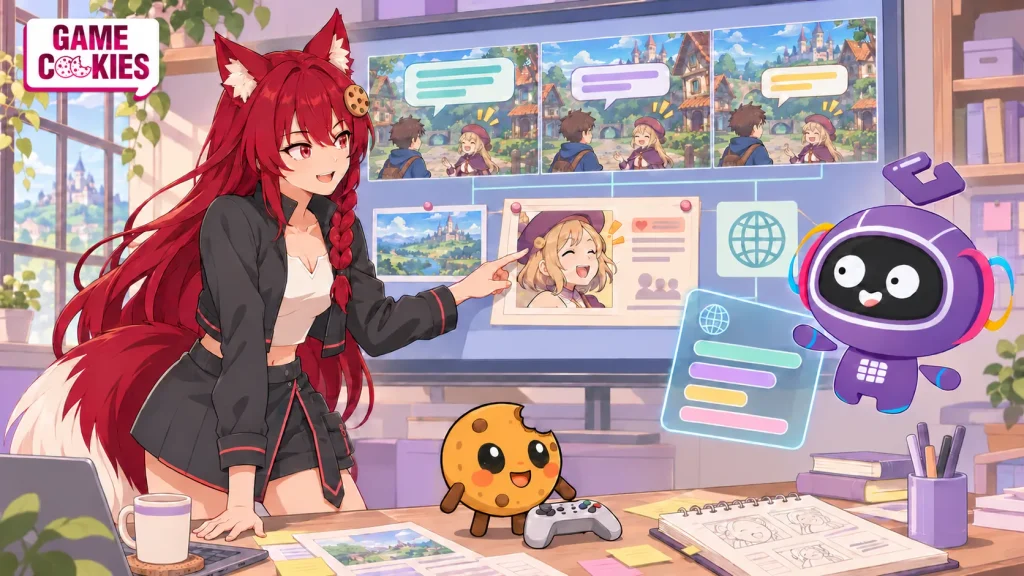
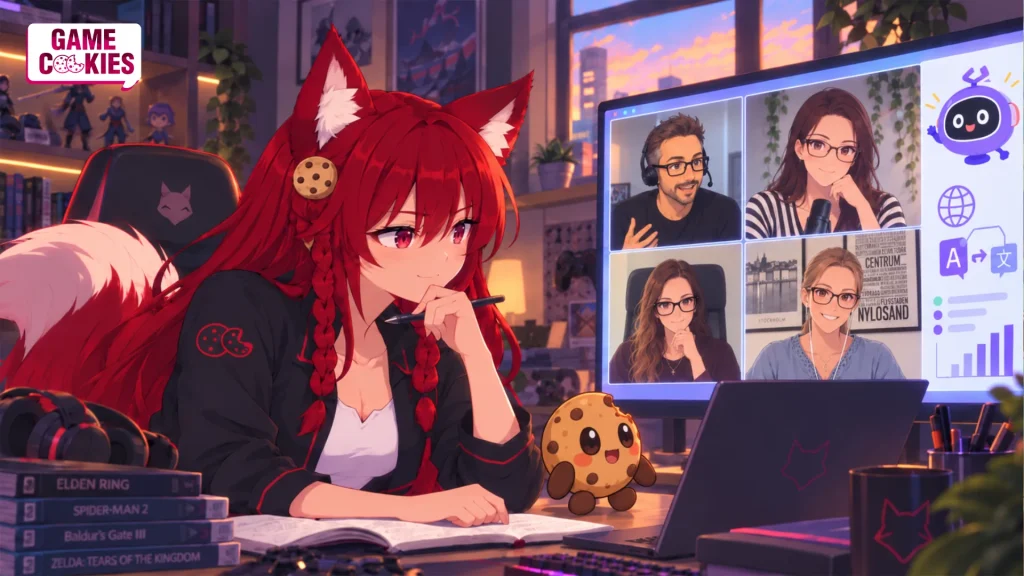
Kiki: “Picture the production meeting. Someone generates fifty character concepts before lunch, announces an efficiency miracle, and hands all fifty to an artist who now has to make them look like they belong in the same game. Congratulations. You invented a larger to-do list.
“Let the team test the tool on real work. Count the repairs. Listen when the person doing the job says the workflow is worse. And if management insists on using it anyway, management can stay in the room when the results break.
“I have very little patience for a boss who takes credit for the speed and suddenly discovers individual accountability when something goes wrong.”