

Hello there, punk-game pilgrims, publisher-watchers, and acquisition-cycle survivors…
Grasshopper Manufacture Inc. becomes independent from NetEase Games today, October 1, 2026, after roughly five years under the publisher. The effective date gives Suda51’s studio a fresh start against an uncomfortable backdrop: NetEase has spent the past two years reducing support for a series of overseas teams, with particularly painful outcomes through late 2025 and 2026.
Grasshopper’s announcement, reproduced by Gematsu, describes a cooperative separation after discussions with NetEase. CEO Goichi “Suda51” Suda also points to improved self-publishing know-how and more options for future releases. The studio already published Romeo Is a Dead Man itself this February. That experience gives the independence announcement substance beyond a change in ownership.
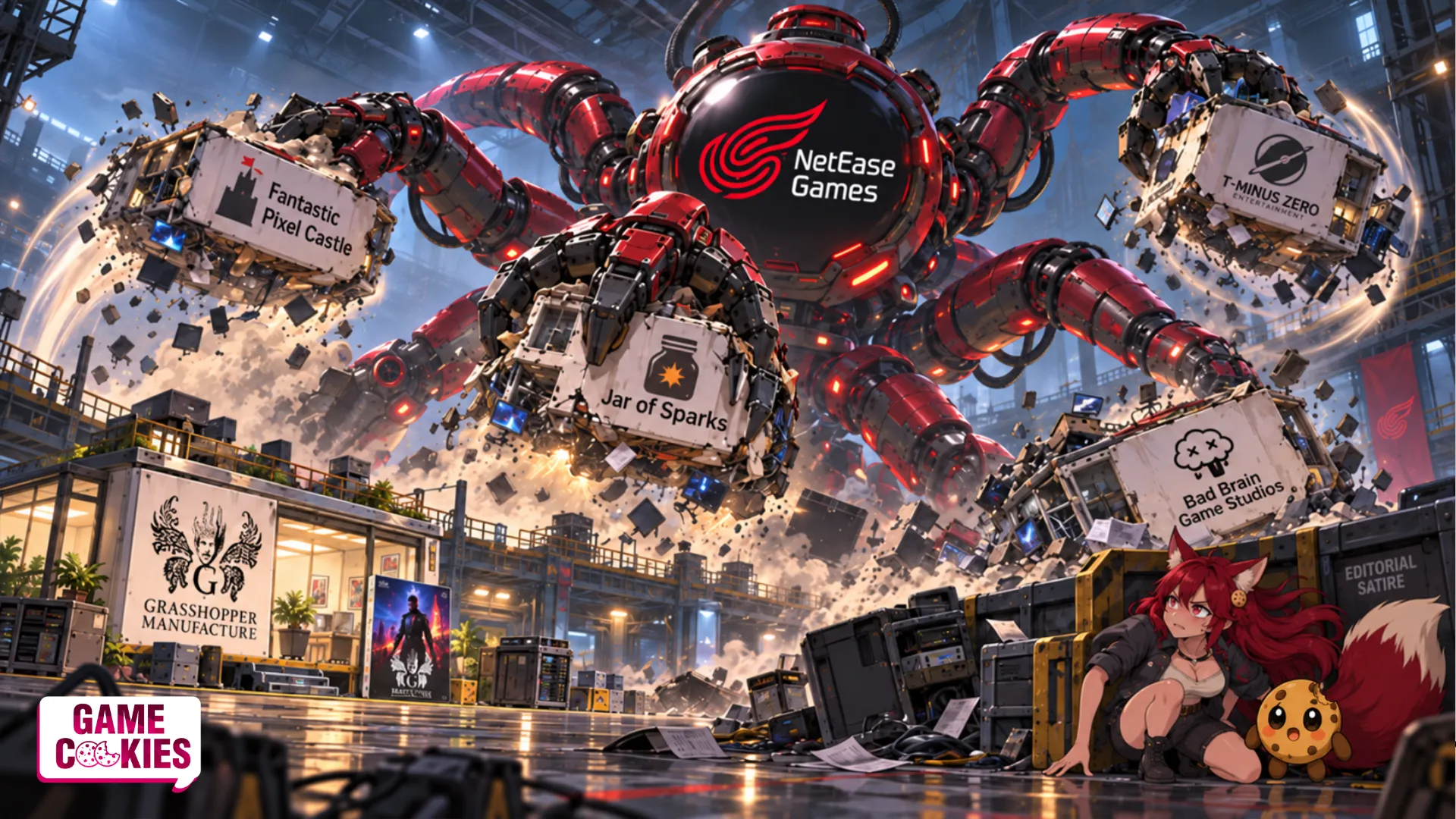
Jar of Sparks, Fantastic Pixel Castle, Bad Brain, and other affected teams faced different outcomes: halted development, closure, or a restart. For players, a change in backing can put an unreleased game and the team making it at risk.
Grasshopper learned the work behind the publisher logo
The original deal was announced in October 2021, under an equity-transfer agreement signed that May. In NetEase’s acquisition announcement, Suda described a division of labor: NetEase would advise on business planning and provide development funding, with art and quality-assurance support, while Grasshopper retained responsibility for creativity and production. Creative freedom was already part of the pitch.
Romeo Is a Dead Man added a different capability. Grasshopper’s official product listing and Steam store page identify Grasshopper as publisher. Ownership of the studio and responsibility for publishing a particular game were separate arrangements.
In a February interview reported by PC Gamer, Suda said NetEase funded Romeo and offered the studio the opportunity to self-publish after it had discussed publishing with other companies. He described unfamiliar work, a difficult learning process, and the benefit of retaining more of the proceeds rather than sharing a large portion with an outside publisher. He also said sales of much of Grasshopper’s older catalog brought the studio relatively little money because other companies published those games.
That account supports a narrower, more useful argument than a secret five-year exit plan. Grasshopper built publishing experience while it had a parent company. Suda now identifies that experience as a source of choice. The public record does not show that learning to leave was the original purpose of joining NetEase, or that self-publishing alone made the separation financially possible.
🦊 Kiki:
Creative freedom sounds lovely until the game is finished and somebody asks who actually knows how to sell the bloody thing. Grasshopper has a much better answer now: it has done the work. I want strange games to survive beyond the pitch deck, and that requires people who understand the boring machinery between a finished build and a player buying it. Suda even admitted the learning curve was rough. Good. That is a more useful receipt than another executive promising to protect the studio’s DNA while posing beside its logo. NetEase helped fund the game and opened the self-publishing door. Credit where it is earned. Apparently the most rebellious unlock in this punk studio was the publishing department.
🍪 Chip slides a publishing manual beneath a wobbly display stand and finally gets the game box to stay upright.
The pullback started before the last twelve months
Jar of Sparks belongs in this story, but its January 2025 announcement falls outside the twelve months leading up to today. The wider sequence begins in 2024. Keeping those dates visible prevents an older collapse from being repackaged as a fresh closure.
Ouka Studios, 2024: Bloomberg reported in August that NetEase had cut nearly all jobs at the Visions of Mana developer and planned to close it. Gematsu’s contemporaneous account says the remaining staff were expected to oversee the final rollout. NetEase then said it had nothing to announce about a potential closure. The cuts were reportedly underway before launch, so the sequence cannot establish that players’ reception of the released game triggered them.
Worlds Untold, November 2024: Mac Walters’ NetEase-backed studio paused operations while seeking a new partner. Team members were encouraged to explore other opportunities. The announcement described a pause and a search for backing, without establishing a successful restart.
Jar of Sparks, January 7, 2025: Jerry Hook’s studio said it was halting work on its current title while searching for a new publishing partner. Staff would explore new opportunities. Contemporaneous reporting identifies it as a NetEase subsidiary founded in 2022. The announcement promised no return date for the team or game.
T-Minus Zero, August 2025: Game Developer confirmed its shutdown after NetEase discontinued funding. NetEase told the publication it had reassessed its business priorities. The developer had built a playable demo, but could not secure the backing it needed to continue at that point.
🦊 Kiki:
The acquisition honeymoon keeps coming with the same awkward question: how long does the money actually last? You can hire veteran developers, give them creative autonomy, and still end up with a game nobody gets to play. Investors are allowed to stop backing a project that no longer makes commercial sense. I am not demanding an infinite-money cheat code. I am demanding that the grand promises be judged against what reaches players and what happens to the team when priorities change. A talented group building a playable demo has achieved something. A closed studio still leaves that work without a route to market. The funding announcement gets a trailer. The developers get a job-search link.
🍪 Chip folds a glossy investment brochure into a tiny paper umbrella over an abandoned game build.
Late 2025 brought closures, then more than one route out
Fantastic Pixel Castle, October and November 2025: Greg Street announced the end of its first-party relationship with NetEase and warned that finding a new publisher for the Ghost MMO was difficult. He subsequently set November 17 as the closure date, while leaving open the possibility that later financing might depend on how much of the team remained. A project’s assets and a team’s ability to keep working together have different survival clocks.
Bad Brain Game Studios, November 2025: In its closure statement, studio head Sean Crooks also named November 17 as the final operating day after efforts to find a new partner failed. He thanked NetEase for giving the team time to pursue alternatives. The game and underlying intellectual property remained available for acquisition or partnership. Keeping an IP available does not preserve the workforce that created it.
Jackalyptic Games, November 2025: Jack Emmert announced the end of its NetEase partnership, and affected developers began looking for work. PC Gamer’s contemporary report noted that Emmert had not announced a studio closure in that statement. Its unreleased Warhammer MMO was caught in the disruption.
T-Minus Zero, October 31, 2025: The story also contains a recovery. A small group of veteran directors and founders acquired the T-Minus Zero name and announced a relaunch as an independent production company. The new model sought project-based financing and co-financing partners. That relaunch should appear whenever its earlier shutdown is used as evidence; it also gives no basis for assuming every former job or the original production plan was restored.
Anchor Point, February 2026: CEO Paul Ehreth announced a transition to independence, thanked NetEase for its support, and began conversations with prospective investors and partners. Grasshopper therefore joins other teams pursuing a future outside the group. Independence can begin with an unresolved financing search.
Nagoshi Studio, March 2026 funding report: Bloomberg reported that NetEase would stop financing the Gang of Dragon developer from May. VGC’s account of that report described a search for new backing and an additional ¥7 billion, approximately $44.4 million at the reported conversion, needed to finish the game. Those are attributed reports about financing and closure risk, rather than a verified final closure announcement.
⭐ Byte:
The Nagoshi figure measures reported additional funding needed to complete Gang of Dragon. It measures neither the game’s total budget nor money already spent, and it is not Grasshopper’s buyout price. The yen and dollar amounts express the same reported requirement, not two separate costs. This sequence also mixes closures, pauses, partnership endings, and relaunches across 2024 to 2026. Adding every name together as a count of studios closed in the past year would produce a misleading total.
🦊 Kiki:
Please stop using “independent” like a magic shield against payroll. T-Minus Zero came back with a smaller founding group and a new financing model. Anchor Point was looking for partners. Grasshopper has publishing experience and a released game. Those are different starting positions, and pretending they are interchangeable sells hope on credit. I want every one of these teams to have a future. I also want to know who can fund that future, what they control, and whether the people who made the prototype are still there. A logo can survive in a folder long after a team disperses. Congratulations on saving the JPEG. I was rather hoping we could save the people making the game.
🍪 Chip props up a studio-name placard with one oval arm while the empty chairs behind it remain plainly visible.
NetEase can help a studio grow and still become a fragile lifeline
NetEase’s February 2025 response to Game Developer said its global expansion plans remained in place, with investment decisions based on business evaluations and structural changes considered part of improving performance. The later closures and departures show how conditional that support can become. They do not establish that every overseas investment ended, or that every affected project failed for the same reason.
Publishers have a fair commercial objection: rising budgets and changing markets can make an ambitious game unsustainable. These announcements omit private milestones, forecasts, and negotiations, leaving too little evidence to attribute every cut to malicious intent.
A studio losing its parent’s funding must find backing, reduce its ambitions, negotiate a departure, or stop. Players can lose the game they were waiting for. Publishing competence provides another route to market, alongside the money needed to finish development.
Suda leaves open future collaboration with NetEase and other partners. The announcement discloses neither separation terms nor ownership-transfer mechanics, providing no basis to claim a buyback, a forced departure, or that Romeo’s sales secured Grasshopper’s future.
🦊 Kiki:
I like this outcome, and I refuse to ruin it with an invented prison-break story. Grasshopper says NetEase cooperated. Suda says the studio learned to publish. A team continuing to make its own games is something players can actually cheer. The fair objection is that a publisher handles expensive, difficult work, and plenty of studios would rather buy that help than rebuild it. Fine. Having the option makes that a choice instead of a dependency you cannot easily change. We still need to see what Grasshopper releases next and how it pays for it. Until then, I will take the demonstrated skill over another promise of autonomy. Creative freedom has a very unglamorous boss fight: keeping the lights on.
🍪 Chip cranks a small desk lamp until it glows, then plants both short oval legs beside the finished game box.
Grasshopper shows an acquisition can end with a functioning studio and greater publishing experience. The losses elsewhere prevent that outcome from becoming a comforting rule. Watch the next release, the people building it, and the financing that lets them finish.
🍪 Missed part of the gaming week?
The Sunday Cookie Box delivers five handpicked Game Cookies stories in one free Sunday email.
⚙️ Stay curious about who funds the next strange game.
⚙️ Keep the studio, the publishing deal, and the people behind both in view.
⚙️ And remember: an exit works better when you can ship what comes next.
🦊 Kiki · 🍪 Chip · ⭐ Byte · 🦁 Leo
Tips, leaks, and suspicious funding runways: contact us here!