

Hello there, Warthog flippers, ringworld veterans, and survivors of the approval dungeon…
Halo: Combat Evolved gave us a ringworld, the Flood and a reason to argue over a sofa. Halo: Campaign Evolved brings that campaign back into a very different development industry. Look through the credits and the production job titles alone invite an awkward question: how much organisation helps people make a game, and when does it become another obstacle?
Halo makes that question tangible. We know the adventure being rebuilt. We can inspect the roles being credited. We should also demand enough context to avoid mistaking a long list of contributors for a list of people who did nothing.
Start with the Halo comparison we can actually check
The official Campaign Evolved credits list executive, principal and senior producers, technical program managers and scrum masters. The same page reproduces Combat Evolved’s credits, including Hamilton Chu as lead producer, Rick Ryan as producer and Alexander Seropian as executive producer. Those are credited roles, not a chart showing who reported to whom or who held veto power.
The projects also differ. The 2001 original combined its campaign with competitive multiplayer; PC Gamer’s review notes that Campaign Evolved omits competitive multiplayer. Yet the remake includes co-op, and Xbox’s development interview describes Unreal Engine 5 layered over original code and systems, additional missions and expanded online co-op. Rebuilding a familiar game still involves engineering, art and testing work.
A fan can reasonably ask why the modern production apparatus needs so many different functions. Answering that requires examining what those functions accomplish. Neither a familiar campaign nor a commercial engine makes the remaining work disappear.
⭐ Byte: MobyGames lists 185 people in the Xbox version’s credits. That is a database credit count, not a measurement of Bungie’s simultaneous development-team size. A remake credit total may also include original contributors, as Halo’s official page demonstrates. Comparing such totals cannot establish a staffing multiplier, productivity decline or number of unnecessary managers without matching their scope and counting method.
A producer should give the team room to work
Into Games describes the producer’s role as managing schedules, resources and problems while connecting developers with other stakeholders. That work can be valuable before it produces anything a player sees: a dependency resolved, a missing resource obtained, a conflict settled before two departments build incompatible answers.
Consider a hypothetical animation change. Design wants a heavier attack, animation needs to know its duration, and programming needs to know when the hit connects. A useful production intervention gets the right people to agree on a testable version and records the decision. An unhelpful one sends each department a new status form while leaving the disagreement untouched.
The difference is visible in what the team can do next. A report may be necessary, especially when money, external partners or release obligations are involved. Its usefulness depends on the decision it supports and whether somebody reads it before requesting the same information again.
🦊 Kiki: I want the person who finds the missing dev kit, gets a decision out of the people dodging it, and leaves the artist alone long enough to finish. Pay that person. Feed that person. Protect their lunch. But if your contribution to a blocked task is inviting the blocked developer to explain the blockage to another room, I have questions. Who can actually say yes? What information do they still need? Why is nobody asking them? I came to Halo to fight the Covenant. If a production process makes getting an answer feel like clearing the Library again, somebody needs to explain what that extra journey buys the player.
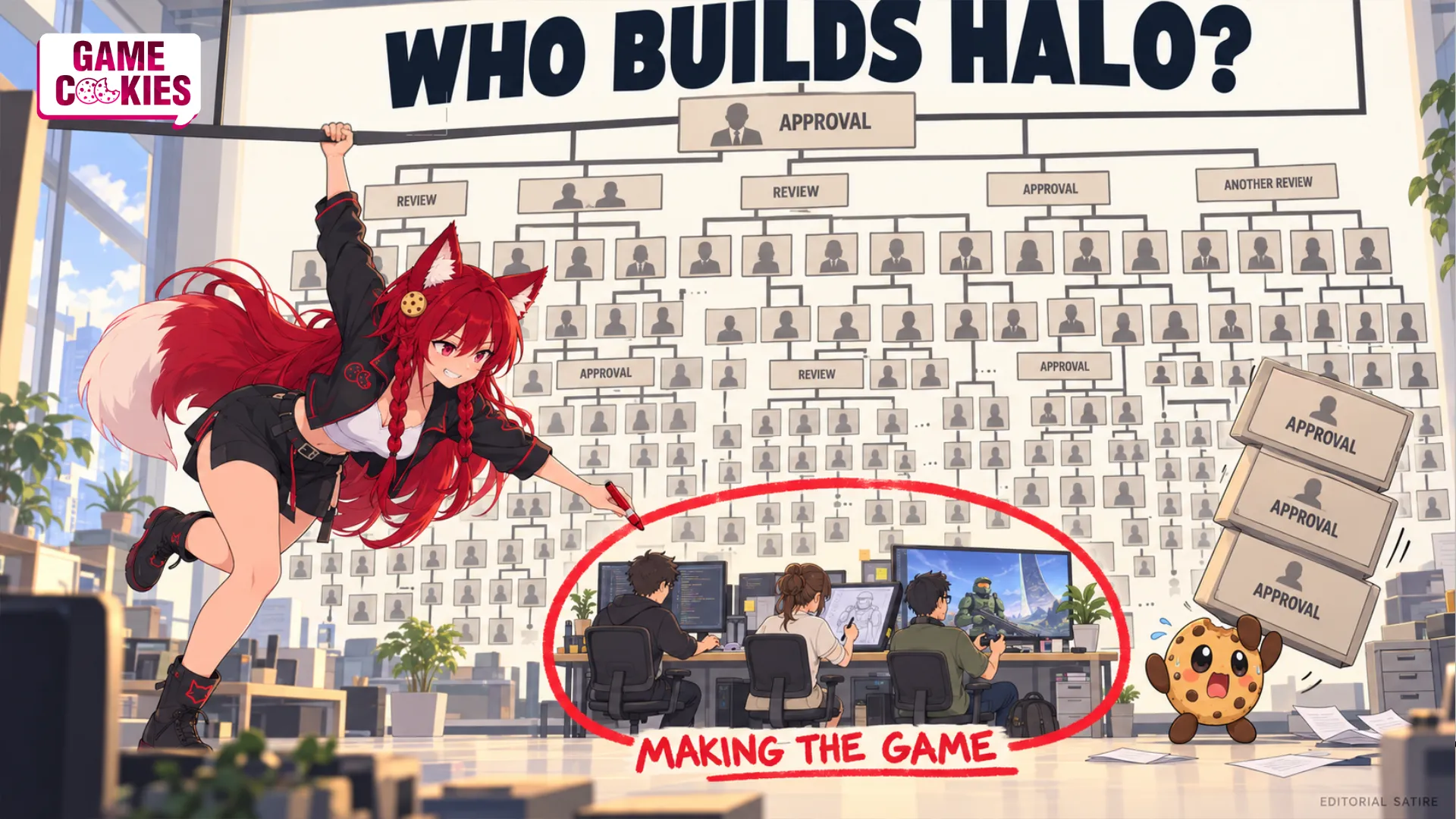
🍪 Chip braces both oval arms beneath a sagging stack of approval boxes.
The credits roll cannot audit a studio
The IGDA’s 2023 crediting guidelines recommend recognizing contributors across employment arrangements, retaining credit for departing workers and distinguishing original-team credits in derivative works. The guide also separates recognition of a role from a judgment of performance. These are recommended standards, not proof that every studio follows them.
A credit count therefore needs context before it becomes a claim about staffing or efficiency. It does not supply concurrent headcount, hours worked or the scope of each contribution. Comparing two totals without that information cannot show how many managers were unnecessary. A persuasive criticism of bureaucracy needs evidence about bureaucracy.
🦊 Kiki: I understand the temptation. Put a small number beside an enormous number and the argument practically writes its own angry caption. I enjoy a satisfying corporate dunk as much as the next fox with an internet connection. Then somebody has to ask what we counted. Translators? Contractors? People who left? The original team whose work survived into a remake? I refuse to turn people finally getting their names on their work into proof that they should never have been there. Show me the duplicated approval, the reversed decision, the task left waiting. Give me the actual obstruction. I brought a crowbar; I would prefer to hit the right door.
🍪 Chip gathers fallen name cards and slides them clear of Kiki’s dangling boots.
Half-Life offers a better test for the meeting
In his 1999 account of Half-Life’s development, Valve’s Ken Birdwell described a cross-disciplinary group called the Cabal. Its sessions produced documented designs, and player testing fed changes back into the process. Observers had to watch without coaching the person playing. The work faced a test beyond the people who had approved it.
Birdwell also described those meetings as grueling. This is a historical account of one project, not a universal staffing recipe. Its useful lesson is narrower: collaborative decisions should produce something concrete, and the resulting design must survive contact with the player.
A meeting that changes a confusing encounter after someone struggles with it has a defensible purpose. A meeting that declares the encounter clear because everybody who built it already understands it needs a player in the room.
🦊 Kiki: There goes my beautiful fantasy of fixing game development by deleting every calendar invitation. Some conversations clearly earn their existence. I can live with that humiliating discovery. Put the build in front of somebody who has never attended your vision workshop and watch what happens. Can they find the door? Does the fight feel good? Are they having fun, or politely hoping you stop looking at them? The person holding the controller gets a vote that your presentation cannot cast for them. Have the discussion, make the decision, test the result. If your brilliant idea needs you leaning over my shoulder to explain why I am enjoying it, we have found a bug.
🍪 Chip presses a controller button beneath the towering chart while Kiki points toward the screen.
Removing friction takes authority as well as goodwill
A producer cannot settle every disagreement by being helpful. Somebody must have authority to choose, and somebody must accept the cost of that choice. If a requested feature exceeds the available time, leadership needs to reduce the scope, change the plan or fund an alternative. Repeatedly asking for a more optimistic estimate leaves the underlying constraint intact.
Nor does removing a production role remove the coordination work. Before cutting a position, management should identify who will handle its necessary responsibilities and how much creative or technical time that transfer will consume. An org chart with fewer boxes can still leave more people waiting.
For players, this argues for restraint about individual workers and higher expectations of leadership. Ask studios to describe a delay in terms of the work and the unresolved problem. Judge the eventual game on what it delivers. Neither a confident executive nor an exhausted team owes us a convincing performance of busyness.
🦊 Kiki: And please do not translate “less bureaucracy” into “the same people now do three jobs.” I can hear that cost-saving presentation warming up from here. Keep the work that protects the game and give somebody the authority to stop demands the team cannot meet. That may mean telling an executive their favourite feature will miss this release. Terrible news. We should send flowers to the feature. The people making it still need a workable day tomorrow. I want ambitious games made by teams that can keep making them, and a producer willing to deliver an unwelcome answer has more value to me than a room full of very encouraging nods.
🍪 Chip catches a falling approval box as Kiki completes a red circle around the working team.
Give the decision somewhere to land
Halo gives this argument a recognizable face, but the standard should travel beyond one franchise: someone owns the decision, the team understands what it can do next, and the outcome can be tested. Keep the production work that makes those things possible. Challenge each approval that adds waiting without resolving a risk. Players eventually get the build; the meeting minutes will not make its jump feel better.
🍪 Missed part of the gaming week?
The Sunday Cookie Box delivers five handpicked Game Cookies stories in one free Sunday email.
⚙️ Stay curious about who clears the road for the people making your games.
⚙️ Keep your standards high and your evidence stronger than your favourite dunk.
⚙️ And remember: the final boss should be inside the game.
🦊 Kiki · 🍪 Chip · ⭐ Byte · 🦁 Leo
Tips, leaks, and suspicious approval chains: contact us here!