


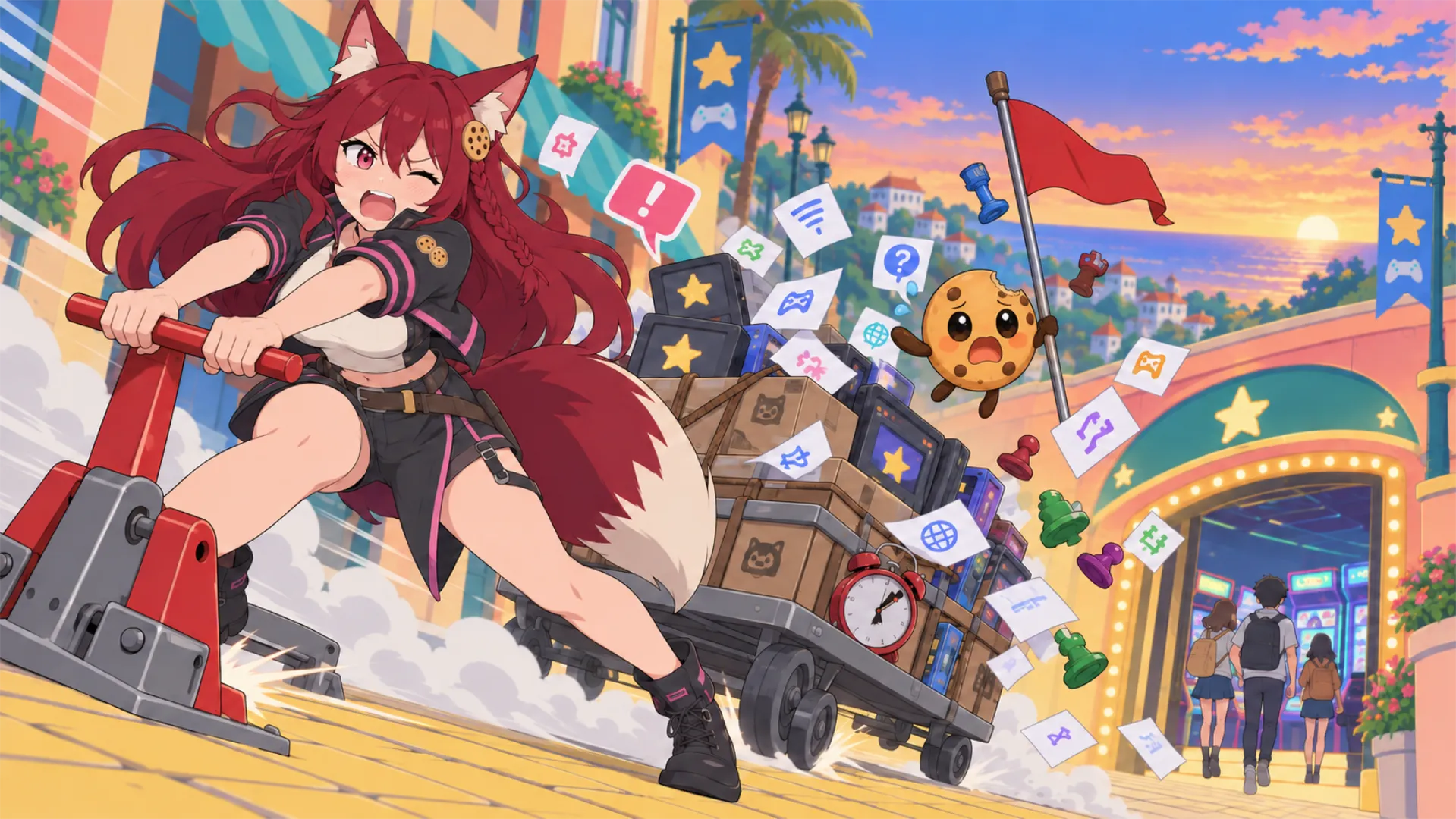
Hello there, patch survivors, subtitle detectives, and weekend warriors…
SAN KIM’s work on the Korean version of Diablo II’s expansion ended with a journey. After roughly two months testing and correcting the build in Dublin, he says, he carried the final gold master back to Korea and sent it to the factory. The words on a spreadsheet had to become a game someone could actually buy and play.
That expansion was Diablo II: Lord of Destruction, released in 2001. In a written interview with Game Cookies, Kim looks back on localization work at Hanbitsoft and Ubisoft Korea, where his responsibilities stretched from proofreading Korean text to directing recording sessions and checking the running game. A gold master, or GM, was the finalized version handed onward for production.
His memories lead to a question that still belongs beside every release button: who remains responsible for the experience after everyone has delivered their assigned files? Kim welcomes better technology, including AI. He also wants the industry to count the costs that fall on players when a release is technically delivered but still difficult to enjoy.
The spreadsheet could not tell him whether the scene worked
At Hanbitsoft, Kim says, Blizzard or the local Vivendi team supplied localization assets, often in Excel. Translation went to external translators; he reviewed and corrected the Korean. Some projects could be tested locally. Others took him directly to the build overseas.
Existing terminology restricted what he could change in Diablo II’s expansion. Yet he remembers a different opening for local knowledge: researching Korean historical artifacts and sending Blizzard images and explanations, including a Silla gold crown and the Seven-Branched Sword. In his recollection, cultural references he selected helped shape game content even while the Korean wording had to follow an established direction.
The less glamorous work was just as consequential. On consoles of that era, he recalls, limited font memory sometimes meant preparing Korean font resources around the characters a game actually needed. Then he had to play and look for missing characters or broken text.
A correct-looking sentence could also misrepresent a relationship. Kim describes a son addressing his father respectfully in one scene and switching to informal speech later. Each line could pass a grammar check while the character’s behavior stopped making sense. Testing the sequence exposed what reviewing isolated strings could miss.
At Ubisoft, he says, he bought a camcorder with his own money to record the screen during quality checks. On Prince of Persia: The Sands of Time for PlayStation 2, he recalls final Korean testing in Montreal and personally taking the Korean master DVD back for submission to Sony Computer Entertainment Korea. He is careful about the job description: he did not own build systems or mastering engineering.
“But I was effectively responsible for making sure the Korean version was ready to become a real product.” Kim writes.
🦊 Kiki:
A localization budget that stops at translated lines is budgeting for an incomplete job. Kim’s father-and-son example is beautifully annoying: every sentence can be correct while the family relationship quietly falls down the stairs. I want the person checking that scene to have time, context, and another pair of eyes. Yes, budgets exist. So does the game you are charging people to understand. And a worker buying a camcorder personally should make management examine its equipment budget, not order a motivational poster about passion. Congratulations on the immaculate spreadsheet. The son is apparently raising his own father now.
🍪 Chip turns two dialogue cards toward each other, then slowly swaps their places.
The deadline that produced Korean voice acting
Kim’s most surprising example of protecting a game under pressure comes from Ghost Recon: Island Thunder on Xbox. As he remembers it, the request arrived with about a week to reach GM.
Getting text translated quickly was only part of the task. He still faced in-game review, font resources, console memory limits, and processing video subtitles. The usual route would not fit the time available. His proposed workaround was Korean dubbing.
Kim says the studio, actors, recording, and final voice assets had to come together within a few days. The material was reviewed and sent back to development, and the Korean version reached GM in about a week. He remembers the result as a richer experience for Korean players, with a Microsoft project manager expressing surprise and praising the work.
“Sometimes you have to change the method in order to protect the meaning.”
This is his account of one compressed production schedule, with the timings recalled rather than drawn from a published production log. It offers a useful alternative to automatically cutting the player-facing experience: reconsider how to deliver it. It also leaves a practical limit. A successful emergency workaround cannot guarantee the same resources or outcome on another game.
A patch could travel by courier while the game ran online
The interview’s patch-CD story has a different source. Kim did not perform this work himself. A junior colleague at another Korean game company told him directly about distributing updates for an online game in Latin America.
According to that account, patch files prepared in Korea were burned onto CDs and shipped by FedEx. A Korean employee stationed in the region then visited Internet cafés with staff from the local publishing partner, installing the update on the PCs.
Kim stresses that the cafés already had Internet access and that the servers were deployed in the region. The reported problem was getting large patch files from Korea reliably enough to repeat the installation across café machines. Slow or interrupted long-distance downloads could make physical delivery the more dependable option.
The account identifies neither the game nor the company, and it should be read as an attributed recollection of what his colleague reported. Its practical point is narrower than a judgment about an entire region: a connection capable of supporting online play could still struggle with distributing updates.
Kim sees a related blind spot in the broadband era. A process that feels easy on a fast domestic connection may impose a very different burden elsewhere. Once a company chooses to serve that market, he argues, players deserve the same ambition for access to its content.
The update also spends the player’s weekend
Kim does not reject a large patch simply for being large. A necessary update may need its full size. His concern is the burden when enormous downloads become routine.
He asks us to imagine a player who has worked all week, sits down at the weekend, and encounters a 50 GB update requiring an hour and twenty minutes to download and install. The company has consumed part of the time that customer had reserved for playing.
“The cost of a patch is not only bandwidth and storage. It is also the player’s time and interruption. Easier distribution did not make that time free.”
⭐ Byte: The 50 GB patch and 80-minute wait are Kim’s illustrative scenario, not a measurement of a named game or a typical connection. Actual waiting time depends on download speed, storage, installation work, and other conditions. Those figures describe one imagined lost play session; they establish no universal conversion between gigabytes and minutes.
Valve’s update guidance likewise asks developers to consider the burden of large updates. Its SteamPipe documentation explains that asset packaging can produce unnecessarily large downloads or substantial local disk work, and that developers can inspect an update’s size before making it live. Some of the burden can therefore be shaped during production, before a player sees the progress bar.
🦊 Kiki:
Players’ free time belongs in the release calculation. I can accept a necessary repair. I can even accept a monster download when the benefit earns it. But imagine reserving your one quiet evening, getting comfortable, and learning that tonight’s opening activity is supervising installation. Then the download finishes and the disk starts its own little campaign. Kim is right to count that interruption. Valve’s own documentation gives teams reasons to examine how updates are packaged. The useful question is what this patch makes players wait for. Please put the estimated time next to the exciting features. I would like to know whether I am playing tonight or managing a progress bar’s career.
🍪 Chip sets a controller beside a kitchen timer and slumps against the controller.
A repair and an unfinished decision create different expectations
Kim understands why day-one patches happen. In his account of large-publisher production, manufacturing, platform processes, distribution, and marketing can already be committed when a problem emerges too late to reverse the master schedule. A release-day correction can become a compromise between the production commitment and the date promised to customers.
His frustration sharpens when players experience a developer’s unresolved decision-making: for example, rapid balance changes that are reversed after reactions and then changed again. He describes the feeling of becoming external quality assurance when that trial and error becomes part of a paid product.
He also distinguishes the promise being sold. For a conventional premium game, he expects a coherent journey from beginning to ending without a major progression blocker requiring a later fix. An ongoing online game promises a sound core and continued operation. Early Access invites customers into a disclosed unfinished process.
Steam’s Early Access documentation makes disclosure and present value central: buyers should understand the current state, receive something playable, and judge what exists today rather than depend on promised future completion. Kim’s standard asks publishers to be equally clear about what a customer is paying to participate in.
AI could give the localization manager more time for localization
Kim’s enthusiasm for AI begins with players who want access to a game in their own language. He points to unofficial Korean language patches made when publishers do not provide Korean, and expects AI to lower the effort required for community localization. That is his expectation about the tools, rather than a measured claim about a particular system.
He wants publishers to revisit the old market-size calculation as tools improve. If players are willing to assemble a translation to enjoy a game more deeply, he asks, should the company selling it keep relying on the same cost argument for excluding their language?
Inside production, he sees possible value in checking typos, terminology, character voice, and unusual context before localized text becomes final game data. A useful first pass could leave a localization manager more time for judgment. The interview supplies no benchmark demonstrating a particular error-detection rate or guaranteed saving.
His boundary is the experience of the line. In Korean, he explains, different expressions for a death can carry formality, tragedy, or contempt. Choosing the appropriate emotional meaning requires understanding the character, scene, and audience. His proposal keeps a person responsible for those decisions and for the result inside the game.
🦊 Kiki:
Use the tools that help more players understand the game, then check the result like you still care about those players. Kim’s proposal earns a fair hearing: let a useful first pass catch repetitive problems so the person responsible can spend attention on the scene. I am open to that. I also want evidence that the particular tool works. Imagine saving all that review time and immediately removing the review. Incredible efficiency. We have automated the part where nobody checks. If the villain now dies in the emotional register of a polite office announcement, the production team still owes the player a better line.
🍪 Chip places a magnifying glass over a dialogue card and nudges it back across the desk.
Local knowledge needs a route to the person who can stop release
The question of responsibility also runs through Kim’s comparison of his employers. He describes Hanbitsoft as an independent Korean publisher able to decline a license when it expected weak local demand. At Ubisoft Korea, a subsidiary, he recalls headquarters holding release authority even when local staff saw limited demand or a need for localization.
He also describes a Korean distribution partner carrying the inventory risk for packaged releases. These are his experiences of those arrangements, rather than a claim about either company’s present structure. They show why collecting local feedback and giving it influence are separate organizational tasks.
“Local knowledge is valuable only if the organization gives that knowledge a meaningful path into the decision-making process.”
Kim’s preferred release checks cover performance and stability, the seriousness of known problems, beginning-to-end playability, localization inside the actual build, and the burden of the release or patch on players. He wants teams to aim at completeness while acknowledging that perfect work and real schedules do not neatly coincide.
Asked who should hold the final stop button, he names the executive accountable for the consequences, ultimately the CEO. Regional staff need a way to report serious problems honestly and reach that decision-maker. An objection that disappears before it reaches authority cannot protect the player.
🦊 Kiki:
Accountability needs a working route upward. Kim could report a serious problem without being able to stop a global launch himself. That is exactly where an executive’s job becomes inconvenient, which is why the authority comes with the chair. Yes, delaying a release can have enormous consequences. So can knowingly shipping the problem. Expecting the local team to care harder while its warning goes nowhere is an excellent way to manufacture a postmortem. Imagine the meeting: everyone praises the lesson learned, and someone at the back still has the original warning email. Give that person a route to the decision before you give the presentation a title.
🍪 Chip slides a warning envelope around a stack of folders and plants it on the empty chair at the head of the desk.
The responsibility worth keeping
Kim outsourced translation and recording himself. His argument gives modern tools and outside partners a place in production; it also asks the people organizing that production to keep the finished game in view. Correct individual deliveries can still leave gaps between them.
“Each person may technically complete their assigned task correctly, but small gaps in responsibility accumulate. I believe those gaps eventually appear as lower overall quality in the finished game.”
His strongest examples connect those gaps to something a player can recognize: a character relationship that survives translation, a Korean voice track produced through a different method, a patch whose burden has been considered, and a warning that reaches someone able to act. Carrying a master across borders belongs to his past. Following the work all the way to the person trying to play remains a useful definition of finishing the job.
🍪 Missed part of the gaming week?
The Sunday Cookie Box delivers five handpicked Game Cookies stories in one free Sunday email.
⚙️ Stay curious about the work between a translated line and a playable game.
⚙️ Keep asking what every update costs the person waiting to play.
⚙️ And remember: the player’s weekend belongs in the production plan.
🦊 Kiki · 🍪 Chip · ⭐ Byte · 🦁 Leo
Tips, leaks, and suspiciously endless progress bars: contact us here!