


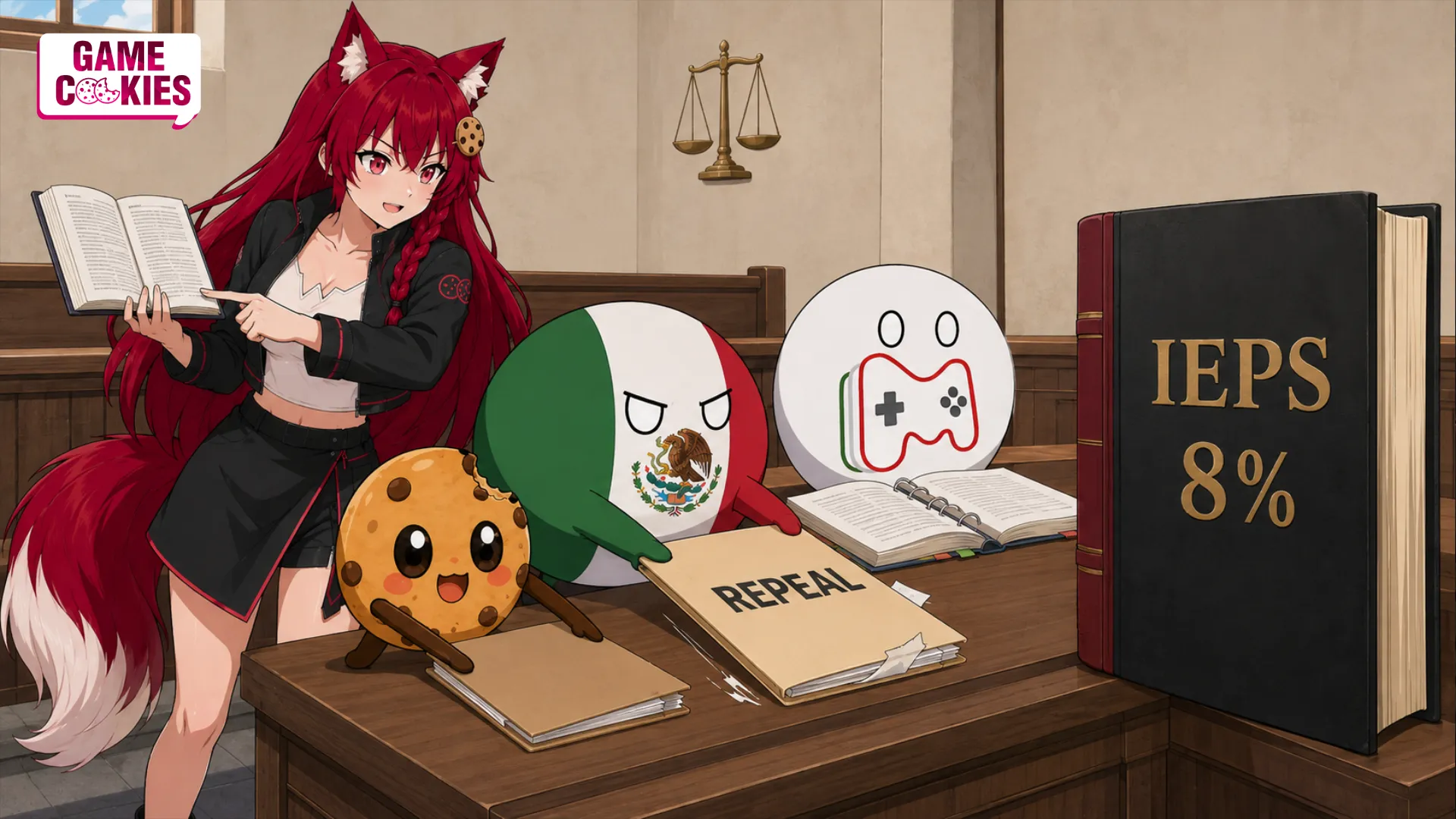
Hello there, border-hopping players, global game makers, and wallet defenders…
If you make or sell games outside Mexico, its 8% gaming tax can still matter to your business: the law explicitly includes foreign digital suppliers serving the Mexican market. If you play elsewhere, the dispute asks a question about the games you buy: what evidence should a government need before using their content to justify a special tax?
GDMEX, Game Developers Mexico, wants Congress to repeal that levy as the country prepares to receive its 2027 economic package on September 8. A presidential credit currently neutralizes collection, with no expiry date. The fight concerns a tax still available in the law, including for international businesses selling into Mexico.
In written answers to Game Cookies on September 7, Kiyoshi Tsuru made the limits of the warning explicit. “There is no public initiative or draft, and what we have heard are comments in the media and on social networks about the possibility of the 8% being charged again,” he said, translated from Spanish.
Tsuru is president of CONCAMIN’s Creative Industries Commission and director general of GDMEX. His organization is asking lawmakers to remove the levy before any decision to restore collection.
A Mexican rule with international suppliers in scope
Mexico’s Special Tax on Production and Services Law, or IEPS retains the 8% provisions introduced in November 2025 for specified games with violent, extreme or adult content unsuitable for people under 18. They cover qualifying physical sales to the public and digital access or downloads supplied in Mexico by domestic or foreign providers.
An overseas company supplying a qualifying download directly to a Mexican customer therefore has a concrete reason to follow the dispute. Its headquarters can be elsewhere while the sale falls within the Mexican digital provision. Responsibility in a platform sale depends on the distribution arrangement, so a developer and its storefront are not automatically the same taxpayer.
President Claudia Sheinbaum’s decree published on December 31, 2025 grants the relevant taxpayers a credit equal to 100% of the IEPS due. The condition is explicit: they must not pass any amount of that tax to the buyer. It also relieves specified IEPS compliance obligations; the decree leaves digital-service VAT obligations in place.
The decree took effect on January 1, 2026. It contains no termination date. There is no automatic switch scheduled for January 1, 2027.
“The decree does not set an end date, so it remains in effect in 2027 as long as the Executive itself does not modify it,” Tsuru told Game Cookies. In his legal reading, because the underlying tax is already in the law, the Executive could restore collection by publishing a decree removing the relief, without first obtaining a new tax law from Congress.
Repeal would remove the existing statutory basis for this levy. For suppliers planning Mexican sales from abroad, the practical question is how securely that market’s tax treatment is settled.
🦊 Kiki: An overseas supplier selling games to Mexican players cannot file this under somebody else’s paperwork. The law names foreign providers. That is about as subtle as a quest marker above your finance department.
The credit delivers useful relief, and having no expiry is good news. I would happily take it at checkout. I would also like lawmakers to finish the repair. A publisher planning a Mexican release needs to know which protections sit in legislation and which depend on a presidential decree. An international launch already has enough moving parts. Apparently the final boss also requires someone to keep refreshing the official gazette.
🍪 Chip wedges a folded receipt under a wobbling stack of tax binders.
One market’s checkout is part of a global release
The charging provisions concern specified content and transactions, including certain paid additions to qualifying games. They do not impose a blanket 8% charge on every game, console or controller. Purchases outside Mexico do not automatically acquire this surcharge because a game is also sold there.
For international publishers and storefronts, a return to collection would create Mexican-market pricing and compliance decisions. That is a business implication of the tax’s scope. The reporting reviewed here does not establish price increases abroad, withdrawn releases or a decision by another country to copy the measure.
Tsuru argues that the content labels stigmatize creative work and create uncertainty for Mexican developers. His answers do not provide a binding ruling classifying a named Mexican game, or evidence of a specific studio losing sales because of this measure.
Tsuru illustrates the possible consumer cost with a MXN 1,499 game reaching roughly MXN 1,619 if the full additional 8% were reflected in its price. For a foreign supplier, that same purchase is a sale to a Mexican customer. The example is hypothetical, with other pricing assumptions held fixed.
⭐ Byte: That illustrative increase is MXN 119.92, taking MXN 1,499 to MXN 1,618.92. Actual prices would depend on the transaction and sellers’ decisions. The market at issue is substantial: The CIU’s September 7 report forecasts 76.2 million players in Mexico in 2026, against its 73.8 million estimate for 2025. It puts 2025 gaming revenue at MXN 42.362 billion and projects MXN 43.590 billion for 2026, up 2.9%. These are whole-market figures, including games beyond the levy’s scope. They show the scale of the audience international suppliers can serve; they do not measure taxable sales or losses caused by this policy.
🦊 Kiki: An extra 120 pesos can change which game survives a player’s monthly budget. A developer competing for that purchase has reason to care whether the studio is in Mexico City or halfway around the world. That is enough to take the issue seriously without inventing a worldwide price hike.
Players abroad also have a stake in the standard being applied to their hobby. A content label describes what is in a game. Using it to justify a special charge needs an argument about harm and results. Demand that evidence from governments, and demand evidence when the industry predicts lost sales or jobs. Our wallets already have enough fictional currencies in them.
🍪 Chip nudges a coin away from an open binder and back beside a game case.
The legal fix still belongs to Mexico’s Congress
Legislators have already put repeal on paper. Public records include a January 7 initiative from PRI deputy Rubén Moreira, a January 7 proposal from Movimiento Ciudadano’s Iraís Reyes and Luis Donaldo Colosio, and a January 14 initiative from PAN deputy Héctor Saúl Téllez. Their existence documents a legislative route, but it does not mean that route has secured the votes to become law.
GDMEX wants Congress to repeal the charging provisions in Article 2, section I(K) and section II(D), remove the related definitions in Article 3, and amend connected provisions while preserving their functions for other activities.
Tsuru described talks with legislators as “open and receptive,” but added: “However, the necessary consensus to repeal the measure has not yet been reached.”
Canal del Congreso reported on September 4 that congressional leader Ricardo Monreal urged people to wait for the economic package before drawing conclusions about its contents. He was discussing the budget generally, without committing to repeal the gaming tax.
An international business watching September 8 should look for the actual legislative text and any separate change to the credit. Budget delivery does not terminate the relief or guarantee repeal. Congress would still need to approve a legislative change.
The argument about violent games has an international history
In Brown v. Entertainment Merchants Association, the U.S. Supreme Court in 2011 struck down California’s restrictions on selling or renting violent games to minors. It recognized games as protected expression and found the state’s evidence insufficient to justify that restriction. The decision concerned U.S. constitutional rights and a sales restriction; it does not govern Mexico’s tax law.
The comparison gives readers abroad a concrete reason to examine the Mexican debate: governments in different jurisdictions have singled out game content while invoking children’s welfare. The policy question travels even when the legal rules differ. What harm is being claimed, and does the chosen measure actually address it?
UNICEF’s guide for parents, featuring researcher Daniel Johnson, cites a 2020 review of 28 studies that found long-term effects of violent games on youth aggression close to zero. The same guide discusses unhealthy engagement, deceptive purchasing design and problematic communities. Evidence against a simple violence claim does not erase those other risks.
Tsuru’s proposed alternatives include Mexico’s existing age-classification system, with A, B, B15, C and D categories, parental controls, age verification and family involvement. He says Mexican developers are ready to collaborate on awareness campaigns and suggests measuring active parental controls, compliance with classifications at physical and digital points of sale, and campaigns’ reach among families.
Those proposals still need targets and results. Tsuru’s answers do not provide a funded implementation plan or baseline measurements. For families and platform users beyond Mexico, useful follow-through would show which safeguards work, how compliance is checked and how age verification protects privacy. Those are standards readers can ask of the services they use wherever they live.
🦊 Kiki: “Protect the children” should come with something parents can actually use, wherever those parents live. Clear content information, controls they can find and honest purchasing screens would be a start. A higher checkout total cannot tell a family who is in the voice chat.
Publishers do not earn a sainthood badge for opposing a bad tax, either. If the industry wants credit for its alternatives, publish the targets and let someone check the results. Count whether safeguards work, not just whether a campaign reached a lot of screens. I will cheer a repeal and still demand better tools. Child safety deserves more than decorative packaging for somebody’s preferred revenue model.
🍪 Chip props a tiny shield against the checkout terminal and rolls a loose coin behind it.
In the end…
For an overseas supplier serving Mexico, this is a live question about the conditions under which it reaches Mexican customers. Watch for legislation repealing the tax or an Executive decree changing the credit. The relief has no expiry, and Tsuru acknowledges there is no public proposal to withdraw it.
For a player outside Mexico, the reason to follow is the treatment of a shared medium. This dispute offers a specific case against which to test claims about violent fiction, special taxes and child protection. Its outcome will determine a Mexican rule. The demand for evidence is useful anywhere a government or publisher asks players to accept a cost in the name of their own good.
🍪 Missed part of the gaming week?
The Sunday Cookie Box delivers five handpicked Game Cookies stories in one free Sunday email.
⚙️ Stay curious about the rules shaping games beyond your own borders.
⚙️ Keep your receipts and demand evidence wherever you play.
⚙️ And remember: a global release still has to survive local paperwork.
🦊 Kiki · 🍪 Chip · ⭐ Byte · 🦁 Leo
Tips, leaks, and suspicious tax respawns: contact us here!