
Hello there, cookie munchers, stream goblins, chat lurkers, and everyone who just learned that “privacy settings” can apparently include a surprise side quest called FIND THE AI TOGGLE.
On August 20, Twitch streamer Warren Pandiscia filed a proposed class-action lawsuit in the U.S. District Court for the Northern District of California against Twitch Interactive and Amazon. The complaint accuses the companies of using creators’ livestreams, recorded videos, images, and other channel content to help train Amazon generative-AI products without obtaining proper consent or providing compensation. Those allegations have not been proven in court, and Twitch and Amazon have not yet lost this case.
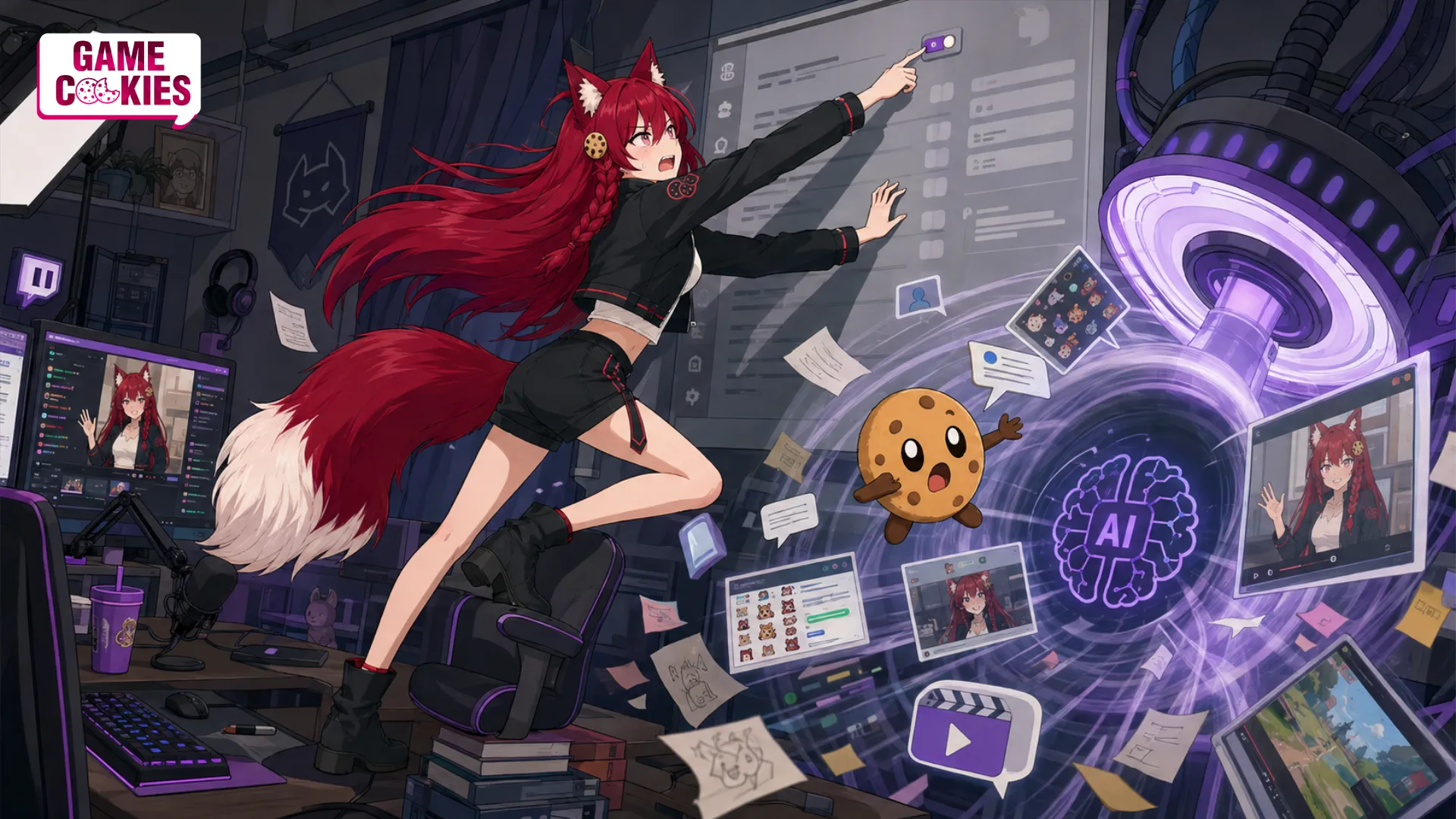
The setting that triggered the fight, however, is very real. Twitch’s own account-settings documentation says channel content may be used to train generative-AI content models at Amazon. Turning the setting off prevents future training on a channel’s streams, VODs, clips, stream chats, pictures, and text. Twitch also makes clear that the opt-out does not stop other AI-supported uses described in its privacy notice, including recommendations, AutoMod, captions, and monetization tools.
And then Twitch supplied the quote that turned a bad policy rollout into a perfect internet object. During an official Twitch stream on August 12, Chief Product Officer Mike Minton was asked why the system was opt-out instead of opt-in. His answer: “If this was opt-in, nobody would opt in.”
That sentence is the center of the story. The legal case will turn on contracts, notice, consent, licenses, and whatever defenses Twitch and Amazon raise. The trust problem is easier to understand: if you already know most creators would refuse, making participation the default changes who carries the burden. The creator has to notice the new use, find the setting, understand it, and say no.
The AI toggle reaches far beyond the stream itself
The breadth of the setting is what makes the policy more consequential than a simple “use my stream” toggle. Twitch groups together livestream audio and video, VODs, clips, stream chat, channel pictures, and text under the same training control. In other words, the material around a creator’s channel can become part of the training pool too, not just the hours when the creator is live on camera.
The opt-out applies to future model training. That wording matters. Twitch does not describe the switch as a rewind button that removes whatever influence already-trained material may have had on an existing model. It also does not give individual chatters an independent opt-out for content they post inside another creator’s channel; the channel’s setting governs that channel content.
That scope feeds directly into Pandiscia v. Twitch Interactive, Inc. et al., filed August 20 as case 3:26-cv-08721. Law360 describes it as a proposed class action against Twitch Interactive and Amazon.com. The complaint argues that creators did not meaningfully agree to this new commercial use of their work. That claim the defendants have not yet had adjudicated.
🦊 Kiki: I need everyone to appreciate how violently funny the “nobody would opt in” explanation is. That is not a defense of the default. That is the reason people hate the default. If your product meeting reaches “our users would reject this if we asked them,” the next slide should probably not be “excellent, enable it automatically.”
Corporate translation: “We respect your choice. We have simply pre-selected the choice you would not make and hidden the undo button in Settings.” Very empowering. Extremely consent-shaped.
🍪 Chip finds a giant purple toggle under a stack of 97 Terms of Service pages, then puts on a miner helmet.
The lawsuit is not the same thing as a court ruling
There is an important brake on the viral framing. Filing a class action does not establish that Twitch or Amazon broke the law. The complaint is one side’s allegations at the beginning of litigation. The defendants can challenge the claims, argue that Twitch’s contracts already granted a sufficiently broad license, dispute the plaintiff’s interpretation of consent and notice, attack class certification, or raise other legal defenses. Courts have also been actively wrestling with AI-training and copyright questions across different cases, and the law is not a single clean “AI training is always legal” or “AI training is always infringement” switch.
That uncertainty is exactly why the confirmed product design deserves separate attention. You do not need to predict who wins the lawsuit to evaluate the relationship Twitch created with its creators. The company added a new setting covering a commercially valuable use of creator content, switched the burden onto creators to opt out, and then publicly acknowledged that an opt-in system would likely produce almost no volunteers.
PC Gamer highlights another notice allegation from the complaint: that Twitch sent no email, showed no pop-up, and made no prominent announcement before the setting was enabled. That claim is part of the plaintiff’s case and will need to be tested. But the backlash itself shows the communication problem: a large chunk of the community learned about the setting from reporters, social posts, and other streamers telling them where to click.
🦊 Kiki: There is a special genre of platform logic where “we technically gave you a control” is supposed to end the conversation. Bro, if the control matters enough to protect your voice, face, chat history, clips, and years of work from becoming training material, maybe it deserves slightly more fanfare than the brightness slider.
🍪 Chip rolls out a red carpet for the hidden settings menu. Nobody attends because nobody knew there was an event.
The real fight is over what “your content” means on a platform
Creators often hear a simple sentence: you own your content. That can still be true while a platform receives a broad license to host, distribute, promote, modify, or otherwise use that content under its Terms of Service. Copyright ownership and contractual permission are different layers. The difficult question is how far the platform’s permission reaches when a new commercial use appears that was not the reason most creators uploaded the material in the first place.
That distinction matters far beyond Twitch. A streamer may think of a VOD as the recording of last night’s Elden Ring run, a clip as a meme, and chat as community conversation. A platform looking at the same archive may see labeled speech, faces, gestures, reactions, gameplay context, conversational text, moderation signals, multilingual data, and thousands of hours of synchronized audio-video material. The content did not change. Its economic use did.
The lawsuit is therefore arriving at the exact fault line that keeps showing up across the creator economy: platforms were built by convincing people to upload enormous amounts of work, personality, and community activity. Generative AI creates a new incentive to treat those archives as industrial inputs. The argument is no longer only “who owns the video?” It is also “what uses did the creator actually agree to when the platform discovered a new market for the same material?”
🦊 Kiki: Twitch spent years saying: build your channel, build your brand, build your community. Amazon looked at the mountain and apparently heard: “Congratulations on building our dataset.”
And yes, you can still “own” something while a contract gives somebody else a ridiculous amount of leverage over it. That is like owning the legendary sword while the platform controls the inventory screen, the fast-travel points, and the patch notes. Technically yours. Very comforting.
🍪 Chip hugs a tiny certificate labeled YOU OWN THIS while a forklift labeled LICENSE TERMS carries the actual box away.
Why the “just opt out” answer is weak
The easiest defense of the policy is also the least interesting: the toggle exists, so creators who dislike AI training can turn it off. That is useful operational advice. It does not answer the design question.
Opt-in and opt-out systems produce different outcomes because attention is limited. People miss emails, skip settings pages, stream from multiple devices, take breaks from platforms, or simply do not know a new use was added. Defaults are powerful precisely because many people never change them. Minton’s quote effectively concedes that Twitch understood this behavioral reality before choosing the default.
There is also a community wrinkle. Twitch’s FAQ says that if you interact on another streamer’s channel, whether that channel content is available for future Amazon generative-AI training depends on the streamer’s setting. Your own channel opt-out does not independently control every message or appearance you make elsewhere. On a platform built around raids, collaborations, guest appearances, shared chats, and community participation, consent does not map neatly onto one creator-one-toggle.
The backlash is already bigger than a niche legal dispute
The story has escaped legal-news containment. When checked Monday morning, the r/technology discussion had passed 4,000 upvotes and the LivestreamFail thread had passed 2,400. The reactions are messy, as Reddit reactions always are: some users assume broad platform terms will defeat the case, others focus on opt-in consent, and many are asking the practical question of whether AI training can ever really be “undone” after the fact.
That scale of reaction matters because Twitch depends on a creator relationship, not just a content license. Streamers provide the inventory that keeps viewers on the platform. If creators increasingly believe every new technical capability may become a new default use of their archives, then every settings update becomes a trust negotiation. Twitch can win a legal argument and still make the product relationship worse.
🦊 Kiki: This is the part executives keep learning in the dumbest possible order: “legally allowed” and “people will not hate you for it” are two separate achievements. You do not unlock the second one automatically after collecting the first.
🍪 Chip checks a checklist with LEGAL, PR, TRUST. Only the first box has been ticked, and even that one says PENDING LITIGATION.
What happens next
The lawsuit now has to survive the normal early stages of federal litigation. Twitch and Amazon will have opportunities to respond and challenge the complaint, and the proposed class still needs to clear major procedural hurdles before it could represent a wider group of creators. None of that should be written as predetermined.
Creators, meanwhile, do not have to wait for the court to check the product setting. Twitch says the control is under Settings → Security and Privacy → Training for Generative AI. Turning it off prevents the listed channel content from being used in future training of Amazon generative-AI models. It does not opt the channel out of every AI or machine-learning use on Twitch.
The broader industry question will outlive this specific case. Platforms accumulated creator archives under one set of expectations. AI gives those archives new value. Every company now has to decide whether it treats that value as something already captured by old permissions or something worth asking for again. The answer tells creators a lot about who the platform thinks carries the risk when technology changes.
In the end…
Pandiscia’s lawsuit may succeed, fail, settle, narrow, or become one more brick in the slow construction of AI law. We should not pretend the filing itself decided the issue. What it exposed immediately is a much simpler conflict: Twitch introduced a new AI-training use for creator content, made the system opt-out, and openly admitted that opt-in participation would probably be tiny.
That is why this story is resonating. It is not only about whether a streamer can win damages from Amazon. It is about whether “your content” means anything meaningful when the platform can discover a new commercial use for years of creative work and make silence count as permission.
The lawsuit will argue about what the contracts allowed. Creators are already arguing about what the relationship should allow.
⚙️ Stay settings-aware like the streamer who checks Security and Privacy before the next surprise feature checks it for them.
⚙️ Keep “you own your content” and “the platform has a license” in separate mental folders, because the difference is where half the internet fights start.
⚙️ And remember: if the explanation for an opt-out default is “nobody would opt in,” you may have accidentally written the critics’ opening statement.
🦊 🍪 ⭐ 🦁 Kiki · Chip · Byte · Leo
Tips, leaks, and suspiciously pre-checked boxes: contact us here!