
Hello there, indie believers, quarterly-report survivors, and everyone who has ever watched a five-year game plan collide with a six-month spreadsheet.
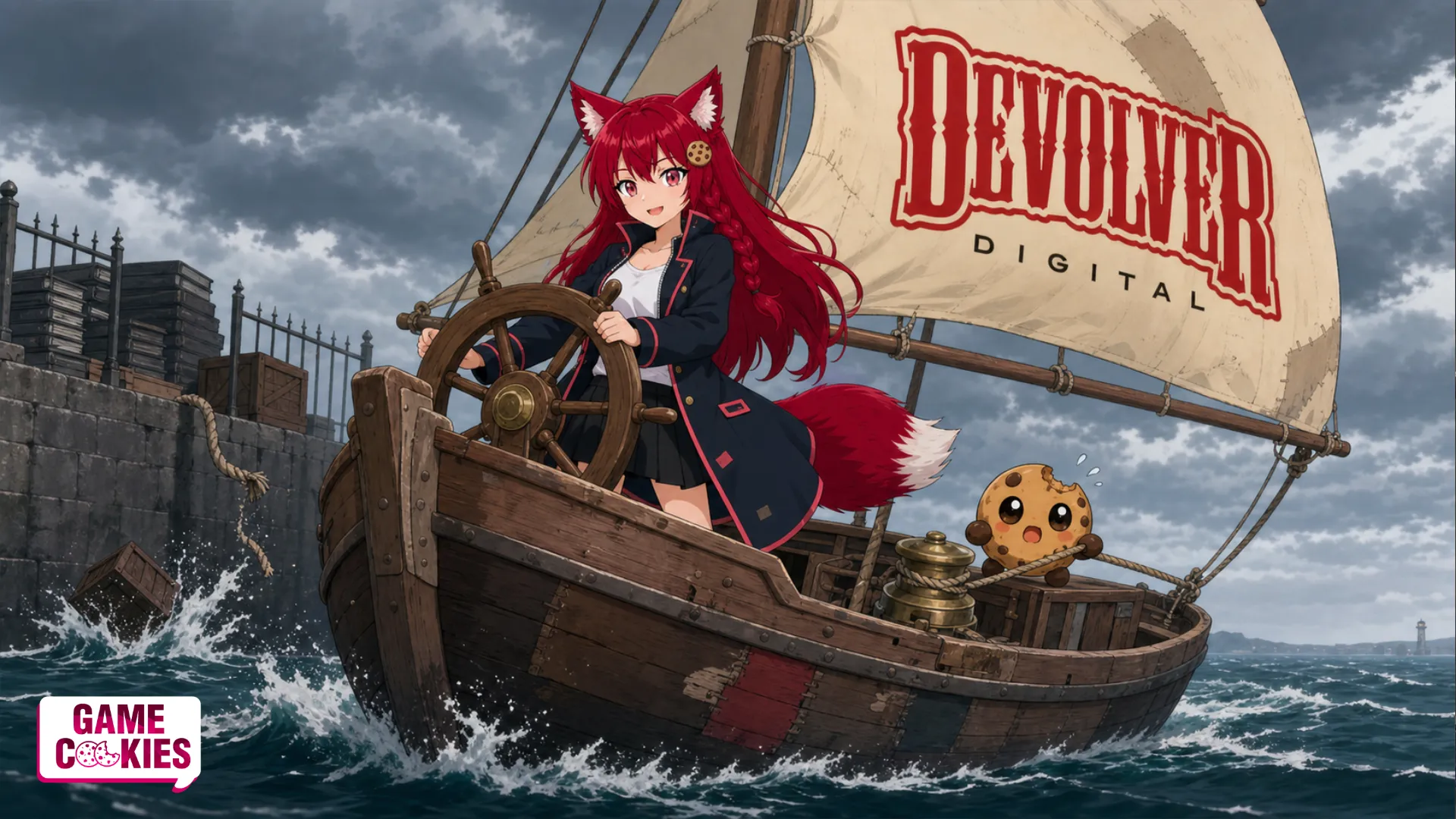
Devolver Digital wants to leave the stock market. The publisher behind Cult of the Lamb, Hotline Miami, Enter the Gungeon, and dozens of stranger bets has asked shareholders to approve the cancellation of its shares from London’s AIM market.
The company’s August 6 proposal gives the blunt version. Devolver says public trading has created a valuation disconnect, added cost and management burden, and forced an indie publisher with unpredictable development schedules and long-tail catalog revenue into a market culture built around sequential growth.
The cancellation has not happened. Shareholders vote on September 8, and at least 75% of votes cast must support it. Approval would make September 15 the final day of dealings and September 16 the cancellation date.
That fact boundary matters. Devolver has proposed an exit from public trading. It has not announced an acquisition, a private-equity buyer, or a completed return to private ownership.
🦊 Kiki: Devolver spent years parodying game executives, joined the stock market, and discovered the final boss has no health bar. It has a six-month reporting calendar and keeps asking why the next cultural phenomenon is late.
The publisher makes weird games on purpose. The market apparently wanted the weirdness delivered in tidy installments with guidance for next quarter. Very rebellious. Please submit the rebellion before close of business.
🍪 Chip stamps a tiny prototype APPROVED FOR Q3, then realizes it is still a sketch on a napkin.
The vote comes before the exit
The proposal is structured around a shareholder decision, not a buyer taking the company away. Devolver’s directors, who collectively hold 25.91% of the voting rights, intend to vote in favor. Other shareholders still decide whether the resolution reaches the required 75% threshold.
The board also proposes a tender offer of up to $5 million at 16 pence per share. The offer covers as many as 23,320,896 shares, equal to 4.71% of the issued and outstanding share capital cited in the proposal. Devolver says it may conduct a second tender of up to another $5 million within the following 12 months.
Those tenders provide a limited exit route for shareholders who do not want to remain after the AIM cancellation. They do not buy out every shareholder. Anyone still holding shares after cancellation would own stock in an unlisted company, with less liquidity and no public AIM market setting a daily price.
The company points to that thin trading as part of the problem. Its filing says average daily volume was roughly 96,000 shares over the previous 12 months, about 0.02% of share capital, and only about 33,000 shares over the previous three months, below 0.01%.
2021 sold a very different promise
Devolver entered AIM on November 4, 2021. Its admission announcement priced shares at 157 pence and valued the company at approximately £694.3 million. The placement raised £190.9 million in gross proceeds through new and existing shares, but only £36.5 million of that gross total went to Devolver itself.
The original pitch sounded reasonable. A listing could give employees and early shareholders liquidity, provide ongoing access to capital, support organic growth, and create a share currency for acquisitions. Devolver’s leadership also said public ownership would help it invest while preserving the company’s culture.
By the close cited in the new proposal, the shares were worth 16 pence. Comparing the 157 pence placement price with that 16 pence close produces a decline of about 89.8%. That is a share-price comparison, not a market-cap comparison, because Devolver’s share count changed after admission.
⭐ Byte: The 2021 placement raised £190.9 million in total, while £36.5 million went to the company. Those figures measure different recipients. The other proceeds came from shares sold by existing holders, so the larger headline cannot be treated as cash Devolver received to fund games.
🦊 Kiki: Devolver chose this. The stock market did not kidnap it. The company arrived in 2021 with a nearly £700 million entrance banner and a tray for investor money.
Now it has learned the worst thing about selling the dream: the buyers schedule follow-up meetings. They heard ‘unpredictable creative hits’ and somehow wrote down ‘predictable creative hits, every six months.’
🍪 Chip hides the word unpredictable under a stack of earnings slides. The stack immediately falls over.
Indie revenue refuses to form a straight line
Devolver’s central argument reaches beyond one falling share price. Indie publishing depends on projects that slip, surprise, stall, recover, or keep earning years after launch. A catalog game can wake up because of a discount, an update, a new platform, a streamer, a sequel announcement, or plain cultural luck. The revenue exists, but its timing does not always cooperate with a reporting calendar.
The proposal says public markets tend to emphasize predictable sequential growth. Devolver argues that this emphasis clashes with variable development timelines and the lifetime value of its back catalog. A game delayed out of one half-year can make one report look weak and the next look spectacular without the underlying publishing thesis changing as sharply as the numbers suggest.
The company’s own June update supplies a clean example. Devolver expected first-half 2026 revenue to be at least 60% higher than the same period in 2025, helped by a Steam publisher sale and three Top 10 Global Steam bestsellers in January. The same update said STARSEEKER: Astroneer Expeditions had disappointing initial unit sales and that the second-half lineup carried encouraging wishlist numbers. One report contained a surge, a miss, and several future bets.
Game Cookies has covered the other side of that volatility too. MECCHA CHAMELEON’s sudden breakout showed how an instantly readable indie concept can accelerate through creators and communities faster than a conventional forecast expects. A publisher needs enough patience and enough cash to survive the games that do not.
🦊 Kiki: Indie publishing is not a vending machine where you insert forecast and receive Cult of the Lamb.
Sometimes the machine gives you a hit three years later. Sometimes it gives you a critically beloved commercial crater. Sometimes a raccoon on Twitch turns Tuesday into your best sales day. Try putting that in the guidance range without the analyst asking whether the raccoon is recurring revenue.
🍪 Chip opens a tiny investor call and waits patiently for the raccoon’s prepared remarks.
The latest numbers support both sides of the argument
Devolver’s 2025 annual report recorded $107.896 million in revenue, up from $104.781 million in 2024. Adjusted EBITDA rose to $7.083 million from $5.083 million, and gross margin improved to 30.7%.
The same report recorded a $15.976 million statutory net loss, compared with a $6.359 million loss in 2024. Cash fell to $36.618 million from $41.645 million. Devolver recognized $4.305 million in impairments tied to released titles and another $499,000 for a cancelled unreleased title.
The back catalog still supplied 64% of revenue. That was lower than 88% in 2024, but the percentage does not say the catalog stopped working. It says newer releases made up a larger share of the 2025 mix.
⭐ Byte: Devolver estimates that leaving AIM would save about $1.6 million each year. Against 2025 results, that equals roughly 1.5% of revenue and 22.6% of adjusted EBITDA. The comparison shows scale only. It does not prove that every saved dollar becomes profit, and adjusted EBITDA is not the same measure as the statutory net loss.
The public market did not invent every problem
Devolver’s frustration deserves a fair hearing, but a delisting cannot turn weak launches into hits or erase the price paid for overoptimistic investments. The 2025 impairments are real. STARSEEKER’s softer start is real. A volatile business can be misunderstood by investors and still make bad calls of its own.
The listing also delivered benefits. Employees and early holders gained liquidity. The company received fresh capital. Public reporting gave outside readers detailed visibility into revenue, margins, cash, impairments, and the performance split between new releases and the back catalog. Leaving AIM removes some pressure and expense, while also removing part of that transparency.
Devolver’s investor pitch still calls it a developer-focused publisher built around fair deals, transparency, and a catalog of unusual games. Its stated investment case also promised clear long-term growth and high visibility on earnings. The tension was present from the beginning: artistic unpredictability on one page, investor predictability on the next.
🦊 Kiki: Here is the reluctant concession nobody enjoys. Public investors were not unreasonable for expecting a public company to explain its growth. Devolver invited them in with exactly that pitch.
The absurd part came later, when everyone acted surprised that an indie publisher behaves like an indie publisher. You bought a bag of experimental games and kept shaking it for quarterly dividends like the weird little creatures inside owed you rent.
🍪 Chip slides one coin under the bag and receives a delayed roadmap.
Going private removes the ticker, not the economics
If shareholders approve the cancellation, Devolver will gain more room to manage for longer horizons and spend less money on listing obligations. It will still need successful games, disciplined greenlighting, careful cash management, and honest conversations with developers whose projects may miss a planned window.
The board says the company has published more than 150 titles and has more than 30 planned across the next three years. That pipeline makes the private-company argument testable. More freedom should show up in the quality of the bets, the patience given to teams, the support offered to catalog games, and the willingness to cancel projects before they become expensive traps.
Four signals deserve attention after the September vote:
– Whether the resolution reaches the 75% threshold and how much of the first tender is used.
– Whether Devolver keeps publishing meaningful financial and pipeline updates after AIM reporting ends.
– Whether the company’s 30-plus-title pipeline becomes more selective, more experimental, or simply cheaper.
– Whether developers experience the promised long-term focus through funding, launch support, and catalog care.
A private Devolver could become more patient. It could also become less visible. The September vote decides which structure shareholders prefer. The years after it will decide whether the structure helps the games.
In the end…
Devolver’s proposed exit is an unusually honest industry document. It says the quiet part plainly: public markets want smoother growth than indie games can reliably provide, and the price of keeping that mismatch alive now exceeds the value Devolver believes the listing delivers.
The company helped create the mismatch when it sold a high-growth story in 2021. Nearly five years later, it wants a business structure that can absorb delays, catalog revivals, surprise hits, and commercial misses without turning every half-year into a referendum on the whole model.
That freedom will be worth celebrating only if it reaches the developers and games beneath the corporate structure. Otherwise, Devolver will have escaped the public scoreboard while keeping the same pressure behind a closed door.
⚙️ Stay curious when a company calls a structural retreat a strategic opportunity.
⚙️ Keep the September 8 shareholder vote separate from a completed delisting.
⚙️ And remember, weird games need patient money, but patient money still reads the receipts.
🦊 Kiki · 🍪 Chip · ⭐ Byte · 🦁 Leo
Have a tip about indie publishing, public markets, or the pressure behind a release calendar? Contact us here!