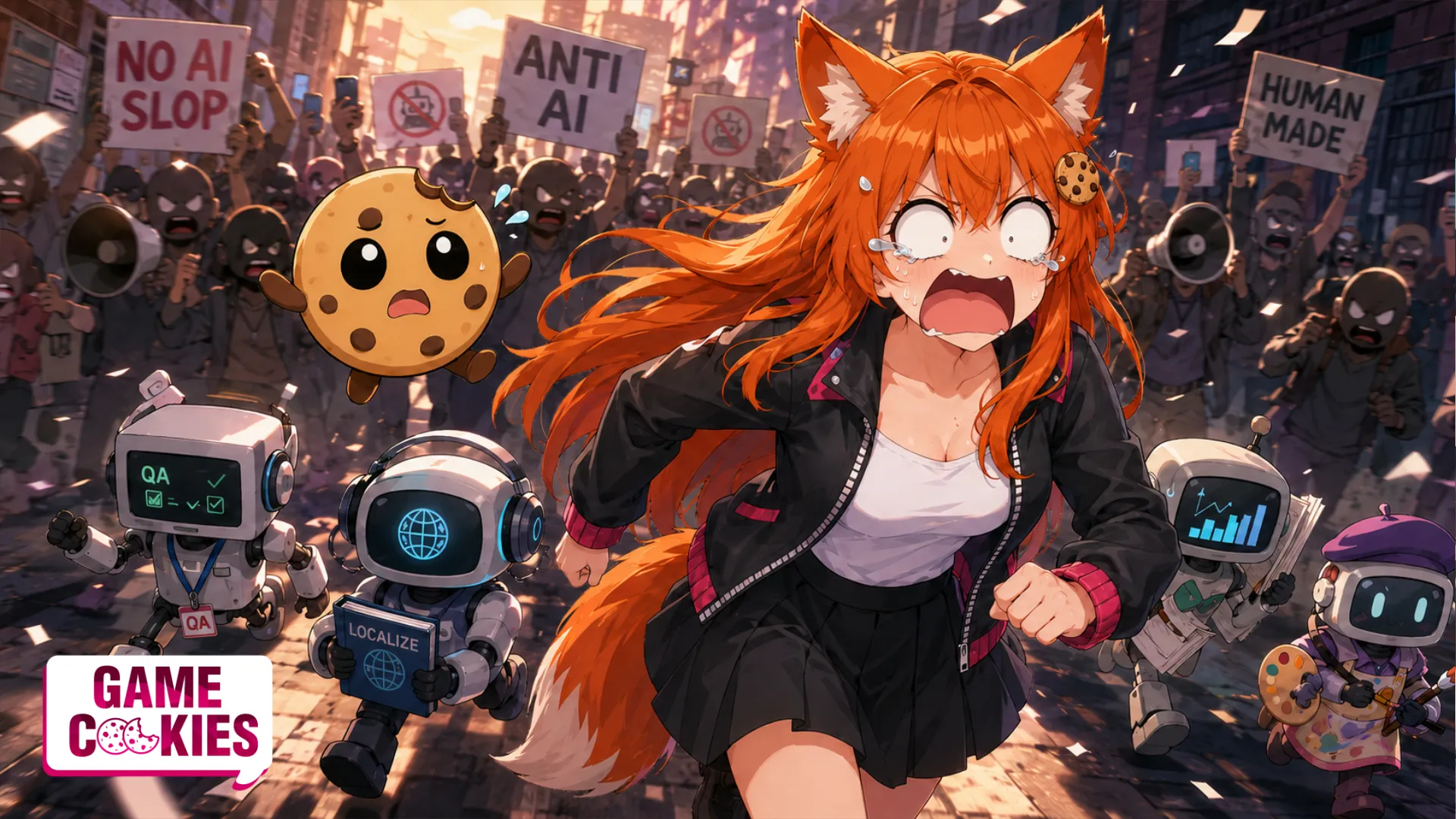
🍪 Take-Two Cut Its AI Team, and Everyone Is Reading the Wrong Story

Hello there, cookie inspectors, AI panic merchants, and everyone who thinks one ugly generated texture explains the entire future of game development. Today we are talking about Luke Dicken, Take-Two’s former head of AI, the company’s reported AI-team layoffs, and why the gaming industry keeps confusing a quality problem with a purity test.
The easy version of the story is already everywhere: Take-Two Interactive reportedly laid off Luke Dicken and an unspecified number of people from its AI team, even after CEO Strauss Zelnick had been talking about the company actively embracing generative AI. That timing is messy, so people immediately turned it into whatever narrative they already wanted to believe.
For the anti-AI crowd, this became proof that generative AI is failing. For the AI hype crowd, it became another corporate reshuffle that means nothing. For everyone else, it should be a warning that the word “AI” has been stretched so far it now means everything from enemy pathfinding to a cursed image generator that thinks hands are optional.
Luke Dicken’s actual concern is more useful than the internet version. He has warned that generative AI is poisoning the well for the rest of AI in games. That does not mean every AI tool is worthless. It means the loudest, ugliest, most legally messy version of AI is making people distrust tools that may actually help developers build better games.
The Take-Two story is not just about layoffs
Dicken’s team did not start as a “make GTA with ChatGPT” department. At Zynga, the group worked on AI research and development connected to machine learning, player behavior analysis, procedural tooling, personalization, and production support. After generative AI became the new magic word in every executive meeting, the team also became involved in governance and strategy around those tools.
That distinction matters because the public conversation is acting like all AI is the same thing. It is not. Traditional game AI, machine learning systems, automated testing, procedural tools, internal search assistants, localization support, diffusion models, LLMs, AI voice replicas, and player-facing generated NPC dialogue are different tools with different risks.
Putting all of them under one giant label creates bad decisions on both sides. Companies can hide weak strategies behind vague AI language, while audiences can attack useful production tools because they are angry at stolen-looking art, soulless promo images, or executives trying to automate taste.
🦊 Kiki: This is where the conversation gets stupid fast. Someone says “AI,” and half the internet imagines a chatbot writing GTA 6 while an artist cries in the parking lot. Meanwhile, a developer may be talking about bug detection, animation cleanup, localization support, or player-behavior analysis. Same word, completely different fight.
🍪 Chip looks at a whiteboard labeled “AI,” sees 47 arrows pointing in opposite directions, and starts chewing the eraser out of stress.
Why Dicken’s warning matters
Dicken’s warning should be read as a vocabulary problem and a trust problem. Generative AI is the loudest part of the room right now, and because it is the loudest, it is dragging every other AI-adjacent tool into the same argument. That is bad for developers building boring but useful systems, and it is also bad for players if the backlash makes companies afraid to use tools that could improve production quality.
The real damage comes when studios overpromise generative AI, ship mediocre output, hide disclosures, scare workers, and then act surprised when players assume the worst. Once that happens, the whole category starts smelling suspicious. A useful QA tool and an ugly generated key art poster should not be judged the same way, but vague corporate language keeps forcing them into the same bucket.
Take-Two’s situation landed right in the middle of that confusion. The company can talk about hundreds of AI pilots, executives can praise efficiency, and then an AI team can still be cut because priorities changed, governance moved, budgets shifted, or the strategy became something else internally. The layoff itself does not prove AI is dead. It proves the industry is still figuring out what kind of AI it actually wants, what it can defend publicly, and what it is willing to fund when the hype slide meets the budget spreadsheet.
The gamer reaction is not as pure as people pretend
The anti-AI crowd wants to say gamers reject AI on principle. That is too clean. Gamers reject bad work, bad disclosure, bad value, and the smell of a company replacing craft with cheaper output. When the game itself is strong, the outrage often loses power.
Crimson Desert is the clearest recent example. Pearl Abyss got caught with AI-generated visual props that were not supposed to remain in the final game. The studio apologized, said experimental AI assets had slipped through, started auditing the game, and began replacing them. That criticism was deserved because the issue was not just “AI touched the game.” The issue was that something below the studio’s own quality bar shipped without the right cleanup.
Then the market did something the discourse does not like. The game kept selling, crossed millions of copies, and even reached a higher Steam peak after launch weekend. Players did not love the AI assets. They did not ignore the mistake. They simply judged the whole product and kept playing because the game offered enough value to survive the controversy.
🦊 Kiki: Crimson Desert walked into court with AI evidence on its shirt, said “sorry, we’ll patch it,” and then kept selling. That does not mean the AI art was good. It means a lot of players looked at the scandal, looked at the game, and said, “Yeah, but can I still launch a goblin into a wall?” Fun beat the purity test. Again.
🍪 Chip hides a cursed AI painting behind a sales chart and pretends this is normal office work.
The Palworld anti-AI pose is a little too convenient
Pocketpair saying it does not use generative AI because “gamers don’t want it” is a smart brand move. It gives the studio a clean position at a time when “AI-free” is starting to work like a trust label. For players who are tired of generated-looking assets and vague production claims, that message lands well.
With Palworld, though, the moral pose is funny. This is a game that became famous partly because everyone immediately noticed the Pokémon inspiration. That does not automatically make Palworld bad or illegal, and it does not make it the same as scraping artists into a model. But it does make the originality sermon harder to deliver with a straight face.
Games have always been built from references, genre borrowing, iteration, parody, remixing, and suspiciously familiar silhouettes wearing new shoes. Human creators do not pull ideas from a holy cave untouched by influence. The difference is not that humans create from nothing while AI uses references. The difference is judgment, intent, accountability, consent, craft, and taste.
That is where AI becomes useful or embarrassing. A human using AI with standards can reject weak output, reshape a concept, test ideas faster, or support boring production tasks. A company using AI without taste can ship cheap-looking garbage and then call it innovation because the investor deck needed a shiny word.
🦊 Kiki: Palworld saying “we would never use AI” while standing next to creatures that look like they know Pikachu’s lawyer personally is incredible comedy. Everyone borrows. Everyone remixes. Everyone has references. The problem is not inspiration. The problem is ugly output, weak standards, and pretending players are too dumb to notice.
🍪 Chip compares a monster silhouette to a legally distinct monster silhouette, then quietly puts on tiny legal glasses.
Bad AI is bad quality moving faster
A lot of anti-AI anger is really anger at cheap work. The internet is full of ugly generated images, fake posters, broken fingers, dead-eyed ads, bland scripts, and thumbnails that look like a marketing intern made them during a gas leak. People see that flood and assume the tool itself is the only problem.
The better read is that generative AI scales whatever standards are already there. A team with taste can use a tool and still protect the final work. A team with no taste can generate more trash in less time. The tool makes the production faster, but it does not magically create judgment.
That is why the recent Shrek trailer backlash is useful. People hated the new design direction and described it as looking AI-ish, but the real complaint was taste. The design looked wrong to them. It broke the character read. Then fans started using AI tools to make “better” versions, which turns the whole moral panic into a comedy sketch. The same audience saying AI ruins art will use AI five minutes later when it gives them the ogre jawline they wanted.
This is the point companies should actually learn. If the work looks cheap, players will attack it. If the disclosure is hidden, players will attack it. If AI is used to replace the people who give the work its identity, players will attack it. But if AI is used under human supervision to improve production, reduce repetitive work, or help a team reach a better final result, the outrage becomes much harder to sustain.
What Take-Two should learn from this
Take-Two’s AI-team story matters because it exposes the gap between executive language and production reality. Executives want efficiency. Developers want tools that actually help. Investors want AI mentioned without needing to understand the pipeline. Players want better games and fewer excuses. That is how one word becomes a battlefield.
The company’s public posture around AI is cautious but interested. Zelnick has said AI can help with assets and production, while also arguing that AI cannot create a hit game by itself. That is the sensible version of the argument. AI can produce options, accelerate tasks, and assist workflows, but hit creation is not asset creation. A pile of generated content is not a game people love.
Dicken’s warning fits that view better than the internet wants to admit. The useful version of AI in games is not the fantasy of replacing artists, writers, designers, and developers with a prompt box. It is the boring production layer that helps teams test, tune, organize, analyze, prototype, and iterate while humans keep control over taste and final decisions.
The danger is that generative AI hype makes every AI conversation look like a replacement threat. Once that happens, useful tools get buried under backlash created by the worst examples. That is the well being poisoned: not because every AI tool is bad, but because the loudest applications make the whole category look cheap, unethical, and creatively lazy.
The real fight is quality versus shortcuts
The industry keeps trying to frame this as AI versus humans. That framing is too simple. The real fight is quality versus shortcuts, disclosure versus hiding, and tools versus replacement.
If AI helps a team make a better game, players may not care. If AI makes a game look cheaper, players will notice. If AI is hidden, legally questionable, or used to erase the people behind the work, the backlash is earned. If AI stays in the production layer and the final game feels better because of it, most players will be too busy playing to demand a philosophical hearing.
That is why the “gamers don’t want AI” line is only half true. Gamers do not want ugly AI. They do not want undisclosed AI. They do not want executives using AI as a layoff excuse. They do not want obvious shortcuts sold as creativity. But gamers have always accepted technology when it improves the final experience.
Luke Dicken’s story should push the industry toward sharper language. Stop saying “AI” like it explains anything. Say what the tool does. Say where it sits in the pipeline. Say whether it touches final assets. Say whether artists approve it. Say whether voice actors consented. Say whether players will see it. Then let the work stand or fall on quality.
Final cookie
The lesson from Take-Two is not that AI is dead. The lesson is that the industry has let generative AI turn a complicated production conversation into a stupid shouting match. The worst AI output deserves every punch it gets, but that does not mean every AI-supported workflow belongs in the same trash fire.
Crimson Desert showed that players can criticize AI use and still reward a game that delivers. Palworld showed that “AI-free” can be a convenient brand shield even in a game built on very visible inspiration. Shrek showed that people will attack AI-looking design, then use AI to fix it when the tool gives them what they want.
The oldest rule still wins: make a good game, do not lie, and do not ship garbage. If AI helps with that, players may move on faster than the activists want. If AI makes the game worse, players will punch the brand whether the asset came from a model, a rushed contractor, or a human artist having the worst Tuesday of their life.
⚙️ Stay quality-obsessed: inspired by every AI panic that lost a fight against a fun gameplay loop.
⚙️ Keep checking the actual product: inspired by every sales chart that made online discourse look louder than it was.
⚙️ And remember: AI will not save a bad game, but a good game can survive a lot of people who were never going to buy it anyway.
🦊 Kiki · 🍪 Chip · ⭐ Byte · 🦁 Leo
Tips, leaks, and suspiciously optimized creativity decks: contact us here!