
Hello there, localization wranglers. Today we are looking at one of the least glamorous problems in game development: the spreadsheet chaos hiding behind global launches, live updates, and every “quick text change” that somehow turns into a production fire.
The problem is file ping-pong.
Yes, that sounds boring. That is how it keeps getting away with it.
Gridly, the Swedish localization and content workflow platform, announced that it has secured a total of SEK 14 million across two recent funding rounds. The company says the investment will support product development, with a focus on translation and QA capabilities powered by agentic AI.
That funding news matters because localization has outgrown the old idea of “send text, get translation, ship language.” For modern games, especially live games, localization is a workflow problem, a context problem, a production visibility problem, and sometimes a “who imported the wrong file into the build?” problem.
The money is the headline. The pressure behind the money is the story.
The invisible chaos behind “just update the text”
Game localization looks simple when people reduce it to “translate the text.” A studio wants to ship in more markets, players need subtitles, menus, tutorials, store pages, patch notes, customer support articles, maybe voiceover, maybe community updates, and somehow all of that has to arrive clearly, consistently, and on time.
From the outside, it feels like a content problem. Inside production, it becomes a coordination problem very fast.
Once a game supports multiple markets, every update creates more strings, more context, more approvals, more screenshots, more placeholders, more character limits, more build dependencies, and more chances for someone to touch the wrong file.
And when that workflow depends on manual handoffs, things get messy.
Someone exports a file. Someone else translates it. Another team reviews it. A producer asks if the latest version is already in the build. A developer imports the wrong sheet. QA finds broken formatting. A translator asks for context because a line says “charge” and nobody knows if it means attack, payment, battery, or legal accusation from the final villain’s lawyer.
Then someone opens a folder and sees:
final_localization.xlsx
final_localization_v2.xlsx
final_localization_FIXED.xlsx
final_localization_REAL_FINAL.xlsx
At that point, the game has already entered spreadsheet horror.
Players rarely see the workflow. They see the result. They see text overflowing from a button, terminology changing between menus, a quest objective that reads weirdly, a subtitle that does not match the tone of the scene, or a patch note that arrives later in one language than another. When localization works, it becomes invisible. When it breaks, it makes the whole game feel cheaper than it actually is.
That is the annoying part. Localization is often judged only when it fails.
Why funding is flowing into localization infrastructure
Gridly’s new funding round included strategic investors such as Jörgen Larsson, founder and former CEO of Stillfront Group. That detail is useful because Stillfront’s world is not some abstract theory about global content. It sits directly inside the kind of environment where live operations, multilingual releases, content scale, and international markets create daily pressure.
Gridly CEO Anna Albinsson said Larsson’s investment is “a strong validation” of what the company is building, pointing to his experience from Stillfront and the broader gaming industry, where localization and content orchestration at scale are business-critical. Larsson also said he sees “tremendous potential” in Gridly’s platform as content scale and speed demands continue to grow.
Strip away the press-release polish and the point is pretty straightforward: games keep producing more content, in more languages, at faster speeds, and the old handoff model is starting to look tired.
Agentic AI is the flashy phrase here, and yes, everyone is putting “AI” into everything right now like it is a mandatory character skin. But in localization, the idea is not ridiculous. Translation QA, consistency checks, terminology management, placeholder validation, context surfacing, workflow routing, and repetitive review tasks are exactly the kinds of areas where smarter automation could reduce the amount of human time spent cleaning up preventable messes.
The risk, of course, is treating AI like magic dust. Localization still needs human judgment, cultural knowledge, creative interpretation, and people who understand what a line is supposed to do inside the game. If AI removes the stupid part of the work, the chasing, checking, rechecking, version matching, and “why is this string broken again?” part, then the value becomes easier to understand.
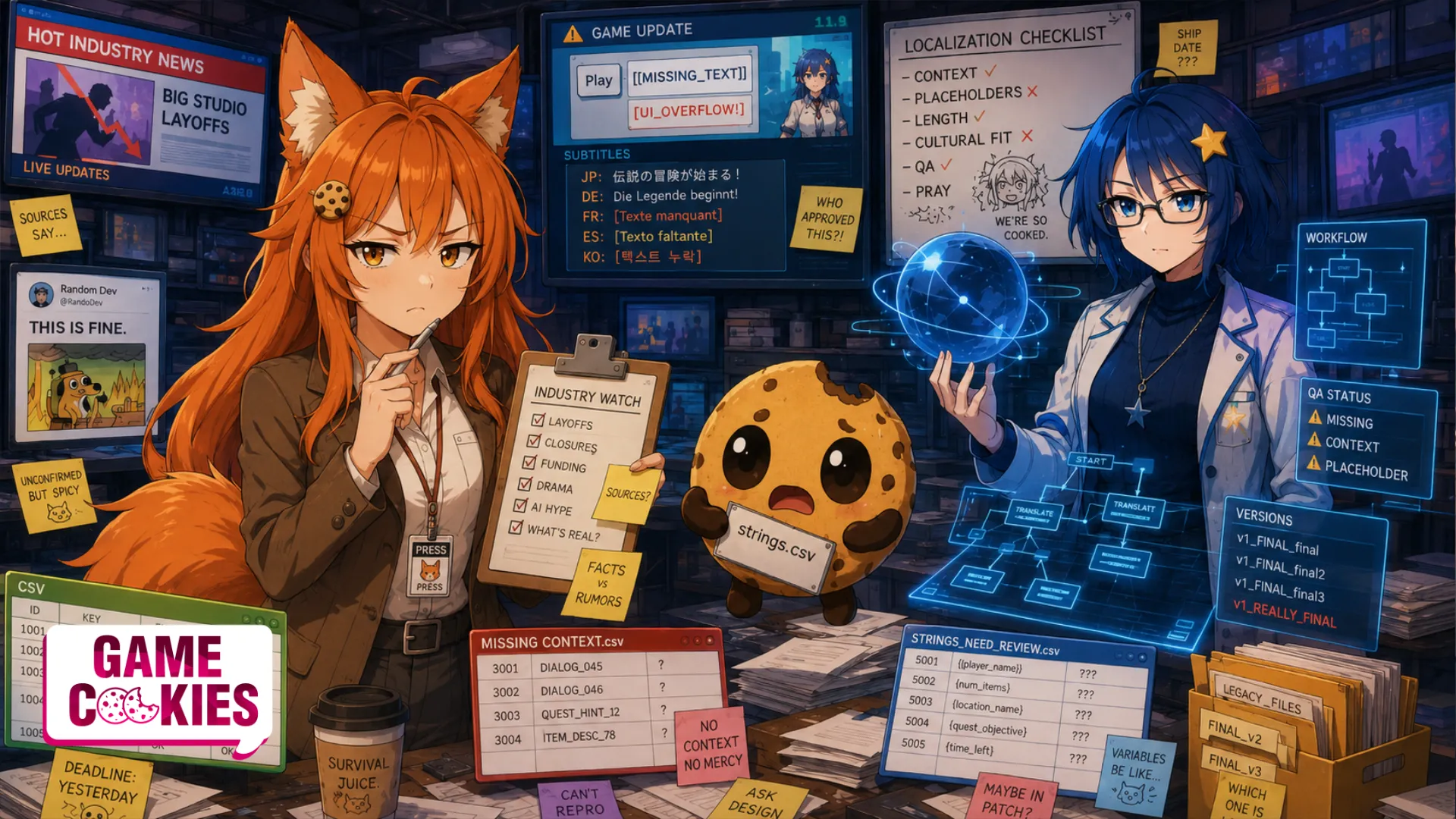
🦊 Kiki: I have seen enough “small localization issue” comments to know those issues are rarely small behind the curtain. Players see one awkward line and think, okay, someone translated that badly. Maybe. But sometimes that line went through a cursed little pilgrimage across a spreadsheet, an email thread, a Slack message, a last-minute import, and a build where nobody had time to check the context anymore. That is how tiny mistakes start looking like creative decisions.
And what makes me tired is how often the industry treats localization like a finishing layer, when the whole point of global games is that the experience should survive crossing markets. You cannot say a game is global and then run the language workflow like someone passing homework before class. At some point, the operational mess becomes part of the product.
🍪 Chip hugs a tiny CSV file and slowly backs away from the import button.
Live games made the old workflow worse
The old mental model of localization was built around big production checkpoints. Prepare the content, send the files, translate, review, import, test, ship.
That model already had problems. Live games made it much worse.
Modern games do not sit still. They patch, rebalance, rotate events, update stores, add seasonal content, rewrite tooltips, change UI flows, adjust onboarding, localize support content, and sometimes do all of that while players are already yelling in five languages. The localization process has to move with the game, not trail behind it like a tired NPC escort mission.
Manual file exchanges create friction exactly where live operations need speed. Every handoff adds delay. Every detached file loses context. Every version floating outside the system increases risk. If a translator cannot see where a line appears in the game, if a reviewer does not know which build a string belongs to, if developers are importing content from files that were already outdated yesterday, the workflow is inefficient and risky.
And yes, sometimes the game ships anyway. That does not mean the workflow was fine. It means someone absorbed the chaos with unpaid emotional damage.
The context problem is bigger than the file problem
The file itself is not always the villain. The deeper issue is what gets stripped away when content leaves its original environment.
A spreadsheet can hold text. It usually does not explain enough.
Where does this string appear? Is it a button, a tooltip, a character line, a warning, a store description, an achievement, or a system message? Is there a screenshot? Is there a character limit? Are placeholders protected? Is the term already approved elsewhere? Is this line reused in multiple contexts? Does the translator know the tone? Is it comedy, tutorial language, legal compliance, lore, or a UI command?
Without context, people guess. Good translators make smart guesses, but guessing should never be the workflow.
Games are especially brutal here because strings are rarely just words. They are attached to systems. They sit inside UI. They interact with code. They carry tone, gameplay meaning, timing, and sometimes player trust. A bad translation can confuse a mechanic. A broken placeholder can damage immersion. A late update can make one market feel secondary.
The more languages a game supports, the more expensive those small cracks become.
Why this matters for studios, not just localization teams
Localization workflow is often treated as a specialized concern, something for localization managers and vendors to handle while production keeps moving. That separation creates problems.
Developers need clean imports. Producers need visibility. Translators need context. Reviewers need consistency. QA needs traceability. Community teams need accurate live updates. Player support needs the same terminology players see in-game. If each team is working from a different version of the truth, someone eventually pays for it.
Usually, that someone is the player.
Better localization workflows are not only about making translators happier, even though that would already be a good idea. They are about reducing avoidable friction across the whole pipeline. The goal is less chasing, less guessing, less duplicated work, fewer late-stage surprises, and fewer “wait, which file did we use?” moments before a release.
That sounds painfully practical because it is. Global game production depends on painfully practical things.
Gridly and memoQ are talking about exactly this
This is also why the upcoming Gridly and memoQ session caught our attention. The webinar is called “Game localization without the file ping-pong”, and the focus is exactly the kind of workflow problem that becomes more painful as games support more markets.
The session is scheduled for Thursday, June 4, from 4:00 PM to 4:45 PM GMT+2. It features Gabor Kovacs, Customer Experience Manager at Gridly, and Santiago de Miguel 🔜 Game Quality Forum, Solution Engineer for Gaming Hub at memoQ.
The pitch is straightforward: if your game localization workflow still depends on manual handoffs between teams, this session is probably relevant. The live format also includes the chance to ask questions directly to the speakers, and if the timing does not work, registering still gets the recording delivered afterward.
You can register here: https://link.gamecookies.news/3AkXVdm
The “final” file is never final
Game localization has changed because games have changed. More markets, more updates, more live content, more player expectations, and more pressure to keep every version aligned. The old file handoff routine can still function for some teams, especially smaller projects with slower content cycles. But once a game becomes bigger, faster, and more global, file ping-pong starts looking less like a harmless habit and more like a production liability.
Gridly’s SEK 14 million funding round is a useful signal because investors are not only looking at translation. They are looking at multilingual content workflows as infrastructure. For games, that makes sense. The industry keeps asking teams to move faster, support more regions, update more often, and somehow make every player feel like the experience was built with them in mind.
Nobody buys a game because the localization pipeline was elegant. Players do notice when the result feels broken, inconsistent, late, or careless.
That is the weird burden of good localization work. If it succeeds, most people never think about it. If it fails, everyone suddenly becomes an expert in UI text, subtitles, terminology, and why the “confirm” button sounds like it came from a haunted banking app.
Stay organized, inspired by every localization team trying to keep global launches from turning into inbox archaeology.
Keep questioning workflows, especially the ones everyone calls “good enough” because nobody wants to rebuild them.
And remember, if your production pipeline has three files named final, none of them are final.
🦊 Kiki · 🍪 Chip · ⭐ Byte · 🦁 Leo