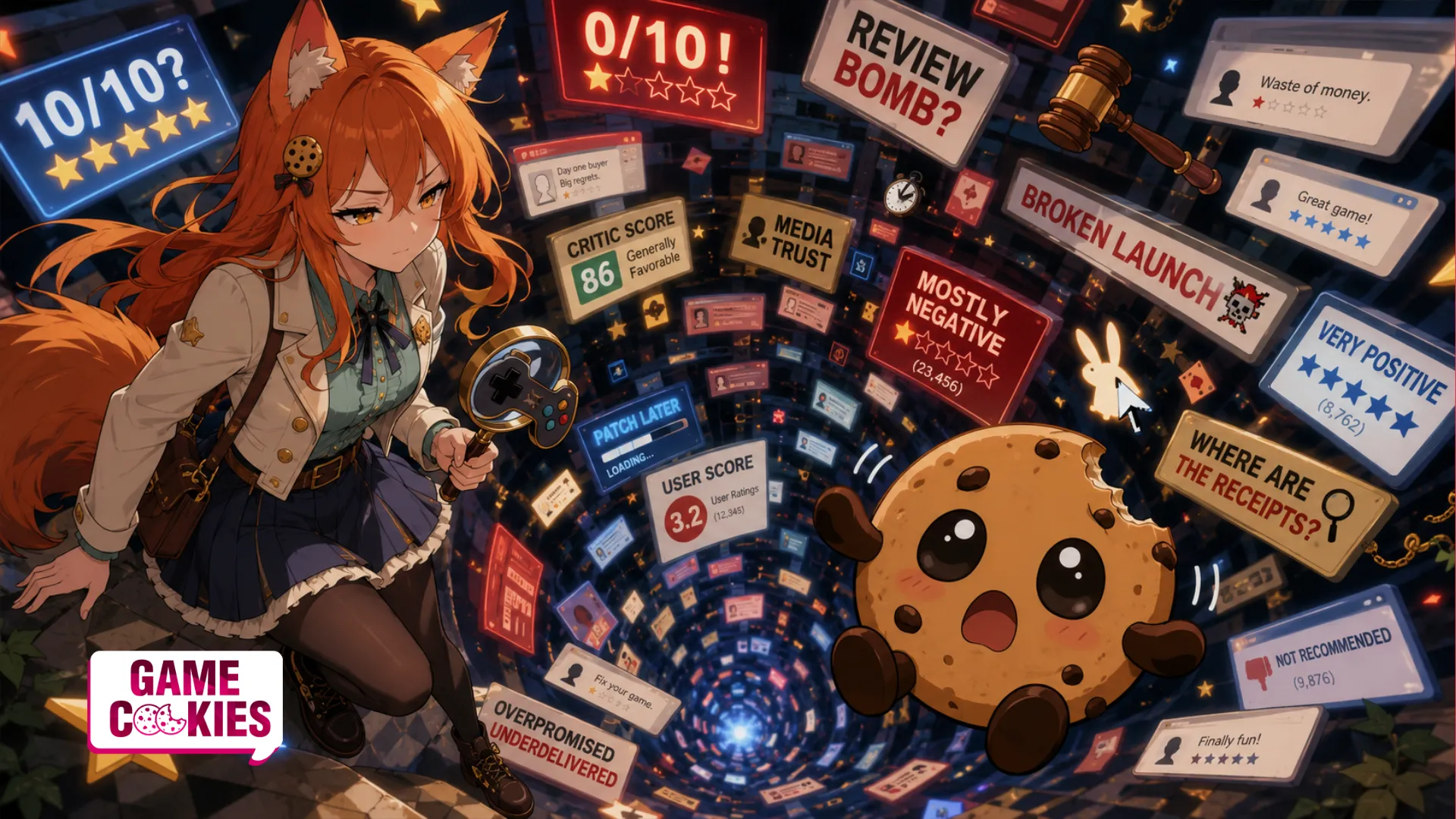
🍪 When “Review Bombing” Became the Industry’s Favorite Excuse

Hello there, score skeptics and media trust survivors. Today we need to talk about one of the gaming industry’s most convenient little shields: the phrase “review bombing.”
It gets pulled out every time players swarm a game with bad user scores. Sometimes the label fits. Some campaigns are clearly ideological, dishonest, or driven by people who never touched the game. That exists. Pretending it doesn’t would be lazy.
The problem starts when the phrase becomes a shortcut for dismissing every ugly audience reaction. Bad performance? Review bombing. Broken launch? Review bombing. Missing features? Review bombing. Monetization that makes players feel like walking ATMs? Somehow, also review bombing.
At Game Cookies, we’re not buying that as the default explanation anymore.
The industry has spent years training audiences to be suspicious. Review copies go out early, microtransactions appear at launch, “live service” often means “unfinished with a roadmap,” and critic scores can land in a completely different universe from what normal players experience on day one. When users hit back with negative reviews, studios and media should ask what broke first: the audience, or the product?
🎮 The label itself has a credibility problem
A 2024 paper studying Metacritic PC user scores describes review bombing as a large volume of unusually low user scores that often may not reflect the product’s real quality. That’s a useful baseline, because yes, coordinated score manipulation exists. Another academic study on The Last of Us Part II argues that review bombing cannot be understood only as misinformation, because ideology, value judgment, and counter-bombing from opposing factions all become part of the same ugly ratings war. In other words, the phenomenon is messy. Treating every bad user score wave as pure bad faith makes the analysis worse, not better.
That distinction matters because companies benefit when the mess gets flattened. If the public hears “review bombing,” the conversation moves away from the actual complaints and toward the supposed flaws of the audience. Suddenly the studio is the victim, the players are irrational, and the product itself gets a strange kind of moral protection.
🦊 Kiki: I’ve seen this trick too many times, and yeah, it gets annoying. Like, bro, players are not always saints. Some of them are weird, some are loud, some are farming rage like it’s a battle pass. Fine. But when a game launches broken, overpriced, weirdly monetized, or missing stuff people were promised, calling the backlash “review bombing” feels like watching someone spill soup on the floor and then blame gravity. At some point the industry has to stop acting shocked that people use the only visible button they have.
🍪 Chip nervously holds up a tiny scorecard, then slowly hides behind it.
🎮 Helldivers 2 showed that review pressure can defend customers
Helldivers 2 is probably the cleanest modern example of player backlash forcing a platform holder to retreat. Sony announced that PC players would need to link a PlayStation Network account, which created a massive problem because PSN access was unavailable in many regions where the game had already been sold. Reports at the time noted that Sony reversed the requirement after backlash and review bombing, while TechSpot reported that the game had been pulled from sale in around 170 countries and its recent Steam rating had fallen to Mostly Negative.
That is hard to dismiss as random gamer tantrum behavior. Players had bought a product. A new account requirement threatened access for people in unsupported regions. Refunds entered the conversation. Sony backed down.
This is exactly why the term “review bombing” needs more care. If players coordinate negative reviews to protest a policy that makes a purchased game inaccessible, the moral center of the story is not automatically the score graph. The center is the decision that triggered the protest.
🦊 Kiki: The Helldivers situation is the one that makes me laugh in that tired, “oh wow, the machine actually blinked” way. Because players did the thing companies hate: they made the problem visible in a place that affects sales. Forums can be ignored. Angry tweets can be muted. A giant red Steam rating sitting next to the buy button is a different animal. That’s not random chaos. That’s players realizing the review box is also a smoke alarm.
🍪 Chip salutes with a tiny cape made from a receipt.
🎮 Dragon’s Dogma 2 was not just people being dramatic
Dragon’s Dogma 2 launched with a split personality. Many critics and players liked the actual RPG underneath the mess, but the Steam reception got hammered by poor performance and a surprise pile of microtransactions. PC Gamer reported that the game had a Mostly Negative Steam rating at launch, with only 39 percent positive reviews at one point, and GameSpot noted technical complaints alongside 21 separate microtransactions, including paid items tied to appearance changes and resurrection resources.
You can argue that some of the microtransactions were technically unnecessary because similar items could be earned in-game. That’s true. You can also argue that dropping them onto a $70 single-player RPG with shaky performance was one of those corporate decisions that makes players instantly reach for the nearest torch.
The issue was trust. Players saw bad performance, one save slot frustration, and paid convenience items arriving at launch. Even if some complaints exaggerated how invasive the shop was, the negative reaction came from real launch conditions.
🦊 Kiki: This one is extra funny because the core game is good enough that Capcom could have just taken the W and gone home. But no, someone had to put the little monetization goblin in the room on day one. And then people act confused when players see performance issues, a full-price tag, and a shop button and start growling. Like, come on. You served a steak with glitter on it and then got mad people talked about the glitter.
🍪 Chip pokes a tiny “$1.99” sticker with visible distrust.
🎮 Overwatch 2 turned disappointment into a public score collapse
When Overwatch 2 launched on Steam, the reviews went nuclear. VGC reported that the game had passed 150,000 Steam user reviews with only around 9 percent positive, with many players criticizing the free-to-play structure and the cancellation of the much-hyped Hero Missions. GameSpot also reported an Overwhelmingly Negative Steam rating shortly after launch, with criticism aimed at the business model and microtransactions.
That matters because Overwatch 2 was not just a new game getting dunked on by bored players. It carried the baggage of replacing the original Overwatch, shifting into a more aggressive free-to-play model, and failing to deliver the larger PvE promise that had helped justify the sequel’s existence in the first place.
A meme-filled review section can still point to a real wound. In this case, the wound was years of expectation management colliding with a product that many players felt had moved sideways while charging harder.
🦊 Kiki: I still think Overwatch 2 is one of the cleanest examples of “you spent years telling people to wait for the big thing, and then the big thing vanished.” Players remember that stuff. They remember trailers. They remember developer promises. They remember when the old game they paid for became something else. So when the Steam page finally opened, people treated it like a public complaint booth with confetti and ASCII art. Childish in places, sure. Random? Nah.
🍪 Chip slowly replaces a “2” logo with a tiny question mark.
🎮 The older examples show the same pattern
This is not new. Warcraft III: Reforged was crushed by users because Blizzard delivered a remaster that many fans felt cut promised features, harmed access to the original client, changed the EULA around user-made content, and failed to match expectations set by its own reveal. Metacritic still shows a 0.6 user score, with 94 percent negative user reviews.
Grand Theft Auto: The Trilogy – The Definitive Edition faced backlash after Rockstar’s PC version was pulled from its launcher, leaving players temporarily unable to buy or play it on PC. PC Gamer described the remaster as full of bugs and glitches, while GameSpot reported its removal from the Rockstar Launcher and the temporary lack of any way to buy the trilogy on PC after the originals had been delisted.
Deathloop faced negative Steam reviews over stuttering and performance complaints that many players associated with Denuvo. The blame around Denuvo was contested, but the underlying player complaint was still performance friction in a fast action game where stutters hurt the experience.
Even Batman: Arkham Knight on PC is worth remembering. Warner Bros. halted PC sales after severe performance issues and glitches, while the game sat at Mostly Negative user reviews on Steam. That was not players inventing a controversy. That was a broken PC launch forcing a publisher response.
🦊 Kiki: The funniest part is that these cases are always treated like new mysteries. Every few years, a big company ships something busted, players freak out, and someone acts like the real issue is the tone of the freakout. Dude, the smoke is coming from the kitchen again. Maybe check the oven before writing a thinkpiece about how smoke alarms are problematic.
🍪 Chip wears a tiny firefighter helmet and stares at a burning review graph.
🎮 Storefront decisions can trigger real consumer anger too
The Metro Exodus Epic Games Store controversy showed another version of this. PC Gamer reported that after Metro Exodus moved to Epic exclusivity less than three weeks before launch, unhappy Steam users review-bombed older Metro games because the new game’s Steam page was no longer available for regular reviews. Earlier Metro entries were still Very Positive overall, but their recent reviews dropped hard as players used the only available Steam pages to protest the storefront switch.
That case is messier because the older games themselves did not deserve punishment for a publishing decision around a newer title. Still, the anger did not come from nowhere. Players saw a last-minute platform change after months of Steam preorders and reacted against what they considered an anti-consumer move.
This is where review bombing becomes both a symptom and a blunt instrument. It can expose a trust fracture while also damaging unrelated targets. Both things can be true in the same mess.
🦊 Kiki: Metro is where I start doing the little exhausted forehead rub. Because yeah, bombing the older games is messy and kind of dumb. Those games didn’t sneak into the boardroom and sign the Epic deal. But the anger itself makes sense. Players hate being moved around like inventory, especially after preorders and marketing have already trained them to expect one storefront. The target was messy. The complaint had a pulse.
🍪 Chip draws a tiny map from Steam to Epic, then gets lost halfway.
🎮 Bad-faith campaigns exist, and pretending otherwise weakens the argument
There are cases where the label fits much better. Total War: Rome II was hit by backlash over female generals, but Creative Assembly clarified that many factions had a 0 percent chance of female generals, most others had only a 10 to 15 percent chance, and the Kushites had 50 percent. PCGamesN reported that the controversy appeared exaggerated, while PC Gamer covered the review-bombing over the female general claims.
Horizon Forbidden West: Burning Shores also became a cleaner example of ideological backlash. Forbes reported that Metacritic issued a statement after the DLC was review-bombed over Aloy’s optional romance with Seyka. Metacritic data still shows a strong critic score and a much lower user score, with thousands of user ratings.
Those cases matter because they show why the phrase exists. Some people absolutely do weaponize user scores over politics, representation, culture-war anger, or issues barely connected to the actual game quality. The problem is that studios and some media outlets now apply the same moral framing to cases where players were responding to broken products, missing features, or bad business decisions.
Harassment is not criticism. Bigotry is not criticism. A player who cannot access a game they purchased because of a new account requirement is also not the same thing as a culture-war spammer.
🦊 Kiki: This is where nuance actually helps, even though nuance is usually where internet arguments go to die in a ditch. Some review bombs are absolutely garbage. People throwing zeroes because two women kissed, or because a historical strategy game included a tiny percentage chance of women generals, yeah, that’s not brave consumer advocacy. That’s just being weird in public. But studios love when those cases exist because then they can point at the worst people in the room and pretend everyone else sounds like them.
🍪 Chip holds two signs, one says “real complaint,” the other says “please stop being weird.”
🎮 Halo, Redfall, and the unfinished launch problem
The Xbox side gives us another version of this credibility gap. Halo Infinite launched without campaign co-op and Forge, two features strongly associated with the franchise. GameSpot reported that 343 Industries confirmed both would miss launch, with Forge and campaign co-op pushed to later updates.
Redfall is even more brutal as a launch-quality example. GameRant reported that users review-bombed the game after release while pointing to multiple problems, and PC Gamer later described the game’s troubled legacy as one defined by an unfinished state, poor AI, an unengaging open world, and broken gameplay that patches could not fully rescue.
When games ship incomplete, players notice. When publishers ask for full-price money, players notice faster. The modern “we’ll fix it later” model has made day-one buyers feel like unpaid QA testers with wallets.
🦊 Kiki: I’m old enough in gamer years to remember when missing co-op in Halo felt like someone forgot to put wheels on a car. You can explain it. You can roadmap it. You can say development is hard, and yeah, development is hard. But players are still allowed to look at a franchise staple missing at launch and say, “What are we doing here?” Same with Redfall. At some point “give it time” stops sounding patient and starts sounding like a hostage note from live service production.
🍪 Chip gently places a “coming later” sticker on an empty box.
🎮 Marathon is the case to handle carefully
Bungie’s Marathon is useful here, but not as a simple review-bombing proof point. The current Steam listing shows the game with Very Positive recent and overall English reviews, which makes it a poor fit if we are claiming players rejected it through user reviews.
Where Marathon does fit is the broader trust conversation. Reports around the game tracked early complaints about UI clarity, confusing onboarding, PvP pacing, voice chat, and player experience, while TechRadar recently reported that Bungie outlined plans to improve the game after the Steam player count fell below 15 percent of launch-day peak.
That is not a review-bombing story. It is a reminder that live-service games live or die on retention, clarity, and trust after launch. A positive review score does not erase friction. A negative score does not automatically prove coordinated bad faith.
🦊 Kiki: Marathon is the one I’d keep in the article with gloves on. Because if we overstate it, we weaken the whole argument. The Steam reviews are strong right now, so calling it some massive audience rejection would be sloppy. What it does show is the same live-service math everyone keeps pretending is wizardry: players can like your gunfeel and still bounce if the onboarding is weird, the UI fights them, or the grind gets hungry. Goodwill is not infinite. Especially not for Bungie. They should know that better than anyone.
🍪 Chip checks the Steam page twice, then nods very seriously.
🎮 The real media problem is score credibility
This is where gaming media keeps stepping on a rake.
Players do not need every critic to agree with them. That would be boring, and honestly impossible. The problem comes when scores feel disconnected from product reality. When technical issues, monetization, missing modes, or broken promises are treated as footnotes while the final score still floats high, users start treating critic scores as brand protection rather than evaluation.
That resentment then feeds the user-score wars. A 10/10 from critics meets a 0/10 from angry users, and everyone becomes less trustworthy. Critics accuse players of bad faith. Players accuse critics of being bought or captured. Studios point at the ugliest comments and avoid the substance. The actual game gets buried under a credibility fistfight.
The industry needs better language. “Review bombing” should describe coordinated score manipulation, especially when reviews are detached from product experience. It should not be used as a magic eraser for customer anger.
If the complaint is performance, talk about performance.
If the complaint is missing features, talk about missing features.
If the complaint is monetization, talk about monetization.
If the complaint is bigotry, say that clearly too.
The problem is not that audiences are always right. They are not. The problem is that the industry keeps acting like audiences are only legitimate when they clap.
🦊 Kiki: This is the part where I get tired, because the fix is not even complicated. Stop pretending players are stupid when the receipt trail is right there. Steam ratings, refund requests, patch notes, missing modes, weird DLC pricing, broken launchers, region locks, all of it leaves footprints. If a player review is trash, fine, ignore that one. But when thousands of people are pointing at the same wound, maybe don’t start the conversation by calling them a mob. Maybe start by checking if the wound is bleeding.
🍪 Chip opens a tiny evidence folder labeled “receipts” and immediately drops half the papers.
🎮 In the end…
Review bombing exists. It can be abusive, dishonest, politically motivated, and unfair to developers who worked hard on games that become culture-war targets. No serious outlet should pretend otherwise.
But the phrase has become overused. Worse, it has become useful to people who want to blur legitimate consumer backlash with bad-faith harassment. That is dangerous for media credibility because audiences can tell when their actual problems are being moralized away.
The industry does not need fewer user reviews. It needs better reading comprehension.
When players bomb a score because a product launched broken, inaccessible, overpriced, unfinished, or structurally worse than promised, the useful question is not “why are gamers so angry?”
The useful question is: who taught them that this was the only way to be heard?
⚙️ Stay skeptical, inspired by the Helldivers who made a storefront problem impossible to ignore.
⚙️ Keep receipts, inspired by every launch where patch notes quietly proved the complaints had teeth.
⚙️ And remember, when every bad score gets called a review bomb, the phrase stops protecting truth and starts protecting the people who shipped the problem.
🦊 Kiki · 🍪 Chip · ⭐ Byte · 🦁 Leo
Tips, corrections, and spicy industry breadcrumbs: contact us here!