
🍪 No Man’s Sky didn’t win people back with PR, it won because Hello Games kept shipping

Hello there… comeback watchers, overhype survivors, and anyone who still remembers what 2016 felt like when No Man’s Sky hit the floor instead of the stars.
There are very few redemption stories in games that actually hold up when you look closely. Usually people call something a comeback because the outrage cycle moved on, not because the company fixed the core problem. No Man’s Sky is one of the rare cases where the repair work was real. The launch was a mess, the trust collapse was deserved, and Hello Games still dragged the thing back from the dead through years of updates, restraint, and a level of stubbornness most studios simply do not have. Now, almost ten years later, they’re adding creature battling with Xeno Arena like this game has become a lab for every leftover idea in modern game design.
A tiny studio sold a cosmic promise it could not carry
No Man’s Sky started as the dream project of Hello Games, a small British studio founded in 2008 by Sean Murray, Grant Duncan, Ryan Doyle, and David Ream. Before all this, they were the Joe Danger team. Good reputation, clever work, indie momentum. Then Murray chased the bigger fantasy: a procedural sci-fi universe that felt endless, mysterious, and personal. That pitch landed at exactly the right time. The game had scale, mystery, and one of those concepts people immediately inflate in their own heads.
Then came the flood in 2013 that wrecked the office and months of work. That part matters because the myth of Hello Games tends to flatten into either “poor indie heroes” or “liars who overpromised.” Reality was uglier. This was already a small team carrying a ridiculous amount of expectation, and then the project got physically smashed before it even became a global spectacle. Instead of backing off, they rebuilt, took Sony’s E3 2014 spotlight, and suddenly the game became one of the most anticipated releases of the decade.
That was the beginning of the problem, not the victory.
The launch disaster was not just about missing features
A lot of people rewrite the original No Man’s Sky backlash into something softer than it was. It was not just “players expected too much.” That excuse has always been lazy. The issue was that the marketing and public framing created a picture of the game that the shipping version did not match. Players expected stronger multiplayer, more meaningful diversity, bigger encounters, deeper systems, more reasons for all that procedural scale to matter. Instead, they got repetition, absence, and the very bad feeling that the idea had arrived before the game was ready.
That gap detonated. Steam reviews cratered. Forums turned feral. The Advertising Standards Authority looked into whether promotional materials had been misleading. Murray reportedly received death threats. Hello Games went quiet, which at the time made everything worse because silence reads like cowardice when people already think they were sold smoke.
🦊 Kiki: Yeah, I remember that period way too clearly. The whole thing had this cursed vibe where every interview, every trailer clip, every fan theory started stacking into one giant imagined version of the game that people emotionally preordered in their heads. And then launch day came and it felt like showing up to a five-star resort and finding folding chairs in a parking lot. That’s why people were so mad. It wasn’t normal disappointment. It felt personal.
Also, I hate when people act like players were stupid for believing the fantasy. Bro, that fantasy was the product. That was the whole sale. You don’t get to build the aura, cash the hype, then act shocked when people notice the box is lighter than advertised. That part was real. Hello Games earned that backlash. What they also earned later, though, was the right to say they fixed it. Most studios never get that second half.
🍪 Chip clutches his own bite mark and stares into space like he just remembered launch week.
The comeback started when Hello Games stopped talking big
What turned No Man’s Sky around was not a magical PR maneuver. It was not a “community-first” statement thread. It was not some executive apology tour. Hello Games basically did the least glamorous thing possible. They shut up and worked. Then they kept doing that for years.
The update trail tells the real story. Foundation in 2016 added base building, freighters, and new modes. Path Finder brought vehicles and visual improvements. Atlas Rises pushed story content and an early multiplayer form. NEXT in 2018 was the major breakpoint, adding full multiplayer, third-person, base sharing, and the kind of structural changes people had wanted from the start. Beyond added VR and social expansion. Origins pushed planetary variety. Interceptor, Echoes, Voyagers, Remnant, and now Xeno Arena kept layering entirely new reasons to care. The updates did not just patch holes. They kept expanding the fantasy until the game became much bigger than the original pitch.
That distinction matters. Plenty of studios “support” a broken launch. Few actually outwork the original failure.
Free updates changed the moral balance of the story
One reason people now talk about No Man’s Sky as one of gaming’s best redemption arcs is that Hello Games did not ask players to pay for the apology. That matters more than people admit. If a studio launches broken, then sells the recovery in premium chunks, players read that correctly. They see monetized repair work. No Man’s Sky took the opposite route. Update after update came free, over years, with no paid expansions attached to the rebuilding effort.
That does not erase the original mess, but it changes the moral equation. It tells players the studio knows the debt still exists. The recovery stops feeling transactional and starts feeling corrective. There’s a reason that rebuilt trust faster than any statement ever could.
🦊 Kiki: This is the part most publishers would absolutely fumble. You know how it usually goes. “We hear you.” “We’re committed.” “Year One Roadmap.” “Founder’s Pack.” “Expansion Pass.” Just pure corporate necromancy. Hello Games, somehow, did the opposite. They kept dropping actual work into the game without standing on a stage asking for applause every twelve seconds.
And yeah, let’s be honest, that bought them a lot of forgiveness because players are not dumb. Players can smell whether a studio is fixing a mistake or monetizing the wreckage. Big difference. One feels like restitution. The other feels like you crashed into my car and then tried to sell me the replacement door in three deluxe editions.
🍪 Chip drifts in slow circles, visibly calmer now that nobody mentioned a season pass.
The studio learned the correct lesson from failure
The easy lesson would have been “don’t dream so big.” That is not what Hello Games learned. The real lesson was “do not sell vapor like it already exists.” The studio stayed ambitious, but it got quieter. It started under-promising and shipping close to announcement windows. That discipline is probably the most important change of all.
Hello Games also stayed relatively small while scaling the game across more platforms and feature sets, which is frankly kind of absurd when you look at the output. By 2023 the team was still only around 50 people. That number is important because it exposes how weak a lot of larger studios look by comparison. Massive teams with platform backing and monetization infrastructure struggle to maintain one live game cleanly. Hello Games kept reshaping one of the industry’s most infamous launches into a long-term success story with a fraction of that machinery.
Not every studio can copy that. Most public companies literally are not built to. The patience required would clash with quarterly pressure, roadmap politics, and the need to constantly narrate value to investors. Hello Games could keep grinding because it stayed independent and protected the project long enough for the work to speak.
Xeno Arena is funny on the surface, but it proves something serious
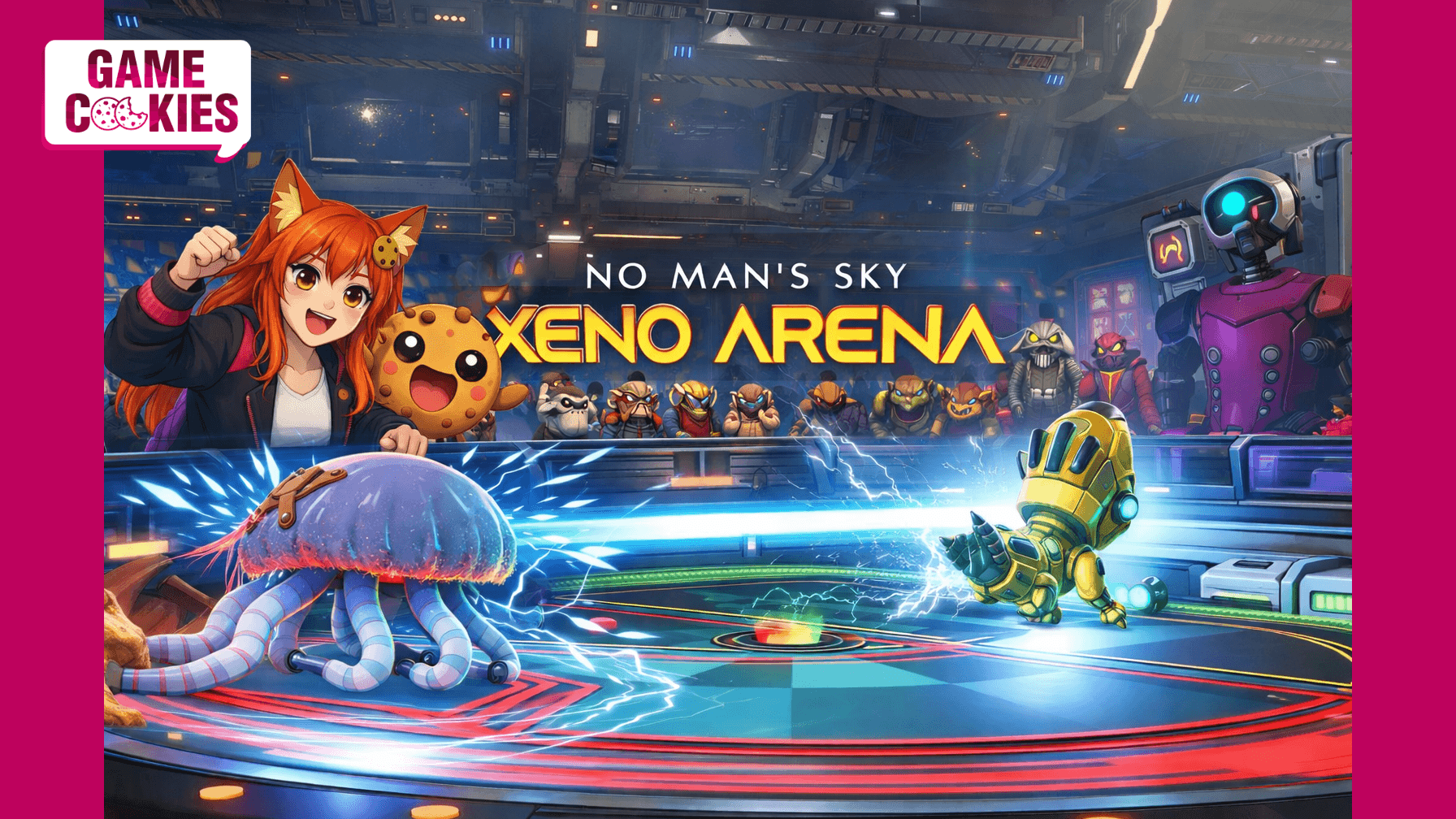
Now we get to Xeno Arena, the April 8, 2026 update that adds Pokémon-style creature collecting, training, and battling into No Man’s Sky. Players can recruit creatures, level them, genetically modify them, push them through ranked leagues, challenge NPCs or other players, build their own arenas, and work with a larger pet limit. It sounds ridiculous because it is ridiculous. It also makes perfect sense for this game in 2026.
At this point No Man’s Sky is less a single genre product and more a living accumulation of systems that all orbit the same fantasy of cosmic possibility. Exploration led to survival, which led to building, which led to social play, which led to customization, which now somehow leads to alien fight clubs on space stations. Xeno Arena is not random feature creep in the usual sloppy sense. It is a sign that the game now has enough trust, enough mechanical depth, and enough player goodwill to absorb weird ideas without collapsing under them.
That is a luxury failed launches almost never earn.
🦊 Kiki: I kind of love how unhinged this is. Like, imagine telling 2016 players that one day No Man’s Sky would become the game where you wander the galaxy collecting weird little space freaks and making them battle in holo-arenas. They would’ve thrown a chair at you. But weirdly, this is what a healthy long-tail game looks like. It starts doing side quests as a personality trait.
And honestly, that’s the part that impresses me now. Not that Xeno Arena exists. It’s that players will probably give it a fair shot instead of instantly reading it as distraction tech. Back then any new feature would’ve felt like deflection. Now it feels like abundance. That’s a brutal shift to earn. You don’t get there through branding. You get there through years of not being full of BS.
🍪 Chip puffs up proudly like he’s ready to enter the league with exactly zero combat viability.
Why this comeback still matters
No Man’s Sky matters because it is one of the clearest examples of trust as labor. Not trust as messaging. Not trust as vibes. Labor. Sustained, visible, compounding work. The game launched into a reputation crater and Hello Games spent nearly a decade filling it in piece by piece.
That makes this story bigger than one game. It cuts into how the industry handles failure. Most companies want forgiveness on announcement day. They want to publish the corrective statement, show a roadmap slide, then move the conversation to what’s next. Hello Games accidentally demonstrated the harder truth: trust returns after the receipts pile up, not before.
There is also a warning inside the success. The redemption story only looks noble because the original collapse was so public and so severe. No studio should want this path. It worked here because the team survived long enough to finish the repair and because players eventually saw something genuine in the effort. That combination is rare. If anything, No Man’s Sky is not proof that broken launches are fixable. It is proof that fixing one properly is exhausting, expensive, slow, and far beyond what most companies are willing to endure.
In the end…
No Man’s Sky did not become respected because time passed. It became respected because Hello Games kept adding substance until the old narrative could no longer contain the game. Xeno Arena is the latest proof that this is no longer a recovery project. It is just a very strange, very ambitious live game that survived its own mythology and outlived the version of itself that people hated.
That is why the story still hits. Not because redemption is cute, but because it is so rare to see a studio do the slow, thankless work all the way through.
⚙️ Stay stubborn
⚙️ Keep shipping
⚙️ And remember trust comes back after the work, not after the apology
🦊 Kiki · 🍪 Chip · ⭐ Byte · 🦁 Leo