

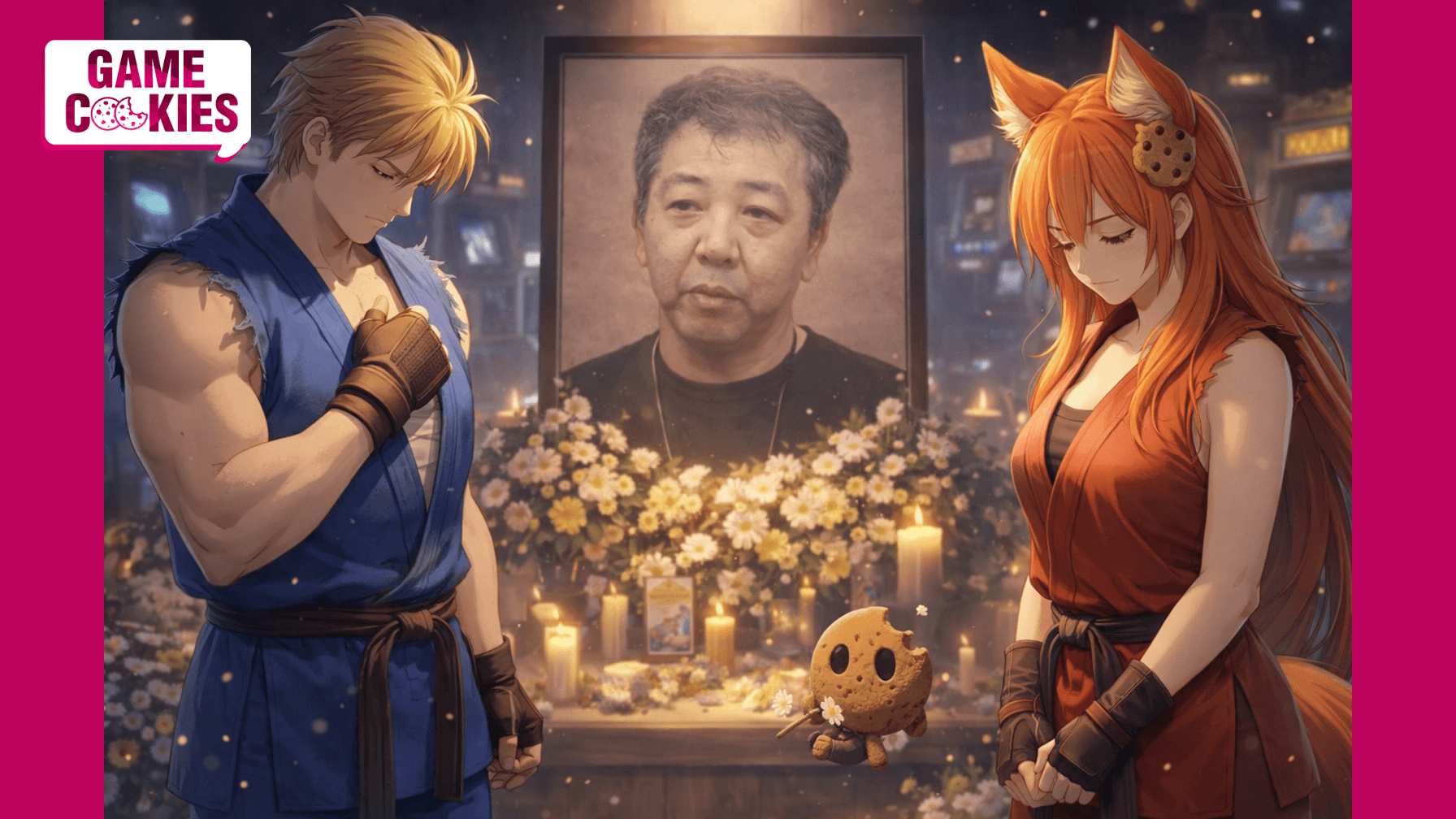
Hello there, arcade survivors and studio doomscrollers. Today’s stack of news feels ugly in a very specific way. One part of the industry is mourning Yoshihisa Kishimoto, one of the people who helped define what video games could feel like with their hands on a cabinet and a crowd around them. The other part is busy arguing that AI will “free” developers, laying off AI teams anyway, fielding new harassment allegations, and letting more outside capital seep deeper into some of Japan’s most valuable publishers.
The week starts with a death, and a reminder of what game craft used to mean
Yoshihisa Kishimoto died on April 2 at age 64, according to a notice shared by his son. For older players, that is not just an obituary. That is a piece of the medium’s muscle memory disappearing. Kishimoto’s name is tied to Kunio-kun, Renegade, and Double Dragon, work that helped shape the beat ’em up as a genre and gave games a kind of street-level physicality that still echoes through action design now. Later in his career, he remained connected to the medium through work on Double Dragon IV and other projects.
What makes that news hit harder is the timing. The same week the industry is asked to pause and remember one of the people who helped build its foundation, the rest of the headlines read like a boardroom trying to automate taste, financialize trust, and treat labor as a temporary inconvenience. The contrast is ugly because Kishimoto’s era was built on people making things that left fingerprints. A lot of 2026 still sounds like executives trying to erase the fingerprints and keep the output.
🦊 Kiki: I always get irritated when the industry starts talking about “innovation” like the whole history of games began when some suit discovered the word efficiency. Kishimoto’s work came from an era where mechanics had personality. You could feel who made the thing, even if you didn’t know their name yet. That matters to me. I grew up around games that felt a little rough, a little mean, a little loud, and very human. They were not optimized into existence.
And yeah, I know, every generation says the old stuff had soul. Sometimes that’s nostalgia talking. Sometimes it’s just true. When one of the people who helped define a genre dies, and the current headlines are all layoffs, HR horror stories, and AI productivity language, it does something gross to the mood. It makes the present look cheaper than it already did.
🍪 Chip curls into a tiny worried ball and hovers lower than usual.
Halo and Piranha are two different stories, but they point at the same rot
At Halo Studios , former art director Glenn Israel publicly alleged that he faced harassment and retaliation after filing complaints with Microsoft HR, and said other senior studio representatives engaged in blacklisting, fraud, favoritism, and harassment. Game Developer reported that other former employees then voiced similar claims publicly. Microsoft did not comment on individual employee issues, but said it takes all claims seriously. These are allegations, not findings, but they are serious, detailed, and they landed on top of years of public criticism around Halo leadership and mismanagement.
A few days earlier, Piranha Games CEO Russ Bullock confirmed that the MechWarrior developer laid off 30 percent of staff, pushing back on an earlier claim that 60 percent had been cut. The studio says it will continue working on DLC, but this is the second major round of cuts there in a little over a year, after MechWarrior 5: Clans reportedly sold below expectations.
Put those stories together and the pattern gets harder to ignore. One studio is accused of treating people like disposable political problems. Another is still carving chunks out of its workforce while promising the content pipeline will continue. The language changes depending on who is talking. “Redundancy.” “Restructuring.” “Economic reality.” “We still continue to work on DLC.” The result is always the same for the people packing up their desks.
🦊 Kiki: This part makes me tired in a very old internet way. First you hear that leadership is messy, then you hear the people closest to the work are the ones getting ground down, then months later somebody in corporate language tells you the project is still moving forward. Cool. Great. Amazing. The project survives. The people get chewed up. Again.
And with Halo specifically, the allegations matter because this is not some anonymous mobile studio nobody outside dev LinkedIn has heard of. This is Halo. If a franchise that central can keep generating stories about mismanagement, internal fear, and retaliation claims, then the industry really needs to stop pretending culture problems are edge cases. They keep showing up at the center of the business.
🍪 Chip nervously clutches an imaginary HR folder and looks like he wants to vanish into it.
The AI pitch keeps getting louder, even while the ground under it keeps moving
Take-Two Interactive reportedly laid off its head of AI, Luke Dicken, along with multiple team members, according to public LinkedIn posts and reporting from Game Developer. That is awkward timing for a company whose CEO Strauss Zelnick said in February that Take-Two was “actively embracing generative AI” with “hundreds of pilots and implementations,” then argued in March that these tools may help create assets but will not create hits.
At the same time, Nexon America is pushing the exact opposite mood. In its capital markets briefing, the company said its “Mono Lake” initiative is about putting accumulated player and development context behind AI workflows, and Junghun Lee described ARC Raiders as a “Trojan Horse” for changing how developers work, spending more time thinking and less time typing. That phrasing came straight from Nexon’s own presentation.
The problem is that the sales pitch already sounds cleaner than the reality. ARC Raiders itself has been moving away from some AI voice work after Embark Studios’s Patrick Söderlund acknowledged there is “a quality difference” and that “a real professional actor is better than AI.” So even one of the showcase examples in this whole “free developers to be creative” narrative has already had to walk some of its own implementation back toward actual human performance.
That does not mean every AI tool is useless. It does mean the industry keeps trying to sell labor-saving infrastructure as creative liberation, and people are getting less patient with the spin. If a publisher says AI will free creators while another publisher lays off the AI team after months of pro-AI language, and the studio held up as the model case is quietly re-recording machine-made voice lines with human actors, then maybe the real story is simpler: nobody fully knows what this is going to stabilize into yet, and a lot of executives are pretending they do.
🦊 Kiki: I hate the phrase “frees developers” at this point. It has the same energy as every tech promise that shows up wearing a nice blazer and leaves half the room unemployed. And yeah, there are useful production tools. I’m not doing the caveman thing where every automation is evil. That’s lazy too. But the industry keeps using soft language for very hard consequences, and people notice.
Also, calling a game a “Trojan Horse” for mindset change is one of those executive lines that should have stayed inside the meeting room. That’s the kind of phrase that makes normal people sit up and go, wait, so the point was not just the game? Because if you say the quiet part out loud like that, people are going to hear exactly what it sounds like.
🍪 Chip bonks a tiny toy robot with a foam hammer, then immediately looks guilty about it.
Capcom’s new Saudi stake is a finance story, but players should read the subtext
Automaton West reports that EGDC increased its Capcom stake from 5.03 percent to 6.04 percent, growing its holding from roughly 26.78 million shares to 32.18 million, and describing the purpose as “pure investment.” That comes only weeks after the earlier disclosure that EGDC had crossed the large-shareholder threshold in Capcom.
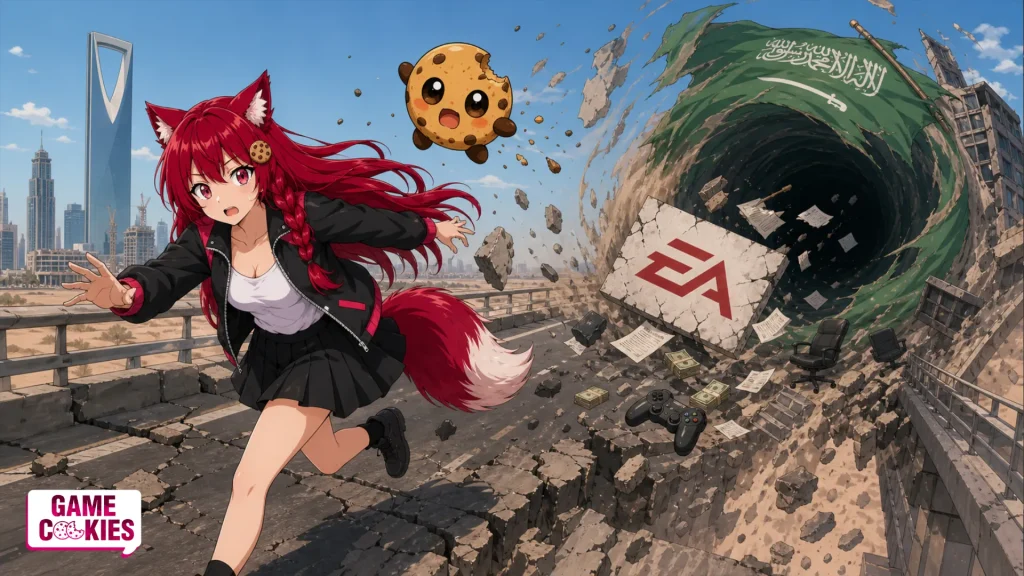
That does not mean Saudi ownership suddenly controls Capcom. It does mean Saudi-backed capital continues to widen its footprint across games, from SNK to Capcom, while the separate proposed EA take-private deal shows how broad that strategy has become beyond one publisher or region. EA itself announced last year that it had agreed to be acquired by a consortium of PIF, Silver Lake, and Affinity Partners for about $55 billion, and U.S. lawmakers later asked the FTC to review the transaction over labor and competition concerns.
🦊 Kiki: People love pretending ownership stories are boring until the consequences finally touch a franchise they care about. Then suddenly everyone wants to act surprised that money changes the weather. I’m not saying a 6.04 percent stake means Resident Evil wakes up tomorrow as a policy document. I’m saying you should watch where the gravity is building.
And Capcom is one of those companies people project stability onto because it has been executing well. Fair enough. They have earned that reputation. That is exactly why this kind of stake creep matters. Capital does not wait for a company to look weak. It likes strong companies too, especially when they own beloved IP and keep proving they know how to monetize it for the long haul.
🍪 Chip puts on a tiny suit jacket and immediately looks untrustworthy.
⚙️ Stay grounded, like Kishimoto’s design instincts.
⚙️ Keep questioning, like the devs who are still willing to speak publicly.
⚙️ And remember, a game business that keeps treating people as overhead eventually forgets why players cared in the first place.
🦊 Kiki · 🍪 Chip · ⭐ Byte · 🦁 Leo