
Hello there, tired developers, cautious investors, and anyone who’s watched a stock chart move faster than an actual game release.
Early this week wasn’t about a new game. It wasn’t about a console. It wasn’t even about players.
It was about a demo.
Google showed off a generative AI world model. Sixty seconds long. Low resolution. Barely interactive. And somehow, that was enough to erase roughly fifteen billion dollars from game companies in a single trading session.
Let’s unpack what actually happened, why the reaction spiraled, and why the industry itself barely blinked.
The demo that scared the market
Google DeepMind unveiled Project Genie, an experimental world-model AI that turns text or image prompts into explorable environments.
On paper, it sounds enormous. Even I raised an eyebrow at first. World models are a real area of research, and they matter.
But once you look past the headline, the constraints are obvious.
Each generated world lasts sixty seconds. It runs at 720p. Roughly 24 frames per second. You can move around, but that’s about it. No objectives. No systems. No sound. No persistence.
🦊 Kiki: I’ve played internal builds that looked better than this and still got cut. That’s just how production works. You don’t ship vibes.
The model regularly forgets what it just created. Geometry shifts mid-walk. Physics gets weird. Input lag shows up fast. It behaves more like a probabilistic video hallucination than anything you could actually build on.
Google itself calls it a research prototype.
And yet none of that mattered.
What mattered was the headline: AI generates playable worlds.
Wall Street took that sentence and filled in the rest with pure imagination.
The sell-off: fear moved faster than facts
Within hours, gaming stocks dropped hard.
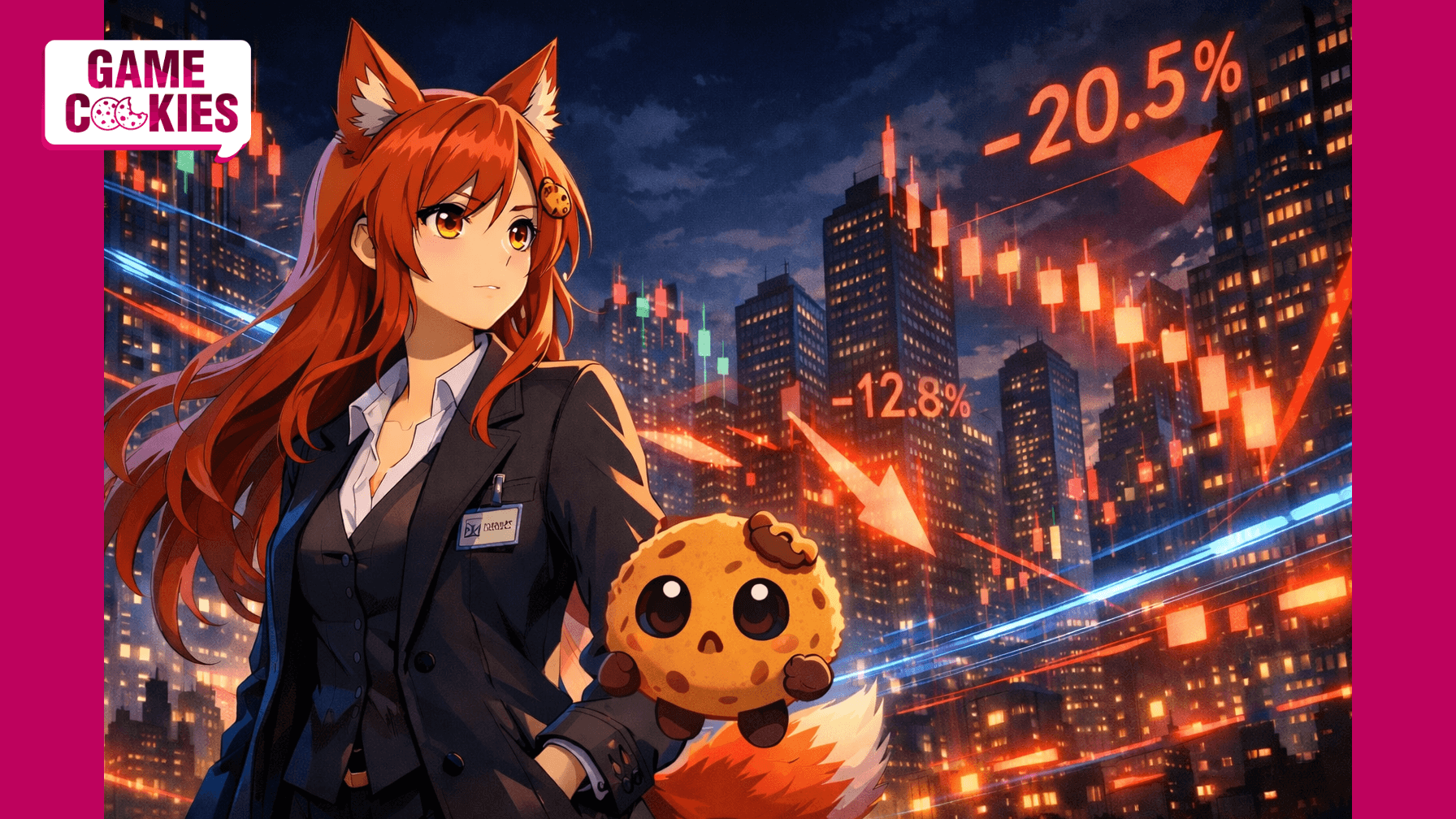
Unity fell roughly twenty percent at its worst, losing about four billion dollars in market value. Roblox slid more than twelve percent, wiping nearly seven billion. Take-Two Interactive dropped around eight to nine percent, even with Grand Theft Auto VI still on the roadmap. Nintendo dipped close to five percent.
Roughly fifteen billion dollars vanished in a day.
🦊 Kiki: Nothing changed operationally. No meetings were canceled. No builds were scrapped. No teams suddenly stopped knowing how to make games.
This wasn’t about revenue. Or roadmaps. Or players leaving en masse. It was about a brief belief that a one-minute AI playground somehow replaced decades of tools, pipelines, IP, and human labor.
That belief didn’t come from developers. It didn’t come from studios. It didn’t come from anyone who’s ever shipped anything.
It came from people who saw “AI world generation” and didn’t bother asking the next question.
🍪 Chip spins slowly in the air, eyes wide, clutching an invisible portfolio.
Why experts immediately called BS
Analysts who actually looked at the tech didn’t sugarcoat it.
Several firms described the sell-off as unjustified. One analyst summed Project Genie up as a “one-minute walking simulator generator.” Another pointed out that it doesn’t export usable data into engines like Unity or Unreal.
It doesn’t manage assets. It doesn’t simulate systems. It doesn’t handle progression, monetization, AI behavior, or narrative logic.
🦊 Kiki: People keep saying “what if this replaces development?” and I keep thinking… replaces what part? The arguing? The crunch? The ten versions of the same mechanic that didn’t work?
It generates a short environment and lets you wander until the clock runs out. Even Google positions it as a previsualization and experimentation tool.
Which is exactly how engine companies reacted.
Unity leadership publicly framed world models as accelerators. Good for ideation. Useful for early exploration. Interesting for inspiration. Nobody inside the industry treated it like a replacement for production workflows.
No studio canceled a project. No publisher changed strategy. No developer panicked.
Only the market did.
The disconnect between investors and developers
There’s a reason the reaction split so cleanly.
Developers understand scope. Investors tend to understand narratives.
A recent developer survey showed more than half of game developers believe generative AI currently has a negative impact on the industry. Only a small fraction see it as outright positive.
Most AI usage today is unglamorous. Research. Brainstorming. Coding assistance. Early prototyping.
🦊 Kiki: It’s the boring stuff. The stuff nobody tweets about. The stuff that saves ten minutes here and there instead of rewriting reality.
Some developers even said they’d rather leave the industry than be forced to use generative AI in production. That sentiment matters, because tools don’t ship games. Teams do.
And teams don’t move just because a demo looked flashy.
🍪 Chip carefully places a hard hat on his head.
What actually changes after this
Short term, not much.
Stocks already began stabilizing once the panic wore off. Analysts reaffirmed long-term outlooks. Nobody revised revenue projections.
Longer term, generative world models will matter, just not in the way the panic assumed.
They’ll speed up early ideation. Reduce some pre-production friction. Help smaller teams explore ideas faster. Create new workflows for layout and concept experimentation.
🦊 Kiki: That’s useful. That’s fine. That’s not scary.
What keeps happening, though, is volatility.
AI headlines move markets faster than fundamentals. This won’t be the last time a demo triggers a sell-off. It just won’t last, because reality keeps catching up.
The real takeaway
This wasn’t really a tech story.
It was a literacy problem.
A gap between how games are made and how they’re perceived by the people trading them.
Project Genie is interesting. It’s impressive in a research context. It points toward tools that could genuinely help developers down the line.
🦊 Kiki: But games are still made by people who argue about pacing, fight over mechanics, kill features they loved, and somehow turn chaos into something playable.
The market jumped. The industry didn’t.
That difference matters.
Stay grounded — like the developers who actually ship games
Keep questioning — like the studios that didn’t buy the hype
And remember — a demo is not a disruption
🦊 Kiki · 🍪 Chip · ⭐ Byte · 🦁 Leo