🍪 Xbox’s reset now looks like studios trying to escape the building

Hello there, Game Pass survivors, console-war veterans, and everyone who watched the Xbox showcase, felt hope for twelve minutes, and then remembered Microsoft still owns the building.
We already talked about Xbox’s reset sounding less like a comeback and more like a bill arriving. Now the follow-up looks worse, because the bill may not be paid only with layoffs. Some studios might be trying to leave before the next cut lands.
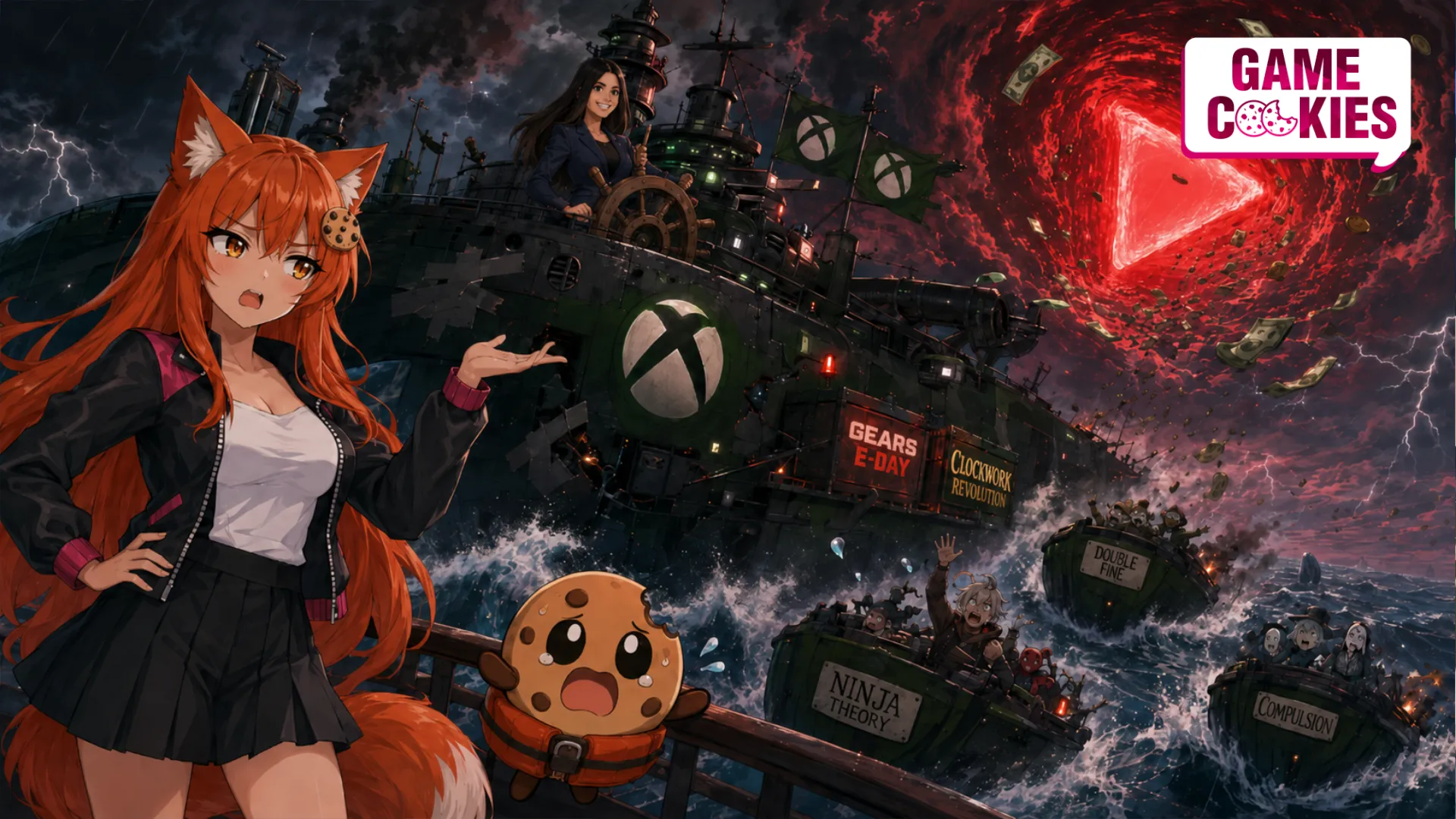
Reports now say Ninja Theory, Double Fine Productions, and Compulsion Games may be exploring spin-offs from Xbox while facing possible closure. That does not mean all three are officially dead. It means the situation is reportedly unstable, negotiations are happening, and “independence” might be the nicer word for “please let us survive outside the Microsoft machine.”
That is already a brutal headline by itself, but the timing makes it uglier. Microsoft is also talking about how Xbox games generate more monetization on YouTube than inside Microsoft, while Xbox is trying to reassure fans that Gears of War: E-Day and Clockwork Revolution are still exclusive.
So, in the same news cycle, Xbox is basically saying: our games create value, we need exclusives, we need attention, our studio system is too expensive, and some of the studios that gave Game Pass personality may need to get out before finance finds them.
That is not a reset. That is a brand having a public argument with its own business model.
The spin-off reports are not random Xbox doomposting
The reported spin-off talks matter because of the studios involved. Ninja Theory, Double Fine, and Compulsion were not supposed to be Call of Duty factories. That was never the point. Hellblade gave Xbox prestige. Psychonauts 2 gave it weirdness and personality. South of Midnight gave it a new IP with an actual visual identity, which Xbox badly needs because you cannot build a platform forever on Halo nostalgia and another “please clap” Gears trailer.
This is the part that annoys me with Xbox. They buy studios that are clearly not designed to be annual blockbuster machines, then later the business starts acting shocked that they are not annual blockbuster machines. Bro, what did you think Double Fine was? A secret military contractor for Game Pass retention? They make strange, authored games. That is why people like them.
Game Pass needed studios like these because the entire pitch was variety. You subscribe because the library has big games, small games, weird games, prestige games, comfort games, and stuff you would never buy at $70 but might try because it is there. If Microsoft now decides that every part of that library needs to justify itself like a giant franchise pillar, then the original Game Pass promise was built on math nobody wanted to say out loud.
🦊 Kiki: I mean, yeah, what did people think was going to happen?
You have Xbox doing the whole “hard truths” speech, and then suddenly studios are reportedly trying to spin off before the axe lands. Come on. That is not a mystery. That is everyone in the room hearing the fire alarm and pretending it is part of the soundtrack.
And this is the part that annoys me. They bought studios like Double Fine and Compulsion because they wanted personality in the catalog. Then the second the business gets tight, personality becomes a cost problem. Bro, you bought Double Fine. What did you expect? Ten million copies of Military Man Shoots Door 7?
If you wanted only giant franchise machines, buy only giant franchise machines. Don’t buy weird studios and then act shocked when they make weird games.
🍪 Chip tries to spin off from Game Cookies, realizes he has no CFO, and slowly rolls back into the article.
Nadella’s YouTube comment explains the pressure
Satya Nadella saying there is more monetization of Xbox games happening on YouTube than at Microsoft is one of those quotes that sounds smart until you think about what it means for players.
He is basically saying Xbox creates entertainment that other people monetize better than Xbox does. Streamers make videos. YouTubers make reactions. Lore channels make essays. Guide channels make tutorials. Drama channels make a month of content every time Xbox says something confusing. Microsoft sees all that attention and, naturally, wants to capture more of the money around it.
From a business perspective, I understand why that bothers them. If Xbox spends billions making games and the biggest cultural energy turns into ad revenue for YouTube creators, Microsoft will look at that and ask why the value is escaping. That is not crazy. Any company would ask that.
The problem is what Xbox decides to do with that observation. If the answer is “we need better games that people care about so much they build communities around them,” fine. Great. Do that. If the answer is “we need more ways to squeeze money out of attention,” then players are right to be nervous, because the modern industry already has enough monetization experiments walking around wearing fake community language.
🦊 Kiki: The Nadella YouTube thing is funny because he is not wrong, but also… okay, and?
Yes, people monetize Xbox games on YouTube. That happens because people care about games. That is the good part. That is culture. That is how games become bigger than a storefront.
But Microsoft hears that and goes, “Wait, why aren’t we getting more of that money?” And that is where my soul leaves my body.
Because you know what the normal-player answer is? Make better games. Make games people need to play. Make games people buy the box for. But the tech-executive answer is always some bullshit like “capture the attention layer” or “expand monetization surfaces.” No. Stop. Shut the meeting down.
Nobody skipped Xbox because the monetization funnel wasn’t beautiful enough. They skipped Xbox because the console stopped feeling necessary.
🍪 Chip opens YouTube, sees eight “Xbox is cooked” thumbnails, and briefly considers becoming a drama channel.
Xbox suddenly remembers exclusives matter
The exclusivity reassurance around Gears of War: E-Day and Clockwork Revolution is important because it shows Xbox knows the console still needs reasons to exist. That should not be controversial. Sony keeps exclusives because exclusives sell hardware and identity. Nintendo built an empire on games you cannot get anywhere else. Xbox spent years acting like the console was optional, and now it has to convince people the platform still has a point.
That does not mean every Xbox game must stay exclusive forever. The multiplatform strategy can make business sense, especially when development costs are high and Microsoft wants revenue from everywhere. But Xbox cannot have it both ways forever. If every major Xbox game eventually goes somewhere else, then the Xbox console becomes a convenience device, not a must-have platform.
That is why the Gears and Clockwork reassurance matters. Xbox is trying to tell fans, “Relax, we still have exclusives.” The problem is that the audience has been trained not to trust the permanence of that sentence. Every Xbox statement now feels like it comes with a hidden timer.
🦊 Kiki: And now Xbox is reassuring people that Gears and Clockwork Revolution are exclusive. Good. They should be.
I know people hate exclusives when it is inconvenient for them, but let’s be honest: exclusives sell consoles. That is the whole point. Nintendo understands this. Sony understands this. Xbox used to understand this when Halo was not being passed around like a cursed family heirloom.
If every Xbox game eventually goes everywhere, then what is the Xbox for? Seriously. What is it for? Game Pass? Okay, fine, but Game Pass got more expensive. Cloud? Fine, but not everyone wants their hobby turned into Netflix with input lag. PC? Great, then I will just use my PC.
This is not complicated. If the box has no must-play games, the box is optional. And if the box is optional, stop acting surprised when people do not treat it like the center of the brand.
🍪 Chip writes “exclusive” on a whiteboard, then nervously adds “for now?”
The player reaction is crude, but it is not stupid
The streamer-brain version of this whole story is simple: stop explaining the reset and make the games. That sounds crude, but it gets close to the truth. Players do not care if Xbox has a 3% margin or a 30% margin when they are deciding whether the platform is worth their time. They care if the games are good, if the service feels worth the money, and if the brand has anything they cannot get somewhere else.
That does not mean the business side is fake. Xbox’s economics can be bad at the same time that players are tired of hearing about them. Microsoft can be right that the model needs work, and players can still be right that the solution cannot just be more cuts, more monetization, and more memos.
The bigger issue is that Xbox keeps turning management failure into studio consequences. Redfall did not happen because players were mean. Halo’s messy years did not happen because Game Pass users lacked gratitude. Xbox’s hardware confusion did not happen because Double Fine made Psychonauts. At some point, when the same platform keeps producing the same confusion, leadership has to own more of it.
🦊 Kiki: The annoying thing is that Microsoft has real problems here. I’m not going to do the baby gamer thing where we pretend money is fake and studios can just burn cash forever.
Three percent margin is bad. That is terrible. I get it. If you are Microsoft and you look at Xbox next to cloud, AI, enterprise software, all that stuff, of course someone is going to ask why this giant gaming division is not pulling more weight.
But I also do not care as a player. I just don’t. That is not my job.
My job is to look at the platform and ask: are the games good, is the service worth it, and do I need this thing? Xbox keeps answering with strategy documents. Nobody wants to play a strategy document.
Make the game. Make the box matter. Make Game Pass feel like a deal again. Do that first, then talk to me about margins.
🍪 Chip tries to install “Microsoft Accountability Margin Simulator” and immediately requests a refund.
The ugly conclusion
The reported spin-off talks may end in different ways. Maybe some studios survive independently. Maybe some stay inside Xbox. Maybe some are reduced, merged, sold, or closed. The important part is that Xbox has reached a point where creative teams associated with its Game Pass identity may be safer outside the company than inside it.
That is the story.
Not because Microsoft is evil for caring about money. Of course it cares about money. The story is that Xbox spent years selling the idea of a broad creative ecosystem, then ran into the reality that Microsoft wants a business with stronger returns, clearer value capture, and less expensive uncertainty.
Those goals are understandable. They may even be necessary. But if the solution is to cut away the studios that made Xbox feel more human, the final product may be cleaner on paper and weaker as a gaming brand.
If you liked this breakdown, give the article a like and tell us in the comments: would Ninja Theory, Double Fine, and Compulsion be better off leaving Xbox, or is independence just a nicer-looking word for the same mess?
Stay skeptical of “reset” language.
Keep watching which studios actually survive the negotiations.
And remember: if Xbox wants attention, maybe stop making the people who create attention look for the exit.
🦊 Kiki · 🍪 Chip · ⭐ Byte · 🦁 Leo
Tips, leaks, and suspicious corporate accounting: contact us here!