🍪 Localization isn’t just translation anymore. It’s narrative, audio, and trust under pressure.

Hello there, global developers, localization managers, narrative leads, audio producers, and publishers shipping games that must land emotionally in more than one language.
For a long time, localization was treated as a finishing step. Text went out, translations came back, the build shipped.
That mental model is outdated.
Modern games are live, narrative-heavy, voice-driven, and updated constantly. Localization now sits at the intersection of writing, production, audio, and community expectations. When it works, players never notice. When it breaks, everything feels off at once.
Most studios don’t struggle with localization because of language quality. They struggle because their tools don’t agree on what the game is trying to say.
Localization today is a workflow problem, not a language problem
In a typical production, localization touches:
Writers working in narrative tools
Designers editing strings in engine
Localization managers coordinating vendors
Translators working in TMS platforms
Audio teams recording VO weeks or months later
Each step might be handled well in isolation. The failure happens in between.
Context gets stripped. Strings get duplicated. “Final” lines change after recording. Someone notices late, and suddenly the conversation becomes about tone, quality, or blame.
🦊 Kiki: I’ve watched teams argue for days about a “bad translation” when the translator never saw the character, the scene, or the emotional intent. Once pressure hits, nobody blames the pipeline. They blame the last human in the chain. That’s how trust erodes quietly.
🍪 Chip flips through three identical lines labeled FINAL.
Content and localization management: the backbone most teams underestimate
At the center of a modern localization pipeline should be a system that treats content as structured, living data, not just text files.
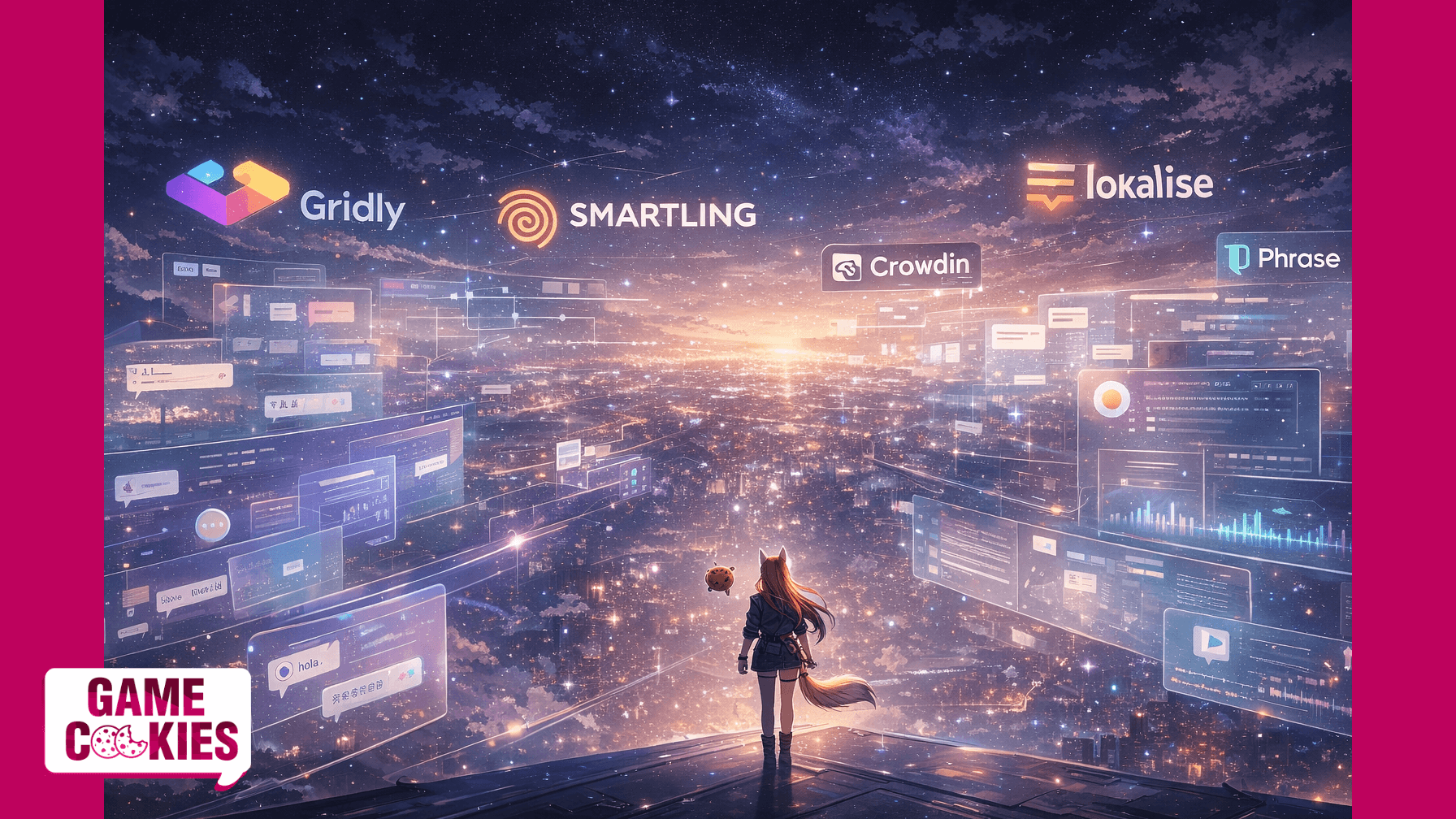
This is where Gridly fits particularly well. It combines CMS-style structure, TMS-style workflow automation, and CAT-style translation and QA features into a single source of truth.
Writers, developers, translators, and producers all work against the same dataset. Context travels with the string. Updates propagate instead of fragmenting. That alignment matters more than any single feature.
Other platforms serve important roles in different environments:
Smartling is strong in enterprise-scale translation workflows.
Lokalise is popular with UI-heavy products and agile teams.
Crowdin integrates deeply with development and CI pipelines.
The real question isn’t which tool is “best.” It’s whether everyone is working from the same reality.
🦊 Kiki: Good localization tools feel boring. Everyone sees the same line, the same context, the same status. If your tool feels exciting but nobody trusts it, you’re already in trouble.
🍪 Chip hugs a spreadsheet defensively.
Specialized TMS tools still matter, especially at scale
Many professional localization teams rely on dedicated TMS platforms for linguistic control and vendor collaboration.
Two names come up constantly:
memoQ A staple for agencies and in-house language teams. Strong terminology control, translation memory management, and offline workflows make it reliable for large multilingual operations.
Phrase Favored by tech-driven teams that want automation, APIs, and continuous localization tied closely to development cycles.
These tools excel at managing translation at scale. Where teams struggle is context continuity, especially when narrative and audio live elsewhere.
That’s why many studios run hybrid pipelines: memoQ or Phrase for linguistic depth, paired with platforms like Gridly for content structure, narrative context, and cross-team alignment.
🦊 Kiki: I’ve never seen one tool solve everything. I have seen teams fail by asking a TMS to be a narrative brain, or by letting writers work in a vacuum. Tools aren’t the problem. Misusing them is.
🍪 Chip juggles three dashboards and drops one.
Narrative tools define intent, and intent must survive localization
Narrative design tools are where meaning is born. Localization pipelines are where that meaning is tested.
Common tools include:
Articy Draft, widely used for branching dialogue and complex story logic.
Twine, often used for prototyping and early narrative exploration.
These tools are excellent at defining what the story is doing. Localization ensures that intent survives translation, cultural adaptation, and production pressure.
When these worlds don’t connect, translators are forced to guess. When they guess wrong, players don’t say “the pipeline failed.” They say “this character feels wrong.”
🦊 Kiki: Tone problems are usually intent problems in disguise. If translators don’t know who’s speaking or why, they’re gambling. And eventually, the house loses.
🍪 Chip points at a speech bubble with no speaker.
AI-assisted voice tools are still part of localization, but the layer is volatile
AI voice tools are increasingly used earlier in localization pipelines for prototyping, pacing validation, and internal builds. They reduce iteration waste when scripts are still moving.
One notable example, Replica Studios, was widely adopted for placeholder VO and early narrative validation. Its recent shutdown is a reminder that this layer is still volatile and should not be treated as foundational infrastructure.
Other tools now filling similar roles include:
ElevenLabs, commonly used for internal builds, timing checks, and early VO validation
In-house TTS systems built on open models, especially at larger studios
The lesson isn’t “don’t use AI voice.” The lesson is don’t anchor production-critical workflows to experimental vendors.
🦊 Kiki: Replica didn’t fail because the idea was bad. It failed because this layer is still experimental. AI voice is great for reducing uncertainty early, but the second you rely on it as infrastructure, you’re betting your pipeline on someone else’s runway.
🍪 Chip gently puts a “prototype only” label on the tool.
What a healthy modern localization workflow looks like
A practical setup often follows this flow:
Narrative intent defined in tools like Articy Draft or Twine
Content structured and versioned in a shared platform like Gridly
Translation handled via memoQ, Phrase, or similar TMS tools
Placeholder VO used to validate pacing and emotional intent
Final VO recorded once narrative and localization are aligned
The tools matter. The alignment matters more.
Why this matters to developers and publishers
Localization failures affect more than text quality. They hit:
IP consistency
Character credibility
Regional player trust
Production budgets
Live-service velocity
When localization pipelines break, teams argue about tone instead of fixing systems. Publishers feel it in brand perception. Developers feel it in rework. Players feel it immediately.
🦊 Kiki: Every localization horror story I’ve seen started with good intentions and bad alignment. The tools didn’t fail individually. They failed together.
🍪 Chip tapes two incompatible tools together and hopes for the best.
Stay aligned — like teams sharing one source of truth.
Keep context — like narratives that survive translation.
And remember — localization doesn’t fail loudly. It fails quietly, until players notice.
Using other tools in your localization, narrative, or VO workflow? memoQ setups, Phrase pipelines, custom systems, or something we didn’t mention? Let us know. We want to hear what’s actually working in real production.
🦊 Kiki · 🍪 Chip · ⭐ Byte · 🦁 Leo